Distillation

“Moondust,” Episode 3 Season 3 in Netflix’s television series The Crown, portrays a slice of Queen Elizabeth II’s husband’s life. In it Prince Philip is suffering from middle-aged malaise, complicated by the extreme restraints placed on him as a royal. In another life he would have gone further in his military career, perhaps becoming an astronaut.

We see him living up to his duties by giving enumerable speeches and presentations at various businesses and civic organizations. Outwardly he is a gracious representative of the British monarchy, the epitome of spit and polish. Inwardly he is lost in a near Walter Mitty fantasy stimulated by his very close attention to U.S. astronauts walking on the moon. He longs to be in a role that allows him to test his limits and to be an individual.

At his insistence he is given a private audience with the three astronauts who completed the moon walk achieving “one small step for man and a one giant step for mankind.” He prepares by spreading many newspaper articles across his desk and by reviewing television reports.

He uses his fountain pen to carefully compose salient points and derive questions for the space explorers. He works the way a Supreme Court Judge does to see into what to ask that is most important. He distills the wild fluid that has been boiling through his mind in recent months.

Ushered into the presence of Prince Philip at Windsor Castle, the astronauts sit quietly waiting to answer his questions. They are deep, philosophical questions that have been boiled out of all that he has read, all that he has thought about in regard to to the giant step for mankind.

The moon visitors’ answers are short, unsatisfactory and not at all what he expected until the astronauts begin talking at once finishing each other’s sentences about what they really did: pay attention to their checklists. They had no time to think in the moment. They carried out their tasks in a diligent way not unlike what Prince Philip does as a representative of the British Crown. The wonder and excitement was mostly for the earthbound.

The space explorers became even more animated when they were granted questions of their own for the would-be King of England. They gushed about the number of rooms and the immensity of the palace. A schoolboy buzz of excitement rose as they questioned the questioner about his fantastical existence.

Just before they started their royal gushing, Prince Philip’s face showed what he as a thoughtful middle-aged man understood that they did not: his age and thoughtfulness had allowed him to distill the essence of their out-of-this world tour that their younger selves had not come to realize.

His maturity allowed him wisdom that their younger years were a decade or more away from. He had an epiphany based on the old saw “youth is wasted on the young.” Wasted is not quite right; unobserved in the moment is better.

As portrayed in the program, from that time on Prince Philip was more at ease with himself. He was old enough to understand something that gives him contentment: action is just that and largely separate from examination and understanding in the moment.

What I like about his seeing into wonder of space exploration is key to my own contentment with who and where I am in my life. Out of the tumult of the action of my younger more active life, I am old enough to observe myself in time. I know myself.

I, too, still crave action but I know that understanding comes later through the work of active reflection.
The Octopus and the Tent

The earliest carnival ride known as the Octopus was built by Lee Eyerly of Eyerly Aircraft Company in Salem, Oregon. It had eight arms with one car per arm that rose up and down, rotated, and spun. It spread across America in the 1930s (Wikipedia).

Esther Takei Nishio used to help her dad with his carnival games. Mr. Takei was a Japanese immigrant who had started with little and built a suite of businesses that included fishing boats, rental property, and a farm. He began with round rings and a few bottles in Venice, California, hosting games of chance and showing off his near perfect English.

He loved Venice and walked around proudly in a dark blue double-breasted suit. His daughter Esther was a successful high school student in 1942 when a notice came that her dad was to be taken away for interrogation and she and her mother were to be sent the Granda War Relocation Camp in Eastern Colorado. They left Venice with the suitcases they could tote.

Long story short Esther died recently and the story of her father and her time in Venice was little known even among the members of her own Presbyterian church.

She became one of the first imprisoned Japanese-American citizens to be released in a test case that paralleled what happened to Rosa Parks. Her experiences from the camp and the period of re-integration were her own private story that Joe Mozingo of The Los Angeles Times uncovered.

I keep circling back to the Octopus and her father. When he was allowed to go home at the end of WWII, all of his equipment and businesses were gone. He had to start over as a gardener. His Octopus had been stolen along with his boats, tractors, and fishing nets.

(data from Column One: She was a test case for resettling detainees of Japanese descent from The Los Angeles Times November 30, 2019, by Joe Mozingo)

Bertha Mae Bevers is 90 and still alive. As a child she immigrated to California’s Central Valley in the Dust Bowl era to work on truck farms. She and her fellow African-Americans lived in Teriston on the edge of the desert in tents. She remembers two houses but a tent was her house. Teriston’s water was irregular and often fowl in the all-black colony .

She looks back on childhood in a town that was beyond where the Okies lived and not as nice. The place was logically uninhabitable.

(data from How Racism Ripples through Rural California Pipes by Jose A. Del Real from The New York Times, November 30, 2019)

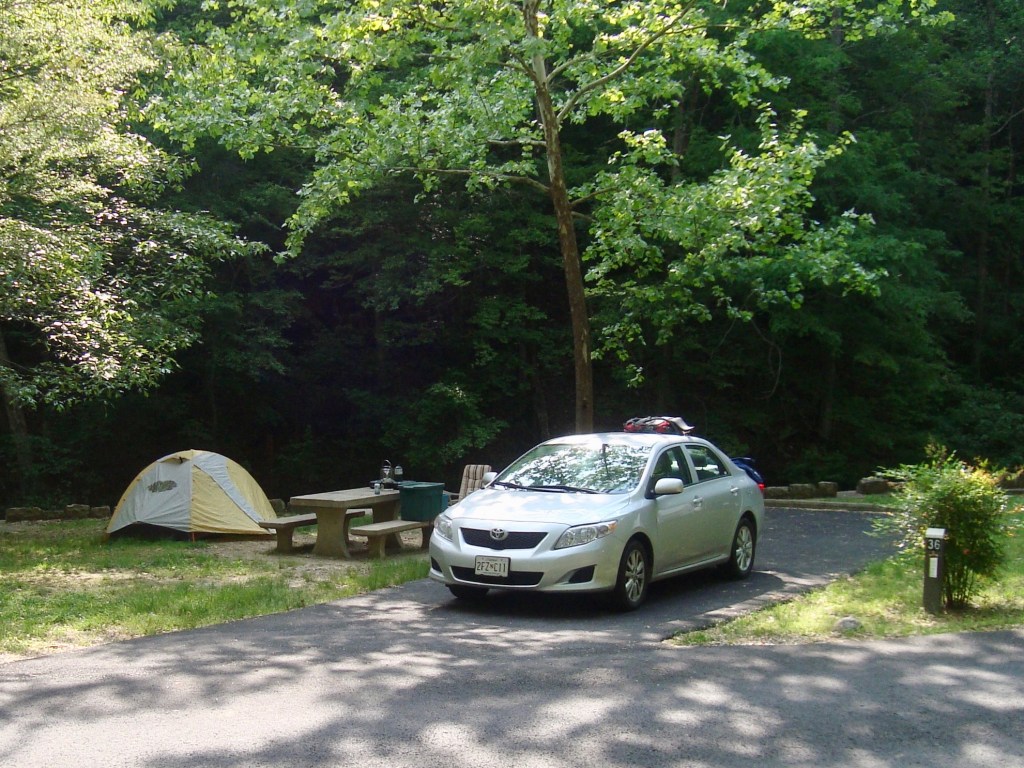
The tent part, like the Octopus ride, sticks with me because it has been my luck to be able drive around America tent camping in 47 states including multiple stops in California.

My REI tent on the ground within walking distance of Little Rock, Arkansas in 2012

As a child I thought myself brave for riding the Octopus at the state fair. Back from my trip to in the sky, I had something to brag about to my friends and think about for weeks.

Esther and Bertha Mae’s stories are from two of the articles I read in newspapers on Saturday, November 30. Each day I read The Herald (Rock Hill), The Charlotte Observer, The Los Angeles Times, The New York Times and The Washington Post.

I like merging my mind with what is happening in the world as a whole. I like understanding what is known about events objectively and finding stories about people I have never heard of. I feel elevated a bit and bigger after reading.

Most people around me think I am odd. They seem to be happy with news feeds via Facebook or Twitter or what spinners posing as journalists say on Fox News. Many think the news is something to be avoided.

Maybe it’s my love of writing that compels me to read what journalists find out about us. Everyone has a story and somehow their stories become part of my story through my daily newspaper reading. My mind often leaps to something I know personally and connects as in the tent and the Octopus.

I like to think I am a better human being for my reading and I seek the grace to endure what life brings in the way Esther did and Bertha Mae continues to do. Our interior stories are mostly silent and unknown. Jose A. Del Real and Joe Mozingo do us a service of incalculable importance in bringing them to our attention.