Rainy, cold, gray. I am back at my blog of sorts, a document I keep as explained in “What I Plan to Do with danielforrest.org” at the top of my homepage.
I add to my primary reason about wanting to provide access to who I was after I am dead another reason: I want to remember myself and I feel that self fading with age. I lose grasp of who I was and what I did.
A Cold Day in the Pole Orchard
In the winter of 1972 I had moved from Fort Jackson to Fort Gordon for my advanced individual training (AIT): pole line construction. AIT was like returning to USC in a way: class after class in a big building. The culmination of learning how to climb a telephone pole was hands on in the pole orchard.
My guess is that it was about five poles by five poles wide each standing about ten feet apart. Being Fort Gordon it was sandy and there might have been some wood chips on the ground that was not soft.
Its firmness was in my mind as my final climb came. I had done my progressive short climbs partway up and had various instructions shouted at me. Rule one is to watch the angle of your body relative to the pole. The climber should always lean out and never allow his body to form a parallel with the telephone pole.
That knowledge works against the immediate tendency to go up straight or lean in as the gaffs attached to inside of your combat boots bite wood. The belt helps. It is slid up after each two steps but to slide it up requires a quick release of the tension formed by leaning out.
My pole was a mess. It looked like a small child had attempted to hatchet it down top to bottom. Splinters bloomed everywhere. My instructor warned me to be careful and the prior training photos of badly scarred arms from a burnout were fresh in my mind.
Half of us were finished and I was at my last step and among the last to prove out. All I had left to do was to go all the way up to the top, get comfortable, lean out, remove my service cap, and set it on the top of the pole.
Once it was atop the telephone pole, I was to await an all clear to retrieve it and work my way back down.
I do remember it being on the top of the pole. Vaguely I remember the quiver present in my tired arms and legs. (Climbing a pole using gaffs is very hard work.)
I do not remember my slide down. My fatigue jacket was torn and my arms were burned and bloody. I must have remembered to work back against my belt some as I slide because I was able to stand at the bottom still hitched to the post.
I do know I was shaken and tired but no matter. A quick review of my situation by the training officer led to the following indirect order, “What are you waiting on Forrest? Go get it.”
I went back up successfully as tired as I was and donned my cap and climbed back down without gaffing out. For over 48 years that memory has hung on the edge of my memory. I wish I could recall more about what went on in the manner of video recording so that I could elaborate but most details are faded from memory.
Marsha Cockrell’s Blue Bike and the Old Elementary School
I lived mainly at 513 West Church Street, Saluda, SC for my first 18 years. I remember the path behind my house near Preacher Padgett’s hunting dog pen along the side of our garden. That is where I cut through to the Cockrell’s yard on the block behind my house. Once on W. Eutaw Street I walked east on my way to my first grade schoolroom.
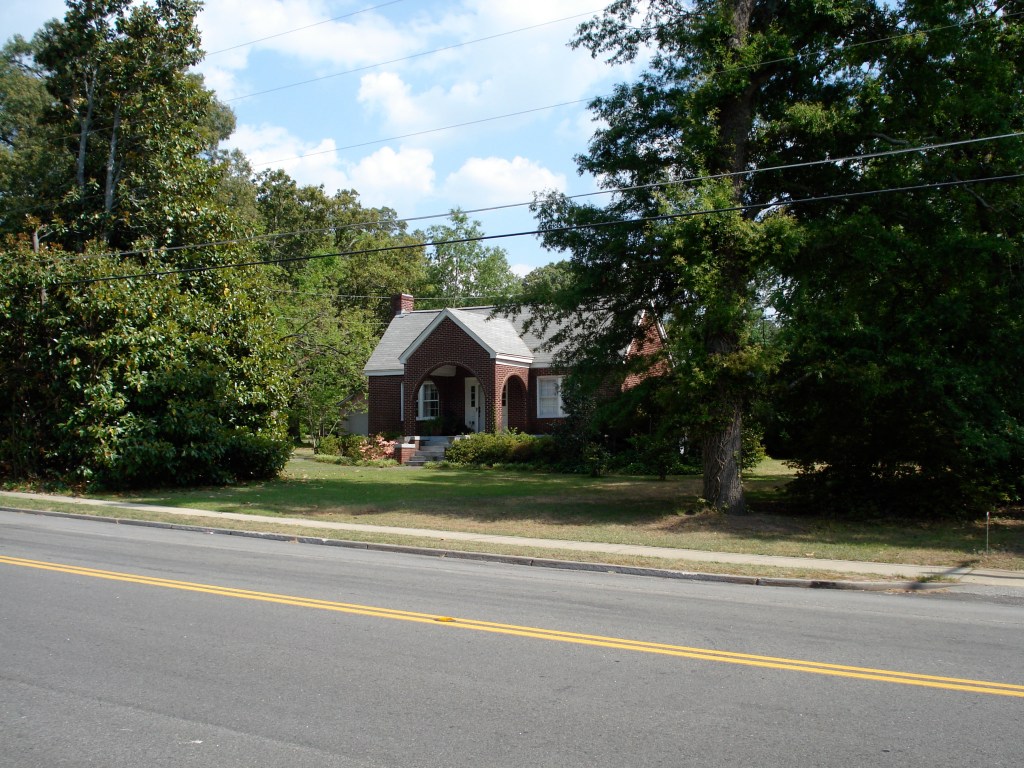
I looked forward to the rough macadam road giving way to wider, smooth asphalt just at Bonnie Boland’s house. From there I would sometimes be joined by other walkers. Walking to school was a cool big deal to me in 1956.
Saluda Elementary School was a three-story brick building facing South Jefferson Street and on it last days. During that same year we would be moved to a new low slung modern building adjacent to Saluda High School.
My walk led me to the school beside the unattached cafeteria building behind the school at the intersection of Eutaw and North Calhoun. I liked that spot because it dipped deep on North Calhoun leading up to W. Church where Ben Hazel’s boarding house stood. Sometime I would walk back that way.
Where the bicycle was parked escapes me as does who I was with that day after school. We got out early and for some reason I took the blue bicycle. Who was with me? I have lost names but I think there were three of us involved. We likely just walked by the parked bike and took a notion as we headed home.
I think I was dared to hide Marsha’s bike. I remember walking it, not riding it. It may have been too big for me.
I took the cut toward Ben Hazel’s and scooted off the road to the right. Who helped me? Not sure but I put the Western Flyer in the big culvert that ran under the road and pushed it partway under.
I had been in the culvert before and even walked all the way across under North Calhoun on a dare. Was it a dare that prompted me to stash the bicycle?
Were I old enough for crushes, I would have one on Marsha, who was years older, a tall black-haired pretty girl. My belief is that I did what I did per someone’s dare, certainly not out of animus for Marsha.
When I got home, I did what I always did: put whatever tablet and pencils I had down and went out to play. The days were long enough that I did not get questioned in regard to my crime until close to sundown. Witnesses, phone calls, inquiries? No doubt a criminal investigation ensued while I went on with my after school play.
At about the time I should be squared away from supper and headed toward shared bath water with my brothers, I was on the ropes. My parents needed to talk to me. Asked, I broke immediately under the questioning.
A spanking would have been a given but I lose my memory beyond confession. I think the event comes to my old man’s head because I felt so bad about what I did. To this day I have a propensity for guilt–even about minor events in the last century.
Bloody Sunday February 25, 1968
Nita says we ate with my mother and younger brother in Saluda on that Sunday. She remembers her stomach hurting but put her pain off to eating something. She said she remembered Cally acting odd. Apparently we headed back toward our Newberry home after stopping by her parents’ house.
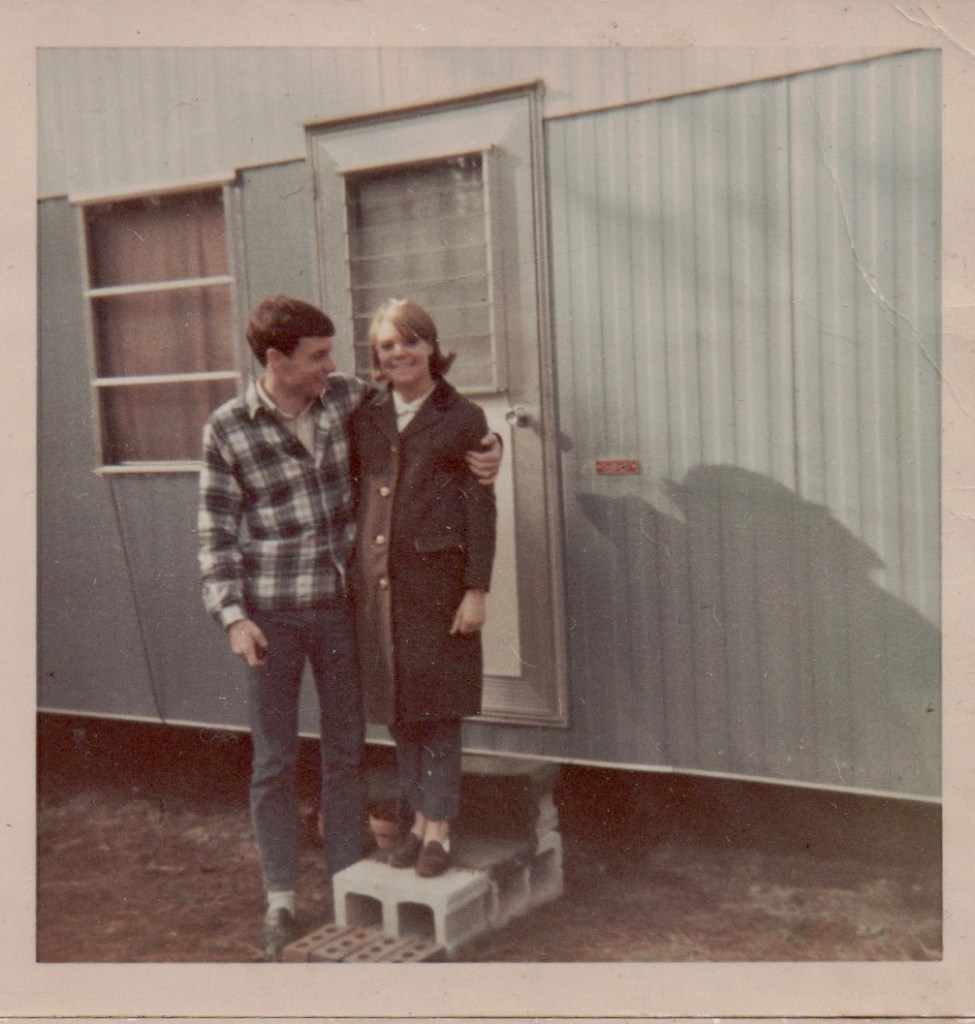
She says that on the way back to Newberry Bobby Shook drove up behind us, flashing his car lights. We pulled over and I got out to talk along side the highway. No memory–edge or elsewhere. She says he followed us back to Buddy Neal’s Mobile Home Park beside the Newberry airport where we lived.
Her memory is going back to the bedroom to lie down while Bobby, a friend from earlier days, and I caught up. “I was back on the bed suffering and you and Bobby were laughing and talking the evening away,” she told me recently. I worry about my mind because none of that comes back.
What does come back is pulling up in front of Dr. Sawyer’s office across from the agricultural classroom building next to Mathews Field. According to Nita we called and he agreed to meet us at his office. Her stomach pain had blossomed into “I think the baby is coming.”
I saw four or five cars there with people standing around. I left Nita temporarily to go inside and that’s where I came upon blood on the floor, the door and all over people’s clothes.
My pregnant wife was not Dr. Sawyer’s only patient. Knives or razors? I was thinking razors. So many bodies and so much blood. Cars parked haphazardly; people whispering. Dr. Sawyer must have already stitched up several bleeding victims. He emerged from a backroom and told me to bring Nita in.
I think that visit must have lasted less than five minutes altogether. What I clearly heard, what I clearly remember was a sentence something like this from the unflappable, laconic, short Dr. Sawyer, “Get to Self Memorial fast.”
I had just driven 25 miles back to Saluda and faced a 30-mile drive to Greenwood. Nita was going to give birth to my son Chris. We may or may not have dropped by her parents again before heading out of Saluda fast on Highway 378.
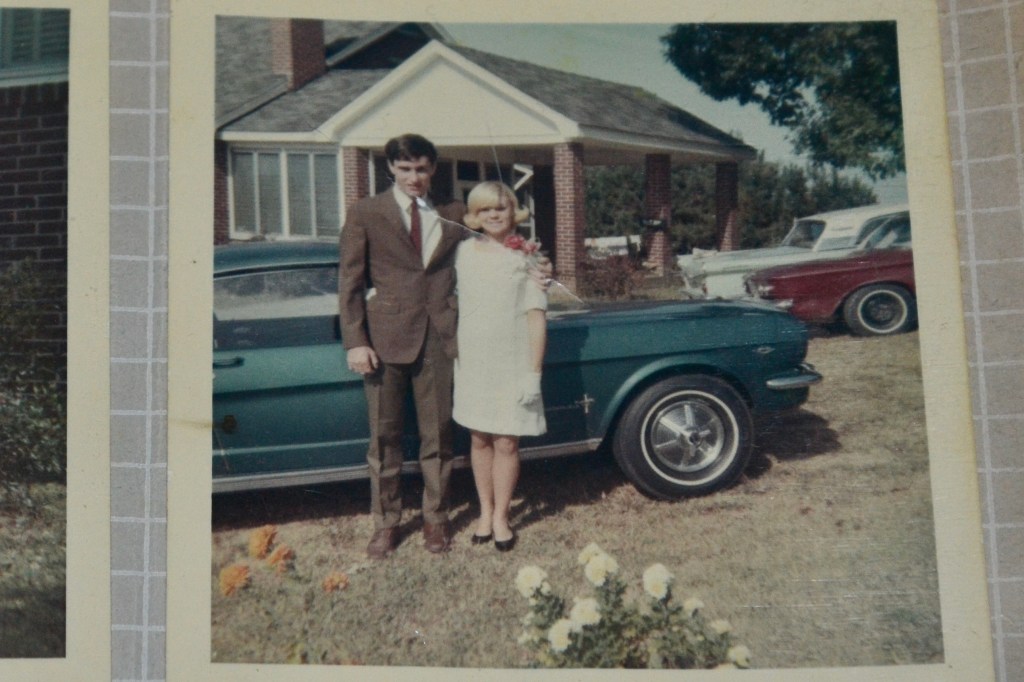
The Mustang we drove is just behind us in our one and only wedding photo. It looked like a good car to drive fast but underneath it was just a Ford Falcon, a big economy car, and I never liked going fast. With Nita’s condition in mind as well as Dr. Sawyer’s command, I drove close to 75 for most of the trip. Highway 378 is from Saluda to Greenwood is curvy. I had in my head one particular curve where my brother Butch had totaled a Ford Galaxy a few years earlier.
I pushed 80 mph on straight stretches but my 1965 Mustang was a former wreck that vibrated at 80 and above. A shaky steering wheel gives a driver pause.
I remembered to go straight and not turning as usual when we got close to Greenwood. My memory of stopping in front of Self Memorial is clear as is the car shutting down as we drifted into the visitor parking lot. Somehow Nita walked along with me and the bag she had packed to the front door to check in.
Chris was born a few hours later in the early morning of February 26, 1968. Nita was fine. I could not have been happier.
 Danny Forrest