At the top of danielforrest.org adjacent to Home, I explain my purpose in creating a written record of some of what I think may be of interest after I am dead and to me in the meantime as my memory fades. I also write because I think I am more myself in written words than in conversation and as I kind of therapy, a way to use my mind. A random survey of people who know me or who have seen me in passing would mention something like “oh, the guy on the bicycle.”
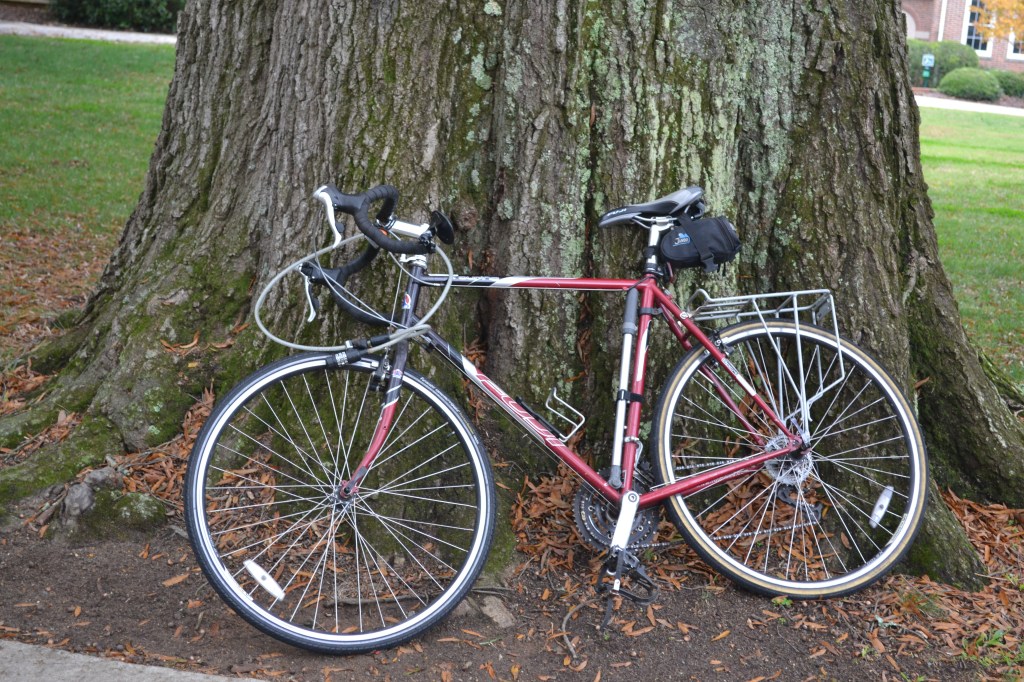
At 75 I still ride a bicycle but not to the top of Mount Mitchell anymore. I hop on my old Fuji road bike to visit grocery stores mainly. During the COVID crisis I toured York County to photograph parks (dmforrest.smugmug.com). Part of me and my personal oddity is linked to bicycles.
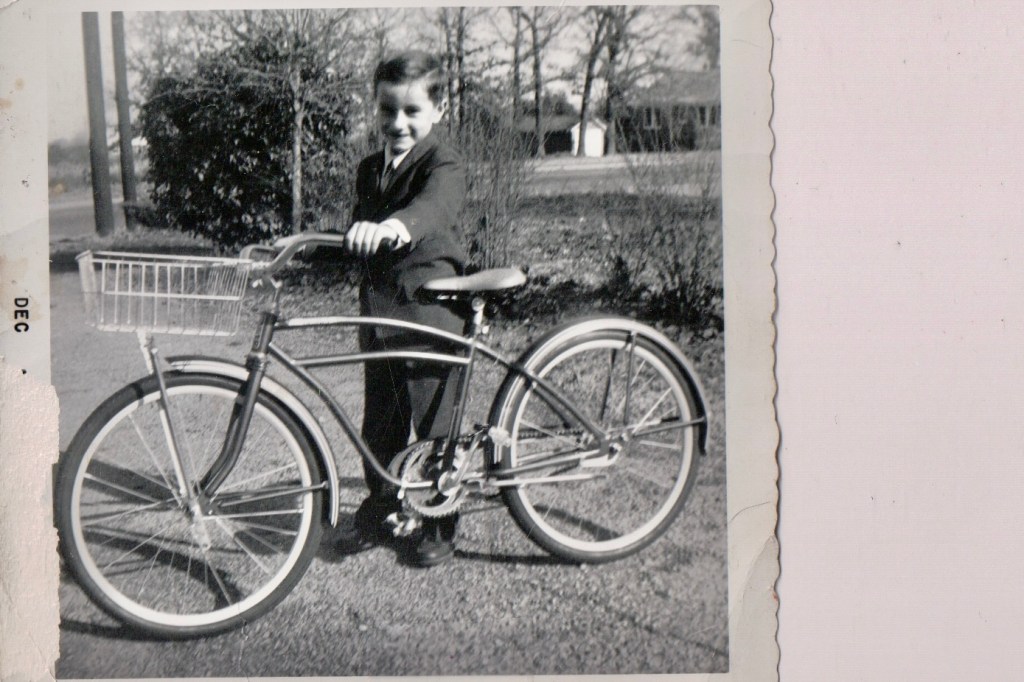
I see December on this old photo which I think indicates that it was my Christmas present in 1955. The bicycle came from Stewarts’ Western Auto store in Saluda about a mile from where I was photographed. It was my first bicycle after the hand-me-down that I learned to ride on. The Western Flyer stood twenty-four inches tall and had twin white pin stripes on the red fenders.
The basket was the most important accessory because it earned me a fortune in soft drink/candy money. Soda pop came in returnable bottles worth three cents. In a hour or two I could find enough bottles to pay for snacks. As a child, I did not realize how patient Preacher Bryant was. He ran the Shell station just up West Church Street and graciously took my returns which I immediately converted into an Upper Ten or a Baby Ruth.
I rode all over town without constraints. Jennings Street was a popular destination. Ricky Yarborough, my best bicycling friend, lived there in his grandmother’s house. Sometimes we would just polish up our machines and admire their beauty, work on model cars, or go to the Western Auto to look at accessories. By that time I had twenty-six inch bike with chrome fenders and a built-in headlight. I had gone from a plain Ford to a Buick.
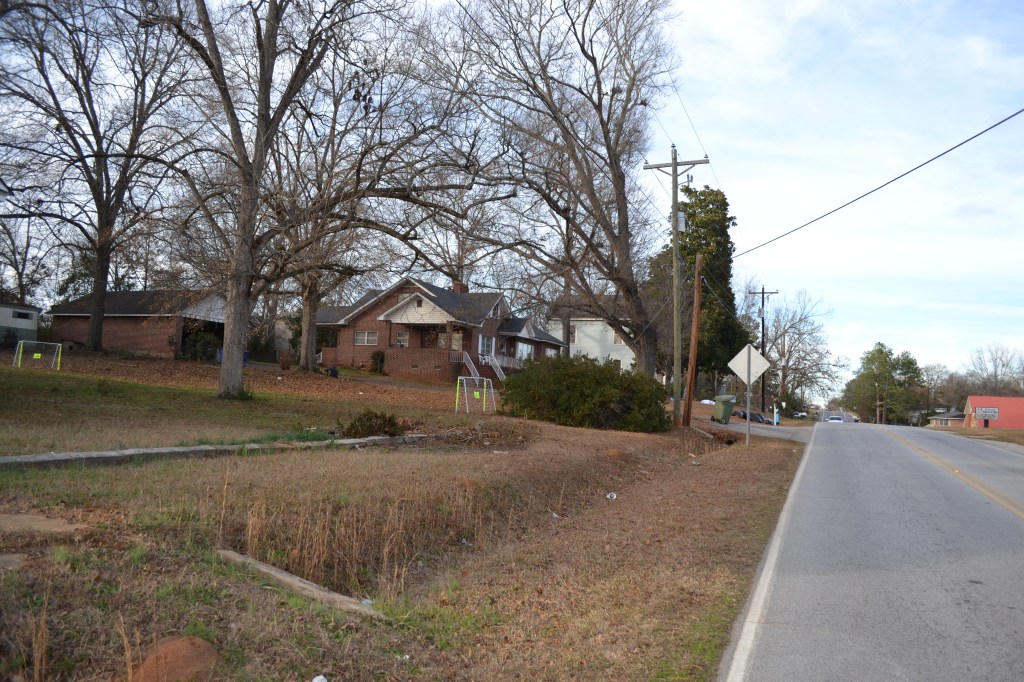
Ricky’s bike was similar to mine but red where mine was black. We staged races starting at the top of the hill where Jennings Street came closest to Red Bank Baptist Church. (The two “giant” hills of Jennings Street are visible in the photo above.) We would race to where Jennings met the Batesburg Highway without breath left to form words. I never won. Do not get me wrong. I was a good rider but Ricky was superb and determined. Ricky moved away and my interest in riding was overtaken by the prospect of driving a car at 14.
After a year at Newberry College, I transferred to USC in Columbia to finish my degree. My son Chris was getting old enough to leave at a Price’s Day Care just around the corner so that my wife Nita could go to work at Southern Bell to help support us.
Getting back and to from USC and J. W. Hendrix mobile home park in West Columbia was easy via SCE&G bus, but getting to work after school at Piggly Wiggly #60 on 378 was a problem because the distance was too far too walk and Nita needed our only car. I bought a three-speed Murray from K-Mart and became a regular bicycle commuter for the first time. Weaving through back roads, I could get to work just about as fast on the bike as I could via car.
After graduation and active duty military service, I started to work at Rawlinson Road Junior High School in Rock Hill. In place of a second car, I bought a Honda 360 motorcycle to commute on.
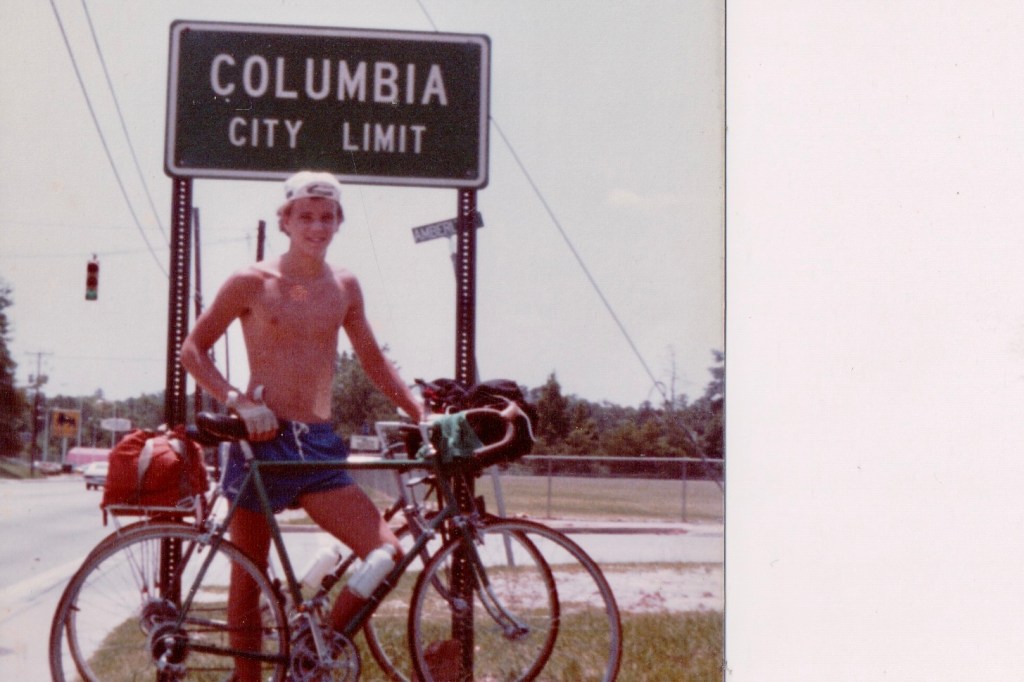
My bicycle days were over until my fifteen-year-old son Chris signed up to bicycle across America with a friend. He and Steve Dietrich rode coast-to-coast from San Diego, California, to Rehoboth Beach, Delaware. His epic ride as a sophomore in high school inspired me to consider bicycling again.
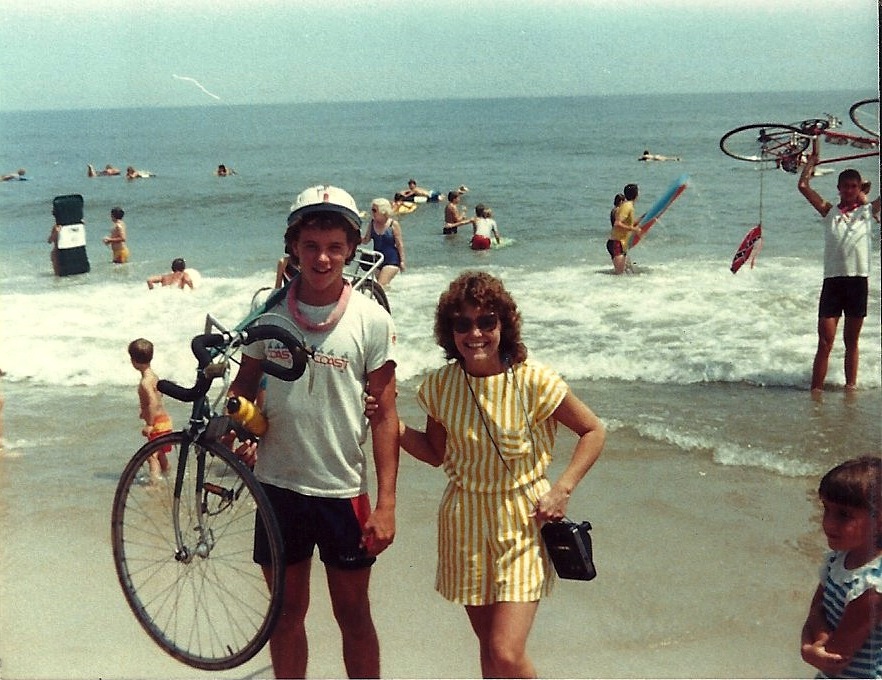
My daughter Danielle and wife Nita are shown standing on the Delaware beach where Chris has dipped his back tire in the Atlantic to finish his transcontinental ride. In recent years I have driven coast to coast several times which renews my awe for what Chris did via bicycle.
We had two cars but Chris seemed to need our second car more than me. At that time a car was to a teen what a phone is now. I recruited Chris and his friend Keith Davis to join me in test riding to Northwestern High School where I now worked one weekend. We made it but Chris laughed at his fellow riders’ slowness.
After a few more weekend practice rides to get in shape, I decided I could handle the commute of about seven miles. My third life as a cyclist was born and continues to this day.
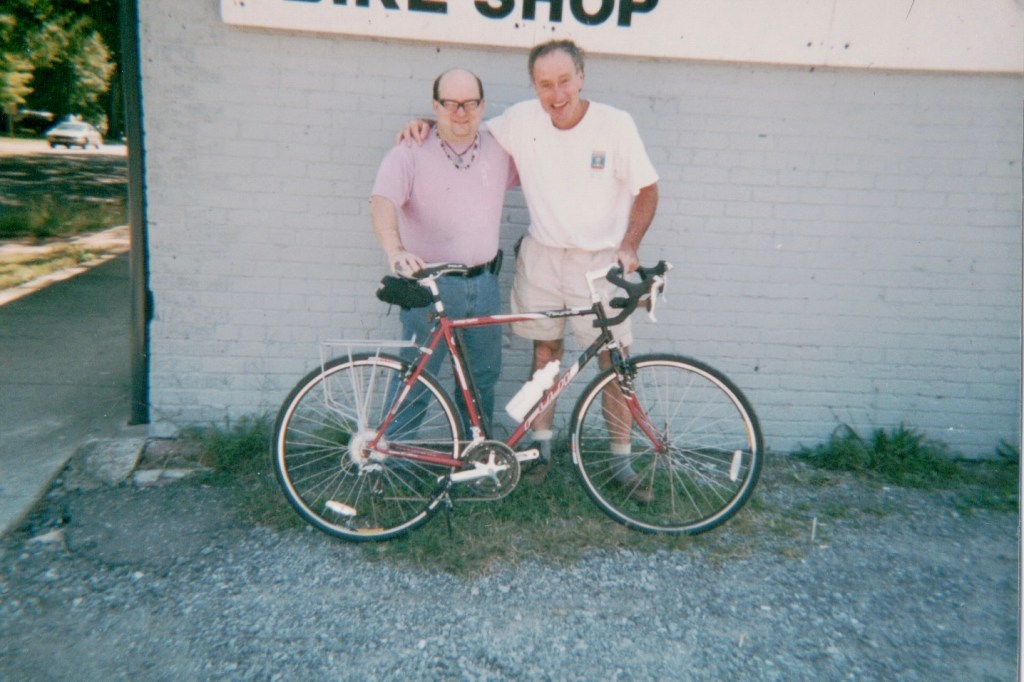
I had four commuters including the turn-of-the-century Fuji road bike pictured above. My former student Robert Baker prepared it for me in his College Cycle Shop on Oakland Avenue near Winthrop University. The Fuji is still in use, though not on a daily basis.
The daily five-mile commute to Northwestern is still etched in my head. So many memories . . . including the day a third-shift nurse somehow did not see me as I pedaled directly in front of the second entrance to Piedmont Hospital on S. Herlong at about 7:30 one morning.
Being hit by a nurse with attendant ambulances a parking lot a way had advantages. I was scooped up and checked out in the emergency room with all the alacrity and care that that is depicted on the best emergency shows on tv. My helmet was cracked and my jacket and shirt torn from my back in the slide that sent me down Herlong after my slipping across the nurse’s hood into her windshield.
I was very sore but all right, though my public crash caused a bit of stir at Northwestern. I was back at work in time to take over my second period. My Navy blue all-aluminum Canondale was twisted like a pretzel giving Robert Baker a chance to sell me yet another bicycle.
Back and to each and every day I went, except on days when rain was already present and heavy. My odd choice for adult transportation had become a habit. In the mornings I liked the direct contact with the outside that my indoor job sealed me from; in the afternoons I needed the exercise as break from the mental rigor of commanding the attention of teenagers thirty at a time. Eschewing the need for pumping gas into a car appealed to my Sierra Club mindset.
How many times did I answer, “Why do you ride a bike?” often followed by “Don’t you have a car?” Adult bike riding in Rock Hill is a lonely endeavor but there are antecedents. During the early twentieth century Rock Hill was an epicenter for the latest craze: bicycle racing. We had two wooden velodromes and the mayor of Rock Hill raced the mayor of Fort Mill before large crowds. (Some of that history is captured in the display adjacent to our current sunken Velodrome in River Walk just off Cherry Road.)
I also knew of the legendary ride of Paul Neal, who was affiliated with the shop where Chris bought his Schwinn Super Le Tour that carried him across America. Paul rode across America as a teenager in a ride that was reported in newspapers, creating an opportunity that saw the mayor of Los Angeles present him a key to the great western city upon his arrival. Paul recreated his famous ride a few years ago in his late 60s.
I had that inspiration in the back of my mind and the newspaper stories about a young biology teacher who rode from his home in York to teach at Fort Mill High School each day. Bill Hilton ended up at Northwestern where I taught. His ride was about triple the length of mine.
Riding connected me to other odd people who formed the Rock Hill Bicycle Club, formed by Dick of Dick’s bicycle shop. We rode criteriums through rural York and Chester Counties; for a time we rode to Myrtle Beach each year. I earned three or four Assault on Mitchell badges for completion of a race that started at Memorial Auditorium in Spartanburg and finished atop Mount Mitchell.
That hundred mile ride caught the interest of riders from across the U.S. and beyond. I remember leaders of the pack whom I glanced at on the starting line finishing and riding back down from the east coast’s highest point whizzing past me so fast that I could not see them beyond a blur through my salt-caked eyes as I struggled with the last twenty miles of the hundred mile event.
Hours later when I made the top, I stashed my bicycle into the luggage hold of a big charted bus and gladly sought the comfort of upholstery, glad to be borne back to Spartanburg in comfort.
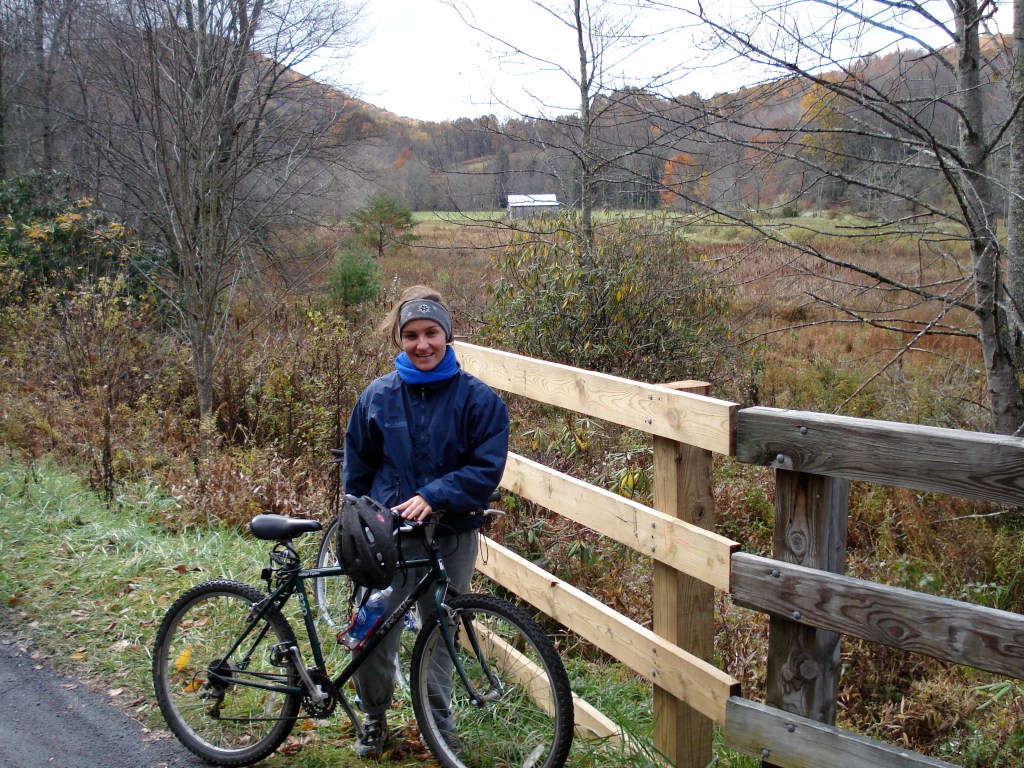
I have been lucky enough to ride with my children, though I am mainly a solo rider. Chris and I rode to Columbia and on to Saluda to see relatives years ago. Elle and I did the Virginia Creeper Trail. Restricted to just bicycles, it puts on display what bicycle transportation could be.
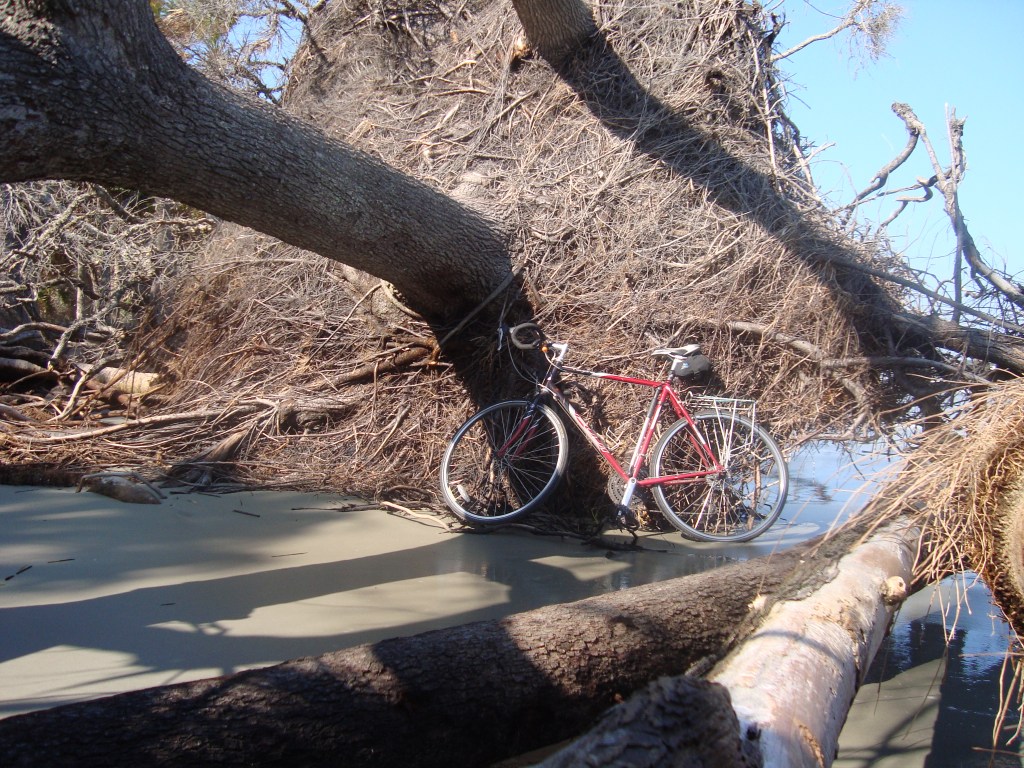
What do the motorists who speed by me think of an old man on a bicycle? I suspect they think that I have lost my license, but I am used to the oddness of being out of a car because I walk places on a daily basis. I still hop on my bicycle on Sunday afternoons when Rock Hill traffic is tamer than normal and spin around just to see some territory and haul it in my pick-up to go camping from time to time.
I am not sure if children ride bicycles much any more. Video may have taken over what this small town boy took for granted: pedaling for pleasure. It is a part of the odd brand, what I am known for.
 Danny Forrest