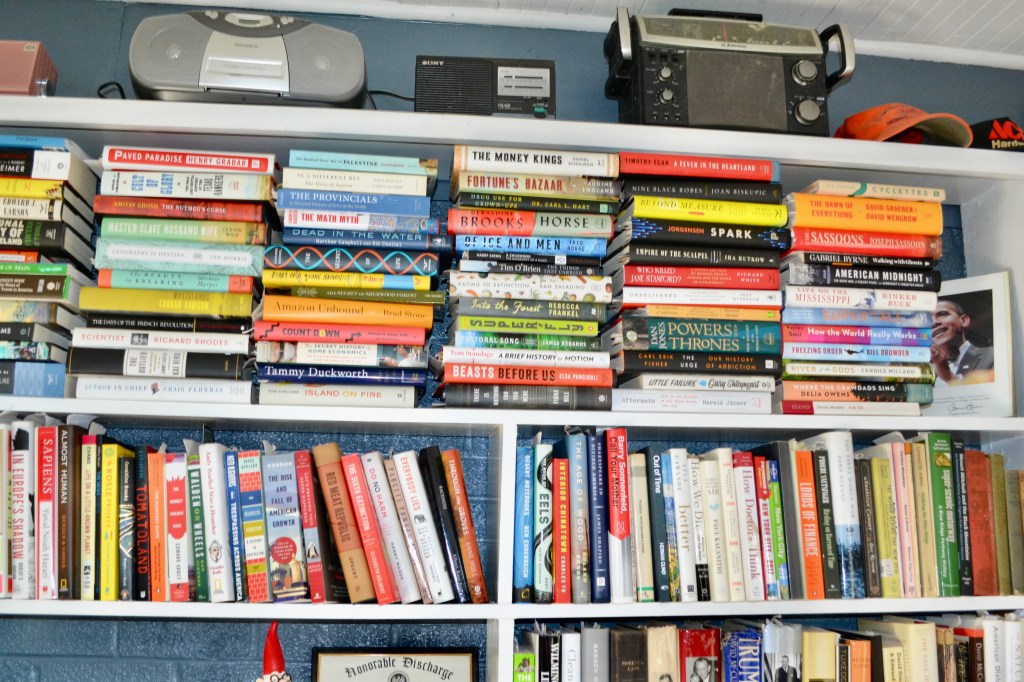
in reverse order:
A Fever in the Heartland: The Ku Klux Klan’s Plot to Take Over America and the Woman Who Stopped It (2023) Tim Eagan
The Money Kings: The Epic Story of Jewish Immigrants Who Transformed Wall Street and Modern America (2023) Daniel Schulman
Hamilton Carhartt in Rock Hill, South Carolina: Founder of Carhartt Clothing, Creator of Bob Overalls (2022) Pat Grant
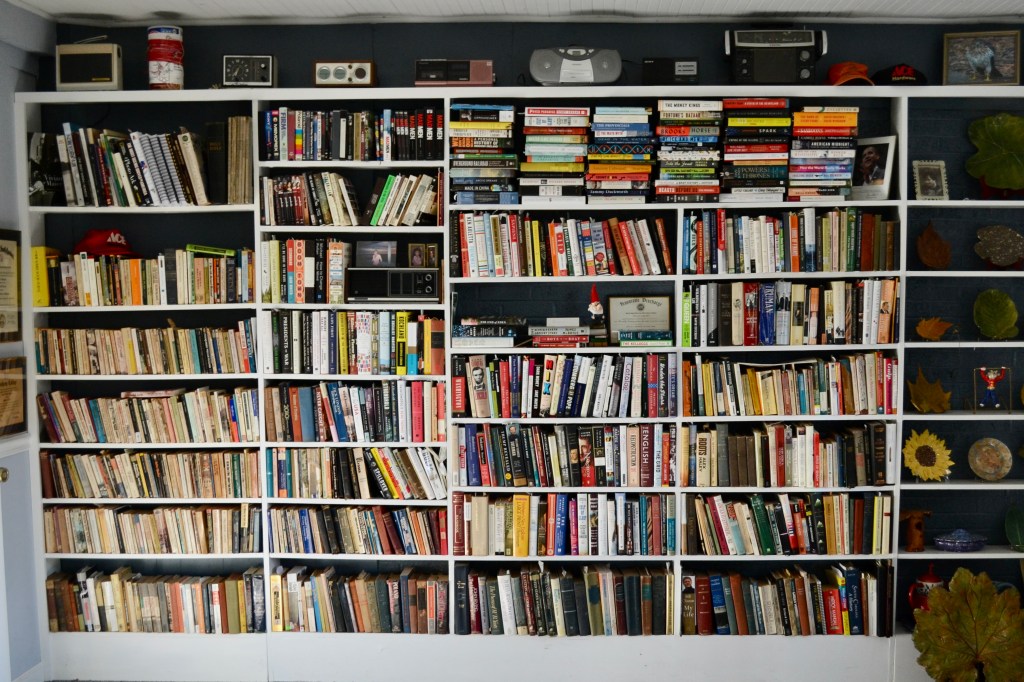
Pioneer Girl: An Annotated Autobiography (2014) Laura Wilder, edited by Pamela Smith Hill
The Hundred Years War on Palestine: A History of Settler Colonialism and Resistance, 1917-2017 (2023) Rashid Khalidi
Paved Paradise: How Parking Explains the World (2023) Henry Grabar
Through the Groves (2023) Anne Hull
In a Different Key: The Story of Autism (2016) John Donovan and Caren Zucker
Wanderlust: An Eccentric Explorer, an Epic Journey, a Lost Era (2023) Reid Mitenbuler
The Color of Water (1996) James McBride
Fortune’s Bazaar: The Making of Hong Kong (2023) Vaudine England
Nine Robes: Inside the Supreme Court’s Drive to the Right and Its Historic Consequences (2023) Joan Biskupic
Charleston: Race, Water, and the Coming Storm (2023) Susan Crawford
American Prometheus: The Triumph and Tragedy of J. Robert Oppenheimer (2006) Kai Bird and Martin J. Sherwin
The Days of the French Revolution (1980) Christopher Hibbert
Master Slave Husband Wife: An Epic Journey from Slavery to Freedom (2023) Ilyon Woo
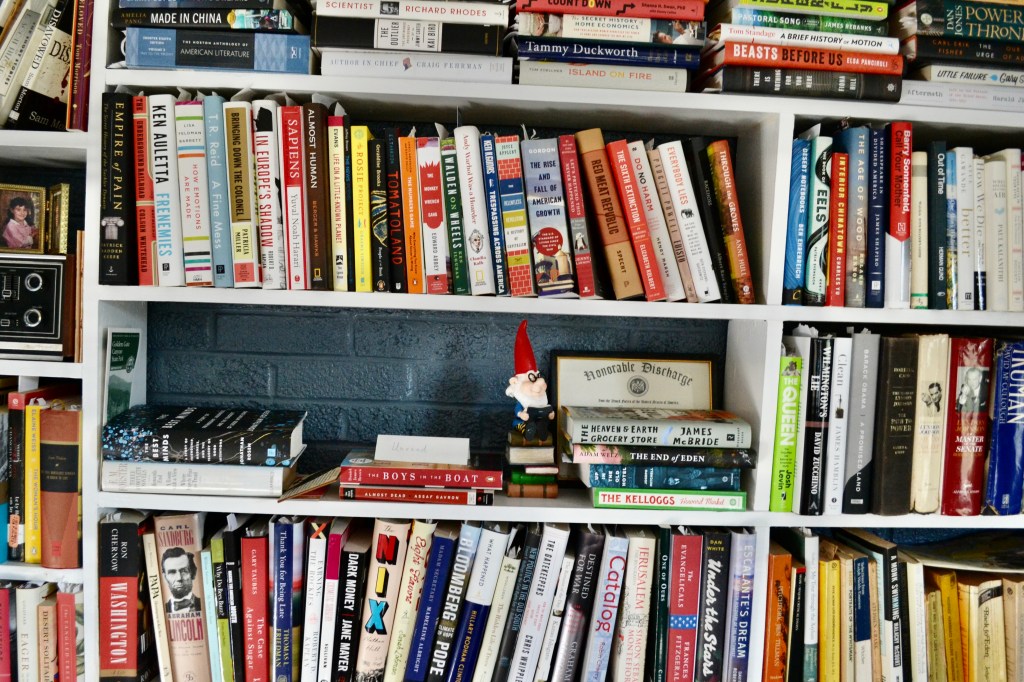
are from my 2024 Reading Record and 2023 Reading Record. I read two or three books per month and write about each book. Sometimes I get carried away and write the rough draft of what could make a decent essay that runs several pages; mostly I put together six to ten paragraphs that allow me to consolidate my thoughts on what I have read.
To me each book represents a long private conversation that I have spent weeks engaging in. No one hears me but me. I sometimes break up the “not hearing” problem by reading excerpts to my wife but she is usually reading her own book and rarely follows in my reading footsteps. I write to interact in a way that helps me refine what I thought and to remember.
I am a reading snob: what I read must be a seriously reviewed book that has won some acclaim. I used to read more fiction. Since I retired in 2006, I have concentrated on history and science. I read to engage with the world, not escape from it.
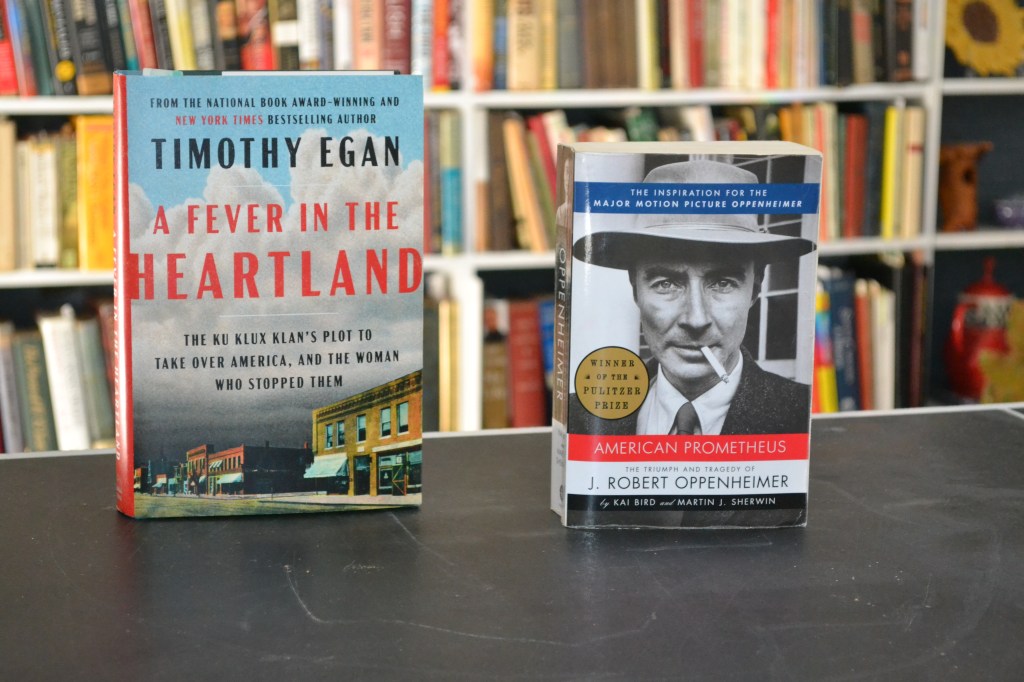
The Indiana KKK dominated America in the 1920s, surpassing the Atlanta-based southern wing of the organization, and drawing in nearly half of its white Anglo-Protestant residents. Women and children had their own special divisions and high school yearbooks of the era feature photos of students in robes. Colorado and Oregon had large KKK presences, too.
The mass of Italian, Irish, and Eastern European immigrants in and around WW I created worry over “the other” that Klan organizers exploited. State and local governments in Indiana were part of a political machine that the KKK ruled. A Fever in the Heartland did what I look for a book: it scrambled my brain and challenged my incomplete knowledge. It troubled me. I am taking my respect for midwestern wholesomeness and virtue off the top shelf.
American Prometheus took me to Los Alamos National Laboratory near Santa Fe, New Mexico. Robert Oppenheimer and his crew of scientists reinvented the modern world there by taking the atomic genie out of its vase. Oppenheimer loved the then remote area and did his thinking atop a horse there across a dry mountainous landscape that includes ruins of Ancestral Puebloans’ civilization that date to around 1100.
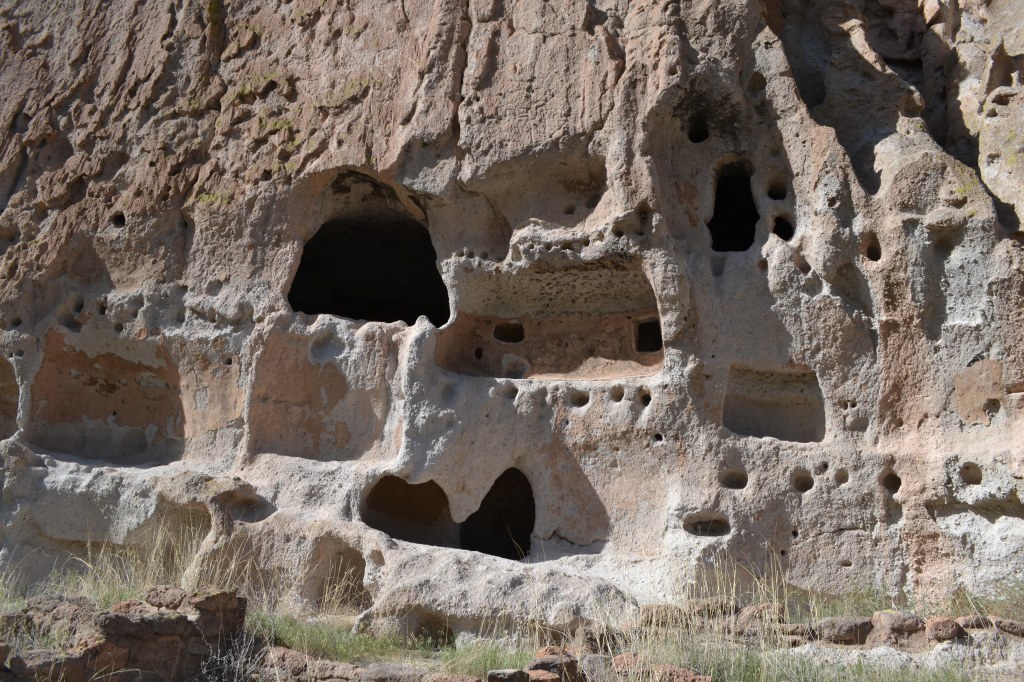
He would have seen these dwelling places. I have camped a couple of miles above them two times in Bandelier National Monument. My camping preceded my reading of Kai Bird and Martin J. Sherwin’s absolutely masterful American Prometheus.
Hiking and camping on part of the setting of the book–Bandelier lies within the atomic laboratory tract–is what I call history camping. I have set out through the years to visit book sites, starting with books I had read about the Civil War. The combination of mental (reading) and physical (camping) is often more than 1 + 1 = 2. The spirit of the place seems to overtake me. Something ineffable happens, creating an experience that is more than two inputs.
When I taught English at Northwestern High School, I used to put a sketch of two concentric circles on the chalk board: the first circle was the student before reading a work of classic literature that they were required to interrogate and write about. The second outer circle was the student post reading. Worthy reading enlarges.
Like the growth rings revealed in a fallen tree, I have a heap of circles that have made me a bigger human. I seek the bigness that shows me my smallness relative to vast universe that I am so curious about.
 Danny Forrest