Bicycles and Me

At the top of danielforrest.org adjacent to Home, I explain my purpose in creating a written record of some of what I think may be of interest after I am dead and to me in the meantime as my memory fades. I also write because I think I am more myself in written words than in conversation and as I kind of therapy, a way to use my mind. A random survey of people who know me or who have seen me in passing would mention something like “oh, the guy on the bicycle.”

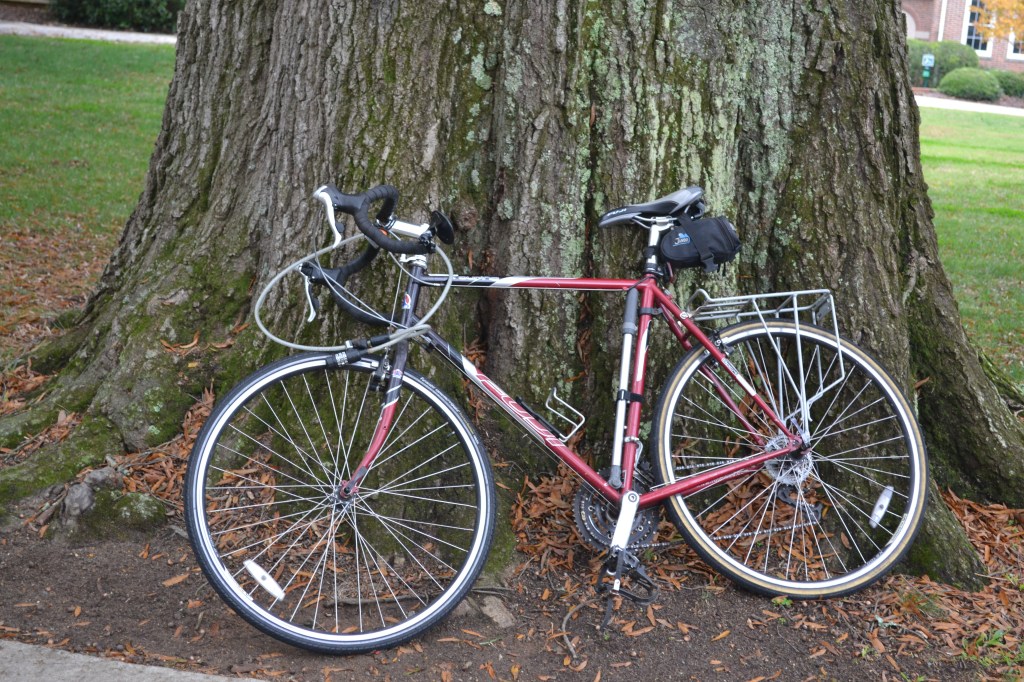
At 75 I still ride a bicycle but not to the top of Mount Mitchell anymore. I hop on my old Fuji road bike to visit grocery stores mainly. During the COVID crisis I toured York County to photograph parks (dmforrest.smugmug.com). Part of me and my personal oddity is linked to bicycles.
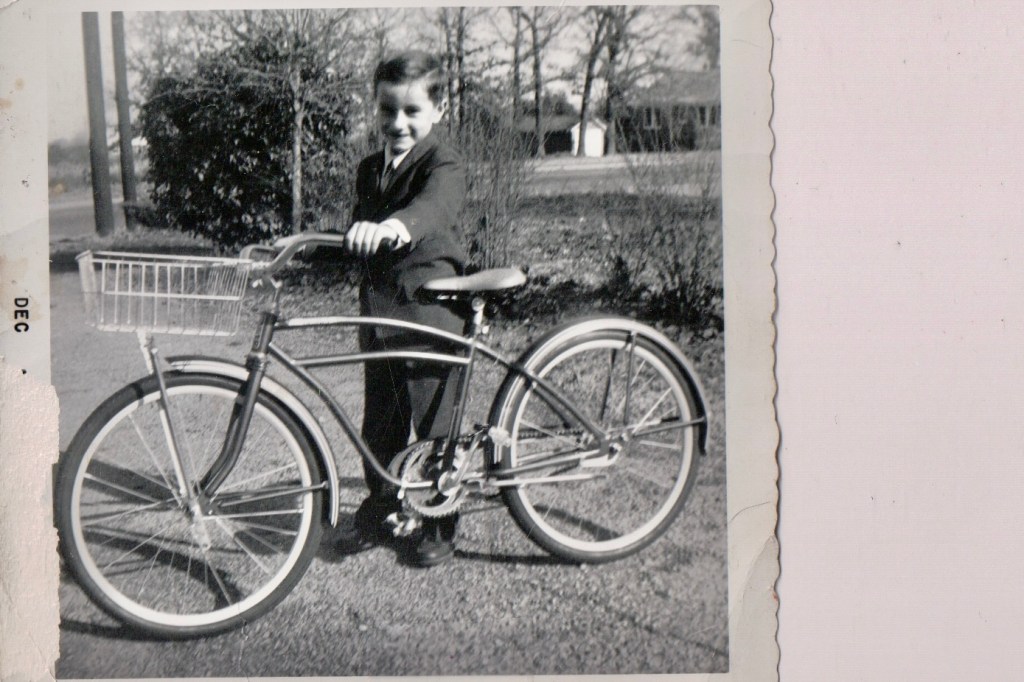
I see December on this old photo which I think indicates that it was my Christmas present in 1955. The bicycle came from Stewarts’ Western Auto store in Saluda about a mile from where I was photographed. It was my first bicycle after the hand-me-down that I learned to ride on. The Western Flyer stood twenty-four inches tall and had twin white pin stripes on the red fenders.

The basket was the most important accessory because it earned me a fortune in soft drink/candy money. Soda pop came in returnable bottles worth three cents. In a hour or two I could find enough bottles to pay for snacks. As a child, I did not realize how patient Preacher Bryant was. He ran the Shell station just up West Church Street and graciously took my returns which I immediately converted into an Upper Ten or a Baby Ruth.

I rode all over town without constraints. Jennings Street was a popular destination. Ricky Yarborough, my best bicycling friend, lived there in his grandmother’s house. Sometimes we would just polish up our machines and admire their beauty, work on model cars, or go to the Western Auto to look at accessories. By that time I had twenty-six inch bike with chrome fenders and a built-in headlight. I had gone from a plain Ford to a Buick.
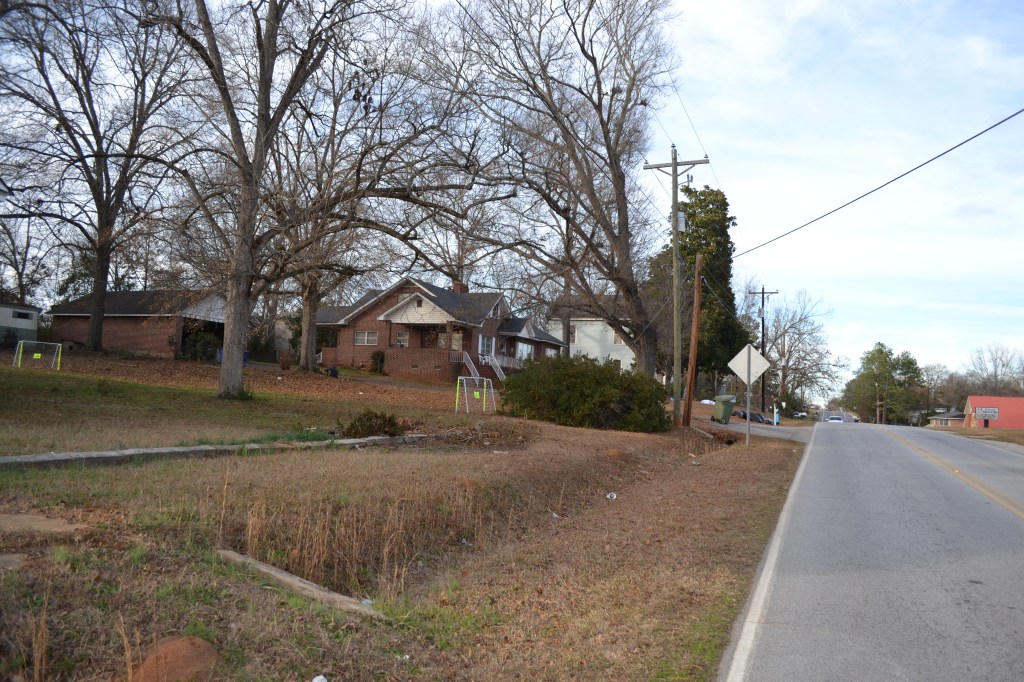
Ricky’s bike was similar to mine but red where mine was black. We staged races starting at the top of the hill where Jennings Street came closest to Red Bank Baptist Church. (The two “giant” hills of Jennings Street are visible in the photo above.) We would race to where Jennings met the Batesburg Highway without breath left to form words. I never won. Do not get me wrong. I was a good rider but Ricky was superb and determined. Ricky moved away and my interest in riding was overtaken by the prospect of driving a car at 14.

After a year at Newberry College, I transferred to USC in Columbia to finish my degree. My son Chris was getting old enough to leave at a Price’s Day Care just around the corner so that my wife Nita could go to work at Southern Bell to help support us.

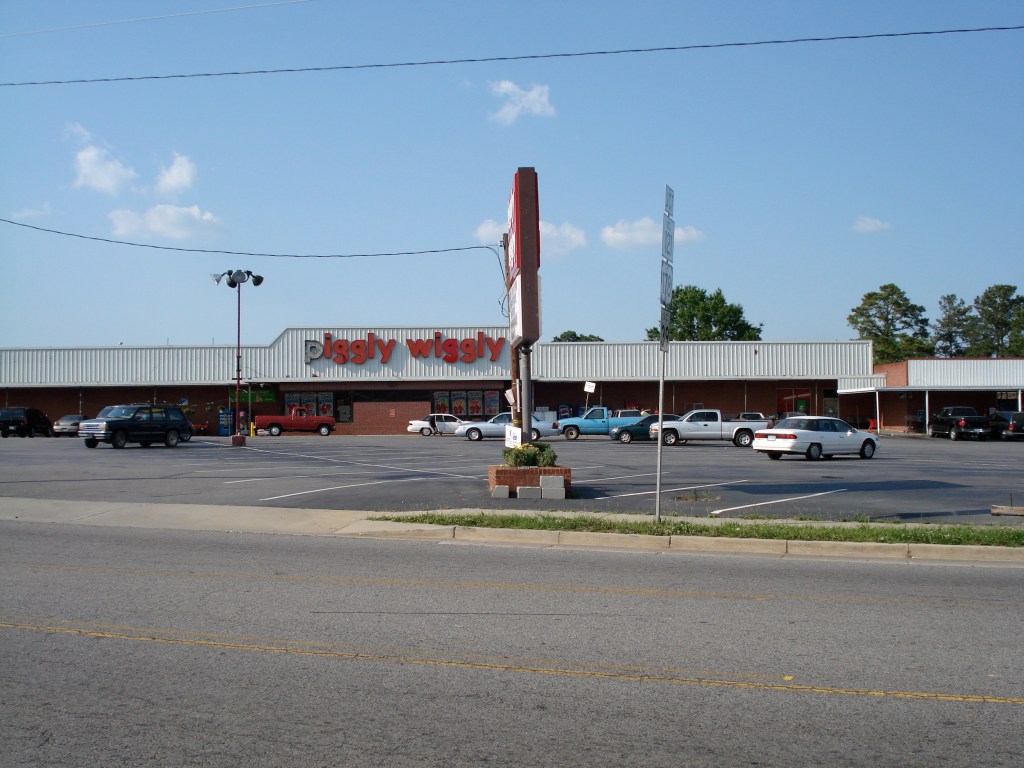
Getting back and to from USC and J. W. Hendrix mobile home park in West Columbia was easy via SCE&G bus, but getting to work after school at Piggly Wiggly #60 on 378 was a problem because the distance was too far too walk and Nita needed our only car. I bought a three-speed Murray from K-Mart and became a regular bicycle commuter for the first time. Weaving through back roads, I could get to work just about as fast on the bike as I could via car.

After graduation and active duty military service, I started to work at Rawlinson Road Junior High School in Rock Hill. In place of a second car, I bought a Honda 360 motorcycle to commute on.

My bicycle days were over until my fifteen-year-old son Chris signed up to bicycle across America with a friend. He and Steve Dietrich rode coast-to-coast from San Diego, California, to Rehoboth Beach, Delaware. His epic ride as a sophomore in high school inspired me to consider bicycling again.
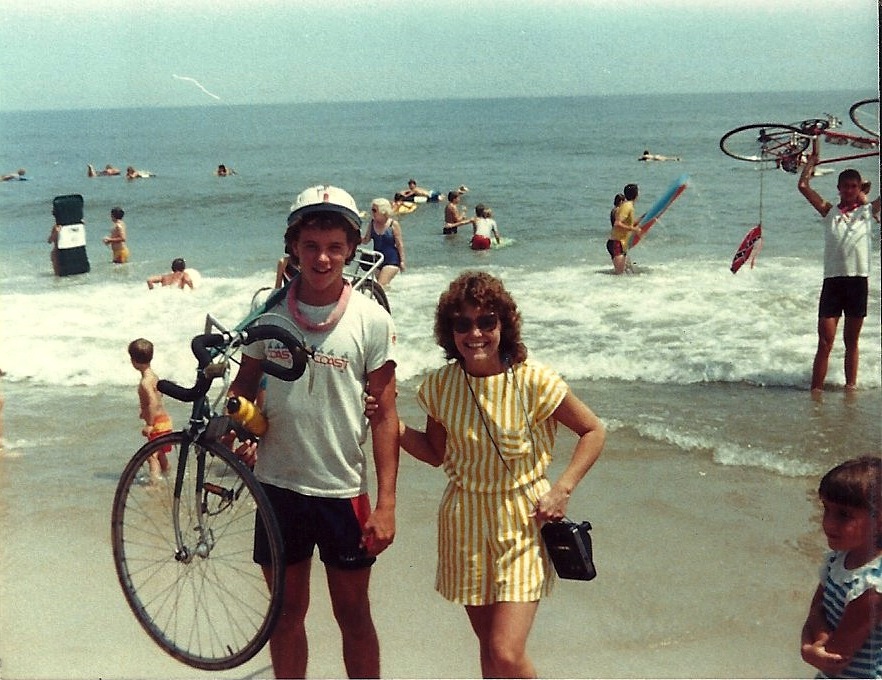
My daughter Danielle and wife Nita are shown standing on the Delaware beach where Chris has dipped his back tire in the Atlantic to finish his transcontinental ride. In recent years I have driven coast to coast several times which renews my awe for what Chris did via bicycle.

We had two cars but Chris seemed to need our second car more than me. At that time a car was to a teen what a phone is now. I recruited Chris and his friend Keith Davis to join me in test riding to Northwestern High School where I now worked one weekend. We made it but Chris laughed at his fellow riders’ slowness.

After a few more weekend practice rides to get in shape, I decided I could handle the commute of about seven miles. My third life as a cyclist was born and continues to this day.
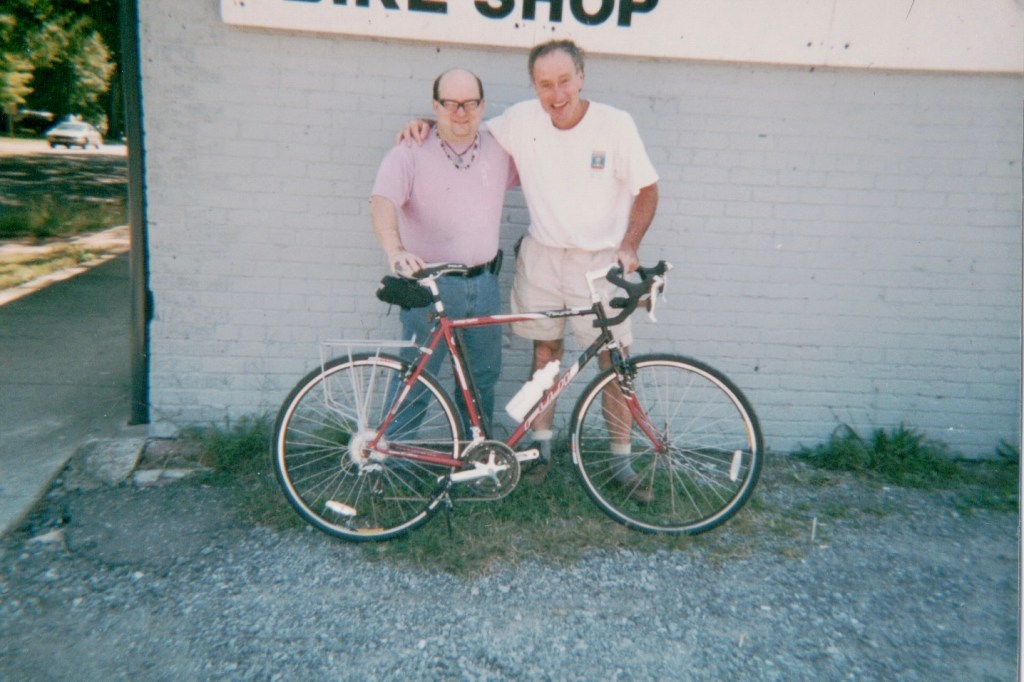
I had four commuters including the turn-of-the-century Fuji road bike pictured above. My former student Robert Baker prepared it for me in his College Cycle Shop on Oakland Avenue near Winthrop University. The Fuji is still in use, though not on a daily basis.

The daily five-mile commute to Northwestern is still etched in my head. So many memories . . . including the day a third-shift nurse somehow did not see me as I pedaled directly in front of the second entrance to Piedmont Hospital on S. Herlong at about 7:30 one morning.

Being hit by a nurse with attendant ambulances a parking lot a way had advantages. I was scooped up and checked out in the emergency room with all the alacrity and care that that is depicted on the best emergency shows on tv. My helmet was cracked and my jacket and shirt torn from my back in the slide that sent me down Herlong after my slipping across the nurse’s hood into her windshield.

I was very sore but all right, though my public crash caused a bit of stir at Northwestern. I was back at work in time to take over my second period. My Navy blue all-aluminum Canondale was twisted like a pretzel giving Robert Baker a chance to sell me yet another bicycle.

Back and to each and every day I went, except on days when rain was already present and heavy. My odd choice for adult transportation had become a habit. In the mornings I liked the direct contact with the outside that my indoor job sealed me from; in the afternoons I needed the exercise as break from the mental rigor of commanding the attention of teenagers thirty at a time. Eschewing the need for pumping gas into a car appealed to my Sierra Club mindset.

How many times did I answer, “Why do you ride a bike?” often followed by “Don’t you have a car?” Adult bike riding in Rock Hill is a lonely endeavor but there are antecedents. During the early twentieth century Rock Hill was an epicenter for the latest craze: bicycle racing. We had two wooden velodromes and the mayor of Rock Hill raced the mayor of Fort Mill before large crowds. (Some of that history is captured in the display adjacent to our current sunken Velodrome in River Walk just off Cherry Road.)
I also knew of the legendary ride of Paul Neal, who was affiliated with the shop where Chris bought his Schwinn Super Le Tour that carried him across America. Paul rode across America as a teenager in a ride that was reported in newspapers, creating an opportunity that saw the mayor of Los Angeles present him a key to the great western city upon his arrival. Paul recreated his famous ride a few years ago in his late 60s.

I had that inspiration in the back of my mind and the newspaper stories about a young biology teacher who rode from his home in York to teach at Fort Mill High School each day. Bill Hilton ended up at Northwestern where I taught. His ride was about triple the length of mine.

Riding connected me to other odd people who formed the Rock Hill Bicycle Club, formed by Dick of Dick’s bicycle shop. We rode criteriums through rural York and Chester Counties; for a time we rode to Myrtle Beach each year. I earned three or four Assault on Mitchell badges for completion of a race that started at Memorial Auditorium in Spartanburg and finished atop Mount Mitchell.

That hundred mile ride caught the interest of riders from across the U.S. and beyond. I remember leaders of the pack whom I glanced at on the starting line finishing and riding back down from the east coast’s highest point whizzing past me so fast that I could not see them beyond a blur through my salt-caked eyes as I struggled with the last twenty miles of the hundred mile event.

Hours later when I made the top, I stashed my bicycle into the luggage hold of a big charted bus and gladly sought the comfort of upholstery, glad to be borne back to Spartanburg in comfort.

I have been lucky enough to ride with my children, though I am mainly a solo rider. Chris and I rode to Columbia and on to Saluda to see relatives years ago. Elle and I did the Virginia Creeper Trail. Restricted to just bicycles, it puts on display what bicycle transportation could be.
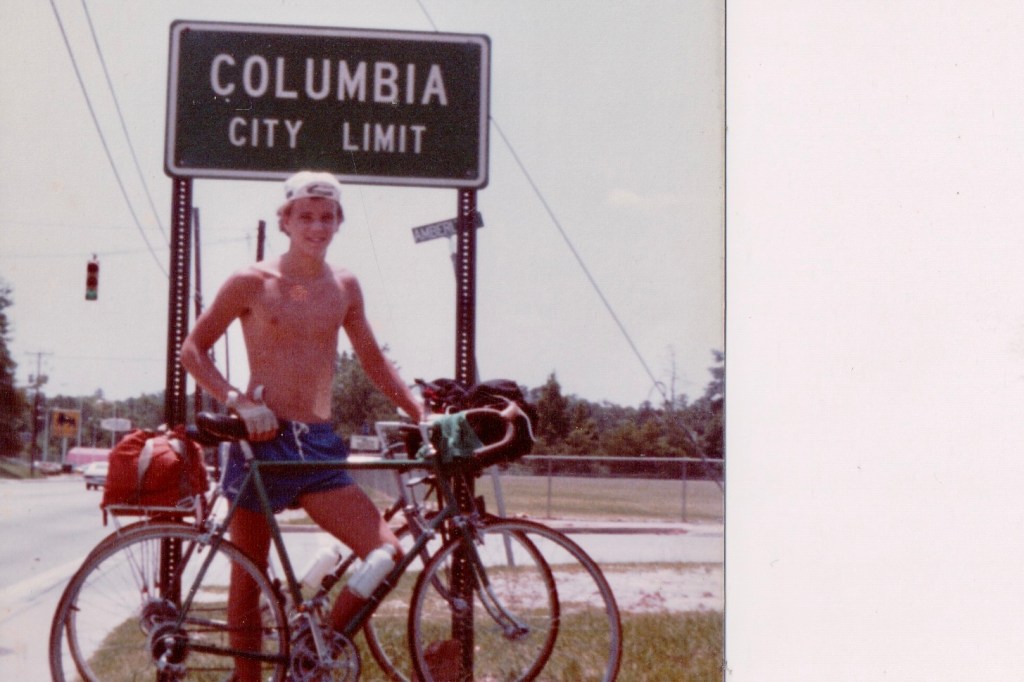
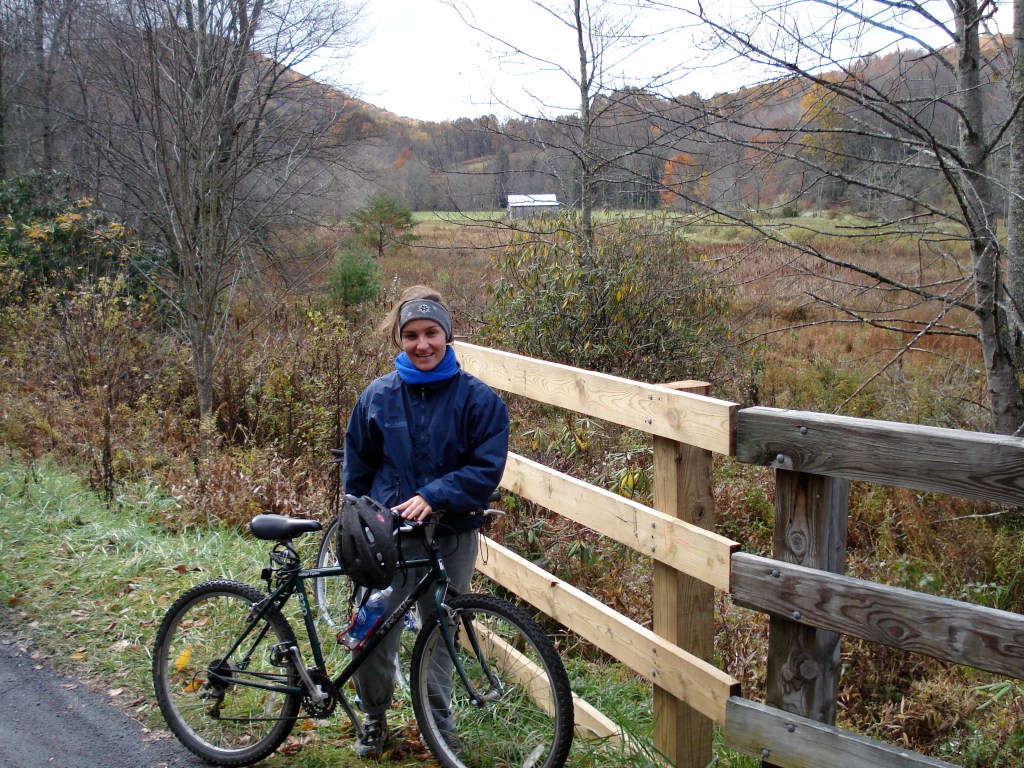
What do the motorists who speed by me think of an old man on a bicycle? I suspect they think that I have lost my license, but I am used to the oddness of being out of a car because I walk places on a daily basis. I still hop on my bicycle on Sunday afternoons when Rock Hill traffic is tamer than normal and spin around just to see some territory and haul it in my pick-up to go camping from time to time.
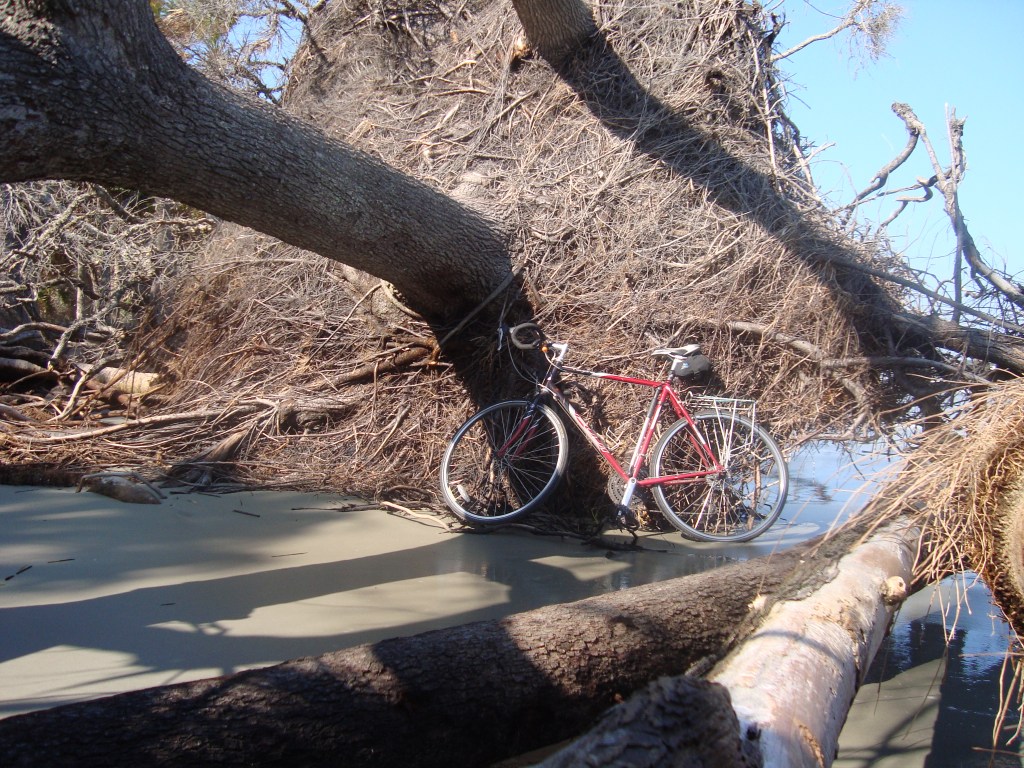
I am not sure if children ride bicycles much any more. Video may have taken over what this small town boy took for granted: pedaling for pleasure. It is a part of the odd brand, what I am known for.
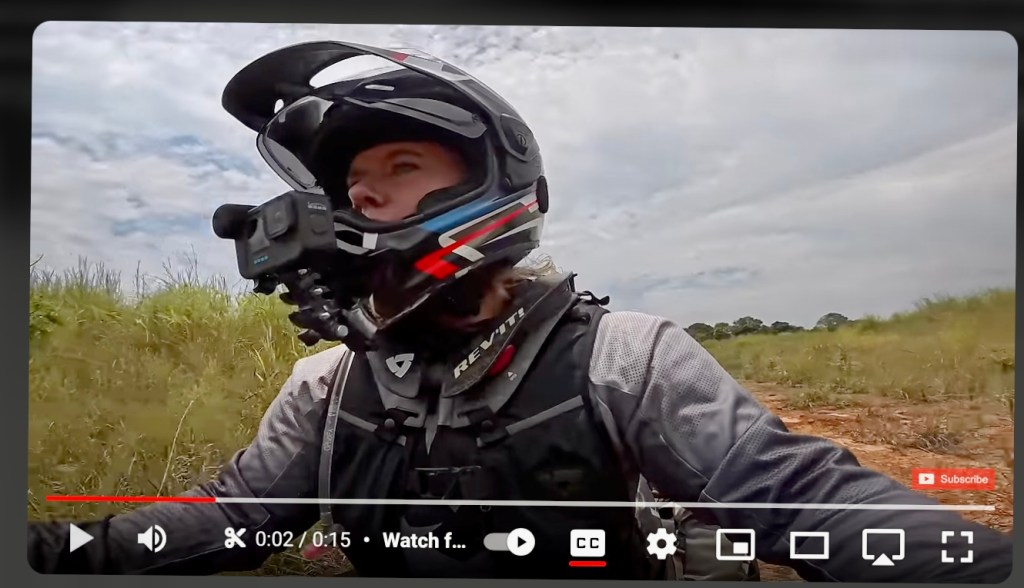
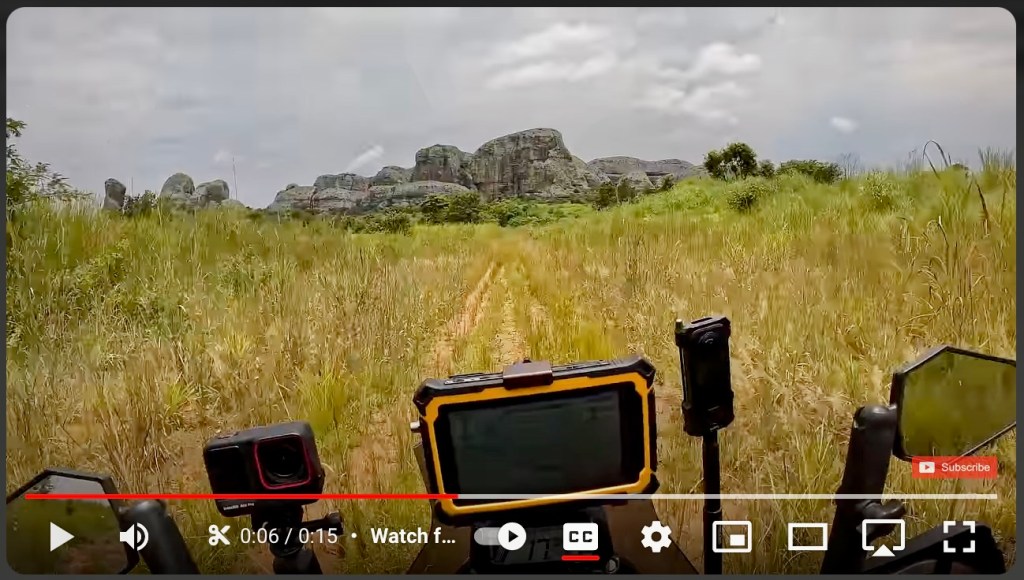
Itchy Boots

is Noraly Shoenmaker outside of You Tube. In 2018 the young geologist stopped scouting mining sites, residing in Holland, and started living on a 300 CC motorcycle. Her home is literally the remote world. She rides on “tracks” or unpaved roads in remote places reporting what she sees. She has filed hundreds of blog posts running about twenty minutes each.

My friend Pete Kreen, a motorcycle enthusiast, tipped me off to her site two years ago. I tuned in to watch her ride from the tip of South America in Puento Arenas, Argentina, near Cape Horn to Prudhoe Bay, Alaska, on the edge of the Arctic Ocean. Since then she has ridden from India back to Holland and through the Mideast. She is currently riding Africa country to country and is in the Central African Republic. 

Screenshot

She does not tour familiar big cities. She does attempt to always ride village to village so what her more than two million viewers see are rural people in natural habitats. She eats what she can find along the way and has encounters with natives where they live outside of the commercial world that I live in.

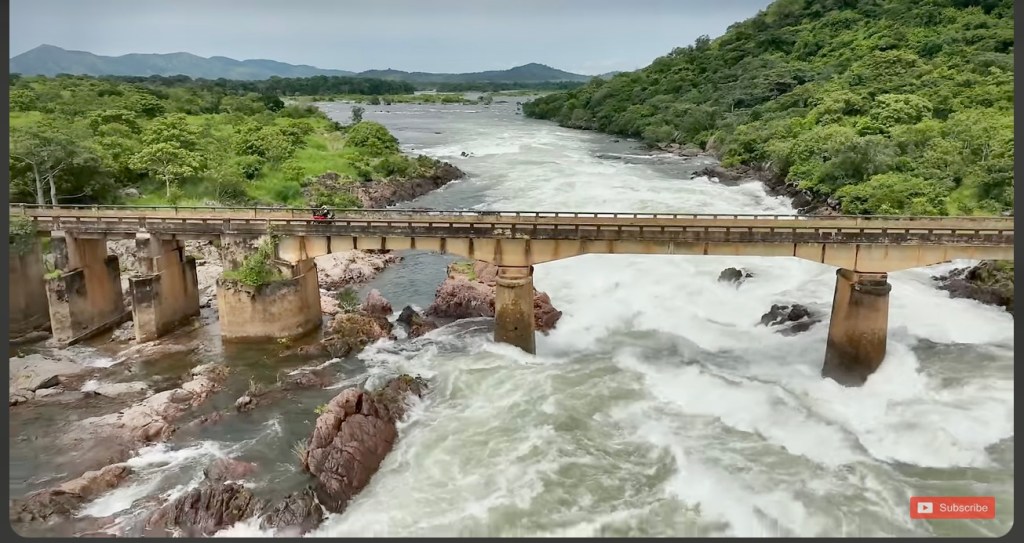
Her motorcycle caught my interest first. Because of her small size and need to navigate dirt, she rides a 300 CC Honda that recently fell out of a pirogue (canoe carved from a log) into the Congo River separating Congo from the Central African Republic of Congo. She stirred my inner motorcyclist–I owned a Honda 360 in the 1970s and rode it back and to for work–but my interest in her machine soon gave way to her way of showing humanity to humanity.

She keeps her opinions and private life to herself and is to modesty what Donald Trump is to narcissism. She is an observer of geology, wildlife, and people in a journalistic way that places the viewer aboard her motorcycle and within her geographical location. Her editing skills–she creates all of her content–suggest someone who could publish video for National Geographic. She uses two Go Pro cameras and a drone to capture footage that she edits when she can find electricity and a SIM card to transmit on a laptop. 

Screenshot

Those items are part of the precious weight that she scrupulously seeks to avoid. Viewers have seen her drop her Honda and bog down to her seat more times than I have fingers.  She is an expert in using her small frame to position herself backwards against her fallen motorcycle to raise it. Until I started viewing her site, I thought I knew something about dirt roads from my rural South Carolina upbringing in the 1950s. Little did I know that those slick muddy tracks were comparative interstate highways compared to the rural third world she inhabits.

Through her blogs, I have seen vehicles so entrapped in mud that they have had to be abandoned until a dry season emerges. The “tracked” third world of her travels goes by donkey, camel, foot, and motorcycle. Noraly is weighted down but she often travels along side Chinese-made motorcycles in remote places that convey whole families and household goods. 

I love geography for its own sake and her Itchy Boots taught me more about North and South America than I had accumulated via a long lifetime of learning, yet that is not what places her travels deep in my heart. 

It is her encounters with people. Her Spanish and Portuguese are excellent and her French, adequate; she picks up local languages fast, earning her respect and smiles from natives.

She uses her bright smile and engaging, fearless personality to find out about people she meets and often boards with them in remote places. She is as expert in drawing out the lives of those she encounters as the best of NPR reporters. 

Screenshot

She has taken me into the lives of ordinary people in more than 100 countries. Her method is rooted in allowing them to speak for themselves. Occasionally the viewer gets a whiff of her worldview (especially in regard to wildlife preservation) but not often. She recently pointed out that her sojourn among the Pygmy tribes in Congo gave her a rare chance to feel tall because she was on average a head taller than Pygmies. She went on to say that people in the Netherlands are quite tall. Poof! That remark came and went quickly because she stands at an oblique angle from what typical internet influencers do. 

I am a somewhat melancholy person but every one of her broadcasts fills me with the kind of joy that often sends me to the next room to tell my wife Nita about what I saw in her contact with rural people in villages. She is a humanitarian and roving ambassador to the world in a Jimmy Carter kind of way.

One lone female motorcyclist has show me the goodness of humanity in remote locations around the globe. I hoard programs–she posts two in a good week–so that I have an experience to cheer me up at the end of the day at least once a week. Her audience comments give me a way to test my own experience. “Am I crazy to be so enamored of her reports?” I ask myself. For sure, “No.” Her followers exceed two million and reflect the wonder and joy that I experience, too, in comments that uplift in multiple languages.

The Red and White

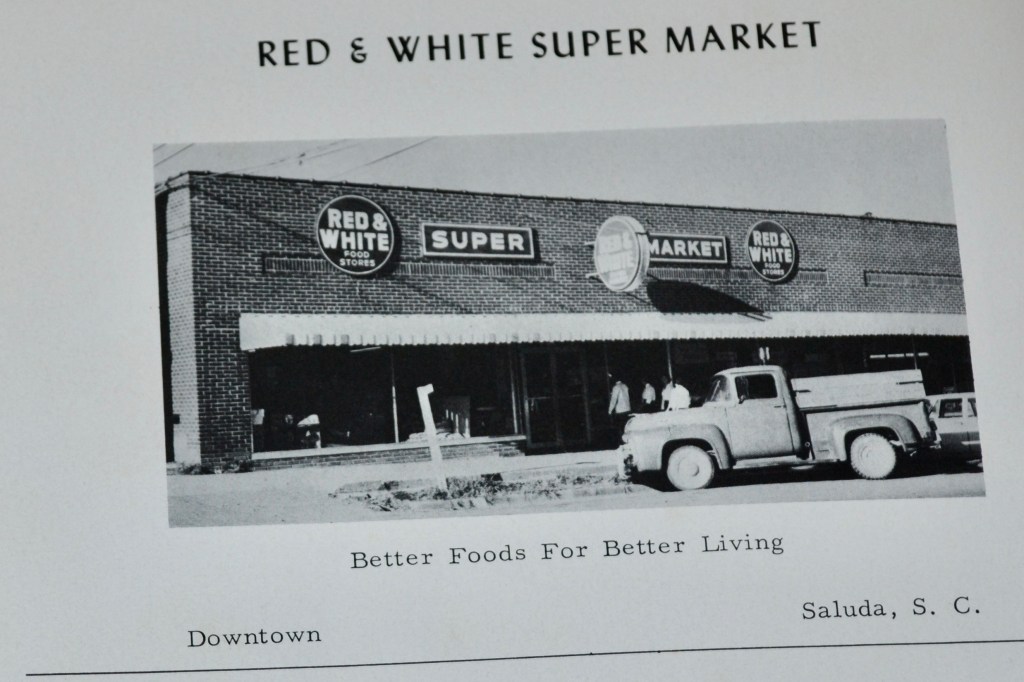
was a supermarket in Saluda, SC, and my first regular pay job. It was three doors down from Ben Hazel’s Grocery Store where I used to take lists of items that my mother Leona wanted. Mr. or Mrs. Hazel would find the items and give them to me carry home or arrange for delivery.

Alfred and Miriam Adams opened their Red and White Supermarket on Church Street just shy of the corner of Main after the Hazel’s Grocery closed. Supermarkets were new and exciting in 1962 when I went to work. I was 14 and at an inflection point in my life because my father died that year.

The Adams were a young couple in their twenties who pooled their savings from working for Winn-Dixie to open their own supermarket when bleach still came in brown glass bottles and frozen food was in its infancy. The store sparkled. All can goods were rotated and faced front. A customer could find his face in the floor. The glass windows were hand waxed weekly by me or Alfred.

I learned how to pack the brown bags that held the items that slid down the counter square. Each item was packed with care. Of course, bag boys like myself carried them to customers’ cars. We usually double-timed back to the store because customers were not allowed to wait and back up. Friendly, fast service was paramount.

I have three university degrees, but in some ways what I learned in that store rivals the substance of any one of those curricula programs. I wore a tie and a white shirt covered by a crisp white apron. My learning was in public and based on following the work of my master, Alfred. He was demanding and taught by showing and doing himself. I watched him work and interact with other employees and customers, imbibing lessons without conscious thought that still stick to me.

Soon I became a good enough stocker to have my own aisles in the middle of store. I stacked cans face forward with speed and efficiency but stopped what I was doing to engage any customer close to me as per Alfred’s way of smiling at each and everyone who entered the store.

Bagging, stocking, hauling empty drink bottles to the back, and unloading trucks led to a promotion to the meat market where I learned how to wrap slice meat, cut chickens, shoulder a side of beef, and grind hamburger. Meat cutters were difficult to find and keep so part of my job was to keep the man in charge happy by making his life a little easier.

George Byrd Yarborough was tall and slim and had curly hair atop his long face. He looked like a movie star with red eyes. Yes, he had the problem; otherwise, he was an outstanding worker who drew customers and kept the most important department in store humming. We sold meat in great volume leading to Alfred employing a young woman in her twenties to help wrap. She was pleasant and sincere but she could not move at super speed or wrap with precision that pleased George. I remember him losing his temper with her and complaining in loud voice from the back about her ineptness to me. In hindsight, I think that was an oblique compliment to me, though I felt sorry for her. Joy was her name. She was soon gone.

Not long after to my great shock so was George. He and his father Horace were killed one weekend over a gamecock. They got into an argument with a handler at cock fight and were gunned down. I did not know much about the incident because it was hushed up but their deaths made the papers as they say. I would no longer be asked to fetch George Byrd’s big two-door DeSoto coupe from the back near quitting time. To this day I see the mint green and white two-tone paint and back seat filled with empty Blue Ribbon beer cans in my head. It was the longest car I had ever driven and shifted via buttons on the left side of the dash.

After a series of temporary meat cutters, we landed Romie Webb. My first impression of him was that the comic book ad for the 90 lb. weakling in need of the free muscle building kit for sale had come to life. He looked like the before image who was suffering sand kicked in his face on the beach with bikini clad beauties looking on.

I was wrong. Romie was strong, efficient, and deliberate. He had an astronaut haircut, fair hair, and black glasses that accentuated his features. As a worker, he was Alfred’s match and that said a lot. He was good with customers but not a talker, which is why Bunk Shealy could so get on his nerves. Mr. Shealy was a retired Ford mechanic who lived nearby with his wife and a great many cats almost under the town water tank. I loved seeing him make his way into our market area holding his cane with his shaky hands. He was there to beg scraps for his cats.

What I most loved was seeing him interact with Romie in a two-or-three-times-a-week showdown. Bunk would start some line of small talk with Romie that was seeded with exaggerations. Romie would play the straight man with a serious demeanor and the kind of questioning voice a lawyer uses in court. Pretty soon Bunk’s scrap bag would be a full as he could manage and the mock hollering contest would conclude. Bunk left smiling and Romie tried to keep his straight face. Their animated theater bit was another part of my Red and White education.

No one from those days looms larger than Luisus (pronounced loo shush) Carrol. He always wore a paper service cap associated with dining establishments and a wide smile. He was singular for being the self-proclaimed best produce man in South Carolina. His friendly bombast was accurate as I found from working in other supermarkets later on. His displays popped; he used colors to break up presentation and displayed fruits and vegetables the way florists work flowers.

In those segregated days he was my only solid link into African-American lives. I had known him in my younger days when he delivered groceries from Hazel’s to our house. His smile and salesman’s skill led to my mother baking an extra pie for him on delivery days. He came into my meat market territory routinely to control the rotisserie that hung over the bacon and sausage portion of the meat counter. I did not take an interest in his barbecue formula but it made the store smell like time to eat. To this day I can still hear his fine baritone singing Down by the Riverside in the back where he readied his merchandise as the doors swung open from the backroom.

My best friend was Nathan Powell who came to reside in the produce department. He learned from the master and soon controlled his area of the store as I did mine when the boss went home. He is the reason I put words down on this site. (See What I Want to Do with danielforrest.org at top.) We used to leave the store as close to 9 P.M. on Saturday night as possible to slide into his old but elegant blue Chrysler for the ride to Winnie Winn’s restaurant. We would find a booth and wait for our hamburger steaks to arrive: two kings of the world on Saturday night. There we were with our stuffed brown pay envelopes in a restaurant ordering food like hot shots and talking about girls and cars. I find tears in my eyes so I want to finish this remembrance with delivering groceries.

Somewhere along the line I became the main delivery van driver which meant keys to the white Chevy van with Red and White logos on the doors and a motor up front beside the driver, no seats in the back. I used it on Wednesdays in advance of double stamp day. The Adams had instigated double Top Value stamps on Thursday grocery purchases. I drove to the shirt plant, hosiery mill, chenille plant, the Nantex, Deering-Milikan: every cotton mill and sewing plant in the textile town of Saluda. I weaved in and out of cars inserting colorful circulas advertising weekly specials under wiper blades of parked cars. The Adams took great care in laying out ads that fetched customers that always included a loss leader like fryers @ 3 lbs. for a dollar.

Driving that van gave me a sense of importance and leads to way to break off my remembering with Saturday deliveries and what I learned from that work. Downtown Saluda was a sea of faces on Saturday with crowds so thick that navigating sidewalks required weaving in and out of pockets of people. The low wall surrounding the courthouse would be covered with sitters engaged in once-a-week-come-to-town conversation.

People would be propped on cars, coming to and fro from stores, and doing Saturday business. We got the groceries to the cars on such days that felt like festivals. Those that did not have a car to be conveyed back home in could count on deliveries. Close to half of our customers were African-American and some did not have driver’s licenses or cars. No problem. You buy groceries with us and we deliver for you.

I made two Saturday runs up and down Bouknight Ferry Road on Saturday to deliver in the solidly segregated area of Saluda. I was a no-nothing white kid popping in and out of homes occupied by people I was not allowed to go to school with or sit in a theater with. Walking in and out of those homes was a trip into a different world.

I remember one order that I sometimes delivered on the far end of Bouknight Ferry by turning down U.S. 378 and driving three miles or so toward Columbia before turning onto dirt lane. I had to coax the lady who rode with me to sit up front in the only other seat in the vehicle. Her children would spread out in back among the bags and boxes of groceries. She felt strange or afraid riding up front with a white boy but it seemed logical to my young mind. I remember the smell of the tar-paper covered shack she lived in. It was nothing like my comfortable house. Flies covered my perspiring face as I lugged groceries in. The canned goods, flour, rice, and sugar I brought in must have seemed like Christmas to it inhabitants. The sink had a pump handle and there were no light fixtures. I saw directly into the heart of racial inequality as I as coming of age and learned lessons that still stick to this day.

A Small Town Boy’s Weekday Night Out

Back in Saluda, SC, in the 1950s I was a Royal Ambassador for Christ. Being an RA meant developing Christian character in the company of boys my own age to Red Bank Baptist Church. To me in meant doing stuff with kids my age aka Stephen King’s Stand By Me. I suppose my character was developed by this Baptist Boy Scout outfit but not due to any conscious effort on my part.

My favorite time of the weekly meeting was the ride home. We were delivered to Red Bank by mothers or fathers who were probably as glad for time alone as the character development. We were taken home by either Carmen Charlie Charles or Kirby Able. We had a choice and a heap of thinking went into that choice.

Kirby had a Volkswagen Vanagon with rows of seats and much more pizazz and appeal than our parents Impalas, Galaxy 500s, or Plymouth Furies. Claim shot-gun and you could co-pilot with Kirby and watch him take the VW through the four gears, on the floor, not the steering column. I liked the notion of not having a hood best. You seemed pushed through the air toward your destination. But for all that, I almost never chose to ride with Kirby, who he was a neighbor two doors up on West Church Street, even though he usually carried my younger brother Cally home.

No, I much preferred Carmen for a variety of reasons. He charmed me. I knew other men who wore overalls like a uniform as he did, but they were not as neat as Carmen. He put his Dee Cees over a Dickie work shirt that was either green or blue and always neatly laundered. You could tell that he had changed into a fresh one after his day’s work at the saw mill. He always had a vinyl pocket liner with a full complement of writing utensils in his shirt pocket and would graciously loan one to fill in a lesson with.

Carmen wore round wire frames that are now popular but back then they weren’t. My notice went more to his hair and cheeks than those glasses. Blood vessels had apparently burst in his perpetually tanned cheeks, leaving a purple tinge. Ever seen hair parted so high it seems to be parted in the middle? That was the shape of Carmen’s and he kept it shiny and slicked back with hair tonic.

Carmen’s strongest asset was not his quaint appearance but his transportation. Warm weather meant the saw mill truck, an old Dodge or Chevy with tandem rear wheels and an open bed. After pledging Christian duty and praying at the end of a meeting, the Royal Ambassadors made for the parking lot ahead of its leaders to chase fire flies, tell lies, and talk about fast cars and baseball. Two groups formed around the choice of vehicles in anticipation of ride home and the visit to Fulmers when our dawdling leaders had decided we had played out a requisite amount of energy. The rule was that after a headcount was taken you had to stick with original driver. I always chose Carmen, or Carmen’s vehicle.

Fulmer’s was a first stop. To a passing motorist on the way to Atlanta, it was a truck stop with an attached speed shop and garage underneath on Highway 378 on the Columbia edge of Saluda. To us, it was a chance for one eat and one drink of our choice on Kirby and Carmen. First, though, we had to get there. Back then the two miles or so from the church seemed like a long way. Carmen instructed those who rode in the bed of the truck to stay against the bed of the cab and above all not to throw wood slabs. We liked taking the rough sawn bits of pine and throwing them at bushes and signs on the sly. What could be finer than sailing through the night air while shouting over the roar of a saw mill truck motor?

You’re right. Choosing the treats. R.C. Fulmer kept two soft drink chests full of the best selection of soda pops in Saluda. He even kept Tom’s peach flavor soda, and, of course, Chocolate Soldiers, Dixie Colas, and Upper 10s were a given. I was smart enough to browse for eats first. Why stand in line or be jostled around choosing Frosty root beer or a TrueAde? Best to let the crowd thin; after all, there was the problem of selecting a bag of of fried pork rinds or a can of Koby’s potato sticks or a Merita honey bun or a Baby Ruth. Some of the boys opted to have R.C. spear a hot Pen Rose sausage or an egg floating in vinegar. Seems like it was Johnny Adams who copied me and went about the selection backwards. We liked to eat and drink while looking over R.C.’s selection of mag wheels, chrome add ons, and various speed components.

The final leg of the trip home was better in cold weather because then Carmen would drive his Oldsmobile, one of those mid-1950s Rocket 88’s with a big block high horse power V-8. To this day, I don’t suppose anyone outside of my Carmen-riding RA’s knows our secret. We never told our parents. Quiet, Christian Carmen was a secret Fireball Roberts. Every Saturday night would find he and his wife Stella parked parked sideway on an embankment under of the big pine trees next to turn two of the dirt track in Newberry. Stella would sit crocheting or visiting with friends while Carmen mingled with groups of men who actually knew the racers and their cars. Visiting him on the day of a NASCAR event meant you had to be quiet so that he could hear the sound of the staticky announcer on the AM station report what position Rex White or Joe Weathers or Fireball himself were in.

We pushed Deacon Charles button on more than one occasion One call for “Hit it, Carmen” wasn’t enough. He demanded a chorus and we had to wear him down. Usually it happened on the way out the Denny Highway on the straight stretch short of William Ross’s house. Because he lived the farthest away, we insisted that we go to his house five or six miles out of town first. By the second or third loud chorus of “Hit it, Carmen” the metamorphosis would take hold. Carmen became Fireball II.

The white hood of the two-tone Rocket 88 lifted slowly but steadily. If I were in the middle rear of the rear seat, my boney back would begin to dig into the middle of the metal insignia that separated the back seat but not for long because I would fight the G forces in to sit up to see the hood ornament raise toward the sky. It was a two-winged rocket with a blocky tail and a long sharp noise that seemed to leave the long white hood once Carmen hit 80 or so. We hollered disappointment when he left off shy of 100 but not too loud because we wanted to hear the big V-8 rumble through the dual exhausts on the way down to proper road speed.

Such was the stuff of a small town boy’s night out.

Butt Patrol

Is something I had not thought about in many years. The phrase occurred to me about half way through my big loop walk around the Ragin Lane/India Hook walk this sunny Sunday.

Just below the multistory apartment complex for old people where Ragin meets India Hook, I stopped to bag up the trash I had accumulated on the walk. Near the the entrance to complex, an older man, perhaps my age, with a small white dog asked me if I were picking up trash. He did not feel well or look healthy but agreed the weather was good even if he was not.

I liked that. He did not have a phone and he was old enough to observe his surroundings rather than a phone screen and to strike up a conversation rather than turn away from a passerby. We talked a bit, though I struggled to understand him through his face mask. His hearing is a few notches worse than mine so I had to talk louder than my usual loud.

I asked, “Were you in the service?” He said, “Yes.” I furthered our conversation by asking if he remembered butt patrol. I detected a smile, mask or no mask.

We both remember standing at arms’ length from soldiers to the left and right to move slowly over ground on military posts. Civilians might not know this but trash is not allowed on base. If a superior can see something that is not dirt or a blade of grass, it must be picked up and pocketed for latter disposal. Cigarette butts do not litter military installations.

He still picks up butts at the entrance to his apartment complex where residents skirt the no smoking rule and we both agreed that cleaning all along prevents excessive littering.

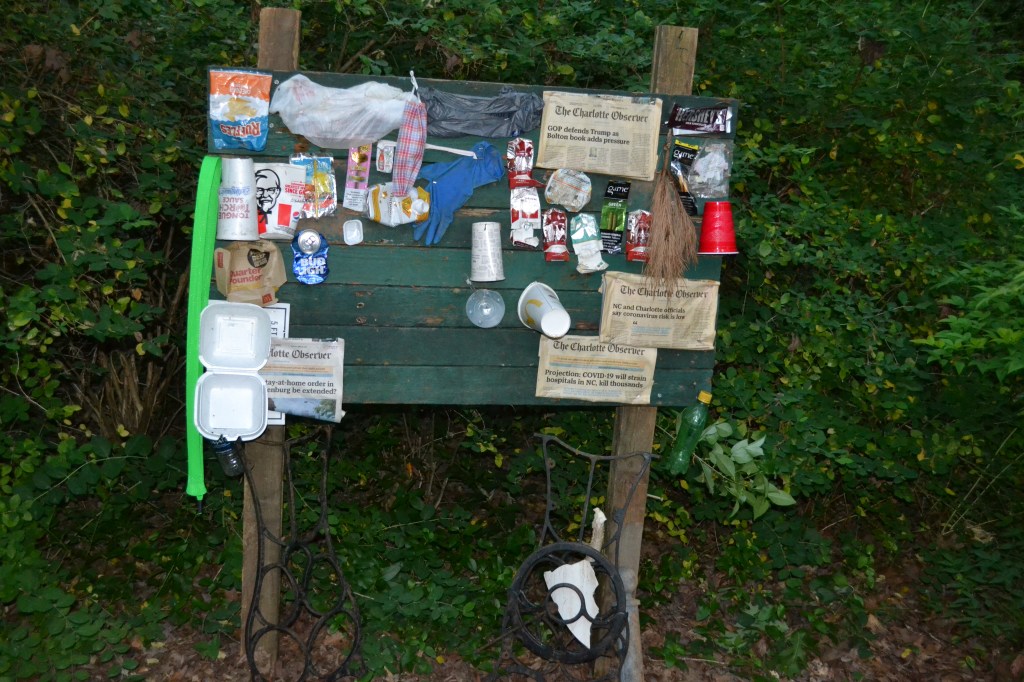
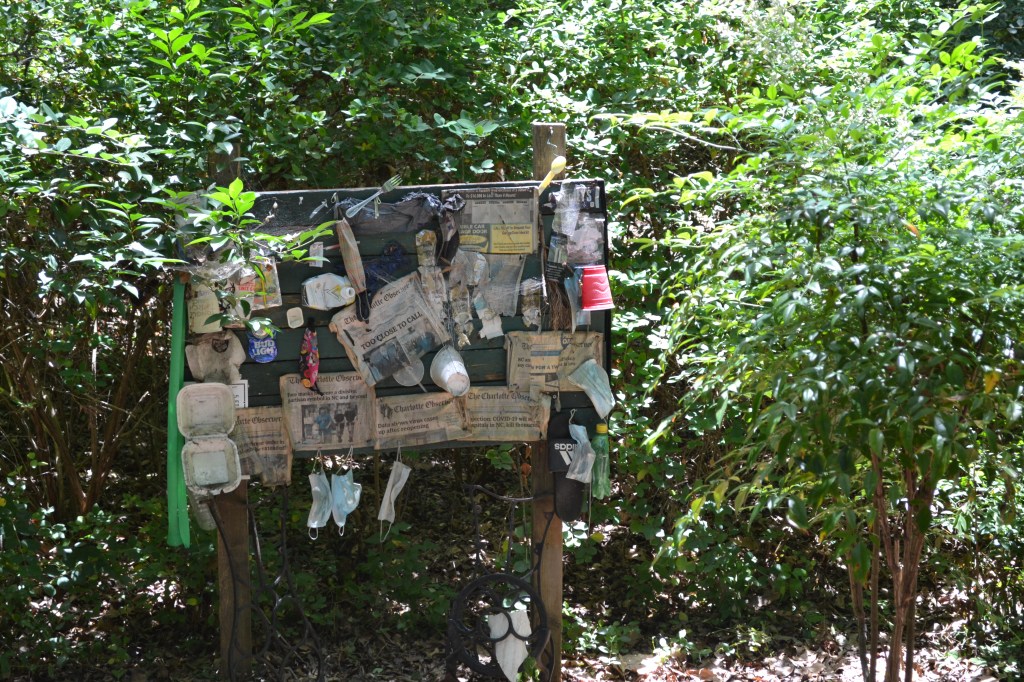
Below are two photos of my trash board: one from early 2020 when I began it and one from today, June 5, 2022. What most people do not realize is that trash endures.

Trash board from early 2020 in the woods behind my house
Trash board as of June 5, 2022

My trash board is an attempt to visualize the staying power of trash. Most–make that all–of the plastic items will outlive me. Small, thin pieces of plastic trash may become invisible to the naked eye but do not decay beyond microscopic balls of petroleum formulations that get tangled into the food chain.

I suppose most people think my picking up trash and putting it on display is odd, but I know from my butt patrol days that it is Army normal.

War in Ukraine

I feel off center due to the second day of a real life television show called “Russia Invades Ukraine.” Ukraine is a country separate from the dissolved Soviet Union since 1992 that has a history dating back to 32,000 BC. My empathetic nature forces me to worry to the point of sleeplessness.

Compounding my worry is pro-Putin/Russia aggression sentiment that centers around former President Trump’s praise for Putin’s aggression as smart and clever. How can entering another country to kill its citizens and destroy its infrastructure be termed clever?

Republicans leaders are silent or supportive in regard to Trump’s cavalier statement about killing humans. Senator McConnell of Kentucky, number 2 to Trump at 1, is limiting comment and criticizing the Biden administration’s efforts in imposing sanctions on Russia in concert with our NATO allies. Live, in real time, as Ukrainians die Republican leadership stands apart from NATO, our armed forces, and Biden.

Unthinkable until this point in my lifetime. The commander in chief should be be given a benefit of a doubt in regard to imposing sanctions and setting up a policy to thwart Putin–at least initially. That Republican partisans want to wound our leader at this critical time seems to be important to them than Putin’s invasion.

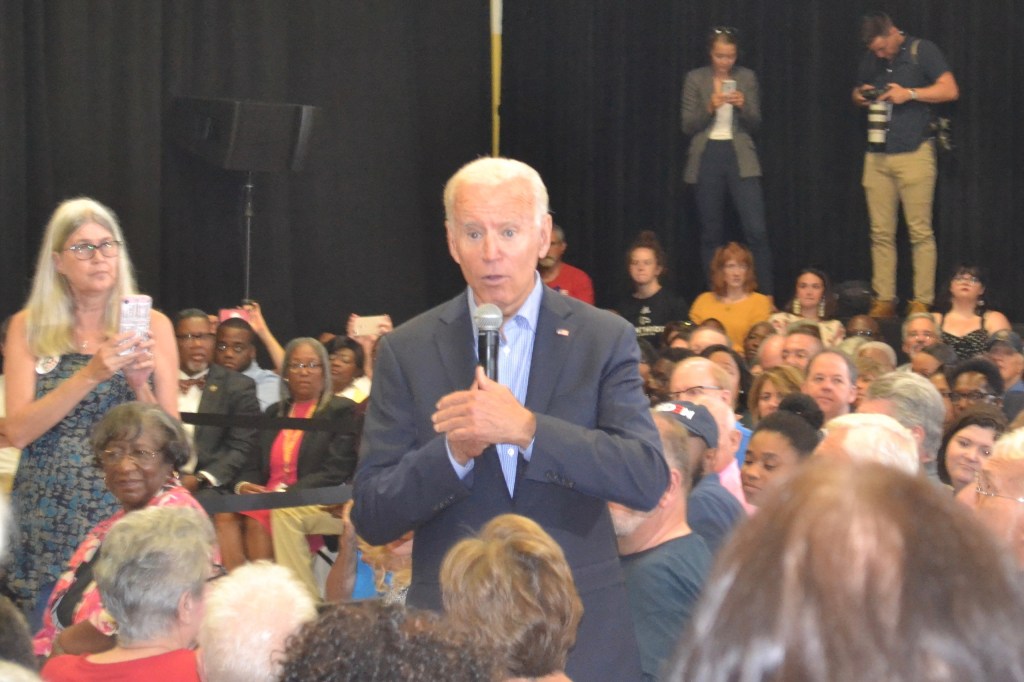
Joe Biden campaigning at Friendship College in Rock Hill

What worries me most is that QAnon, Republicans who purport to actually believe that Democrats kidnap children to eat them, and Fox news personalities such as Tucker Carlson continue to support the January 6, 2021, Trump-led insurrection that attacked the Capitol, terrorized lawmakers, and caused multiple deaths of police officers. Pair that support with indifference to a war of aggression in Ukraine and what does a person logically conclude? Against every instinct, my brain tells me that Republican supporters are capable of supporting a leader like Trump who could do to the United States what Putin is now doing to the Ukrainians.

President Biden is facing Putin’s invasion and the potential beginning of WW III by following treaty commitments, partnering with the 27 NATO countries, and consulting US diplomatic and military experts. He is an experienced old guy political leader who will work methodically and logically to prevent the doomsday that conservative Republican leaders are at best seemingly indifferent to. I hope Biden is successful and I hope that Trumpists do not decide to take over our country. Maybe, just maybe, Trumpists will fade and Republicans will step away from the world of cable news/internet craziness.

The Hottest and Coldest Nights

I have not been sleeping on the ground much these last two years due to COVID, but I anticipate tent camping my way out to New Mexico and Colorado soon. I like working my way across America via two-lane highways to see my daughter who lives in Colorado and to visit national parks and historic sites. I never tire of looking at farms and small towns. My home away from home is two-person REI tent that has been on the ground in 47 states.

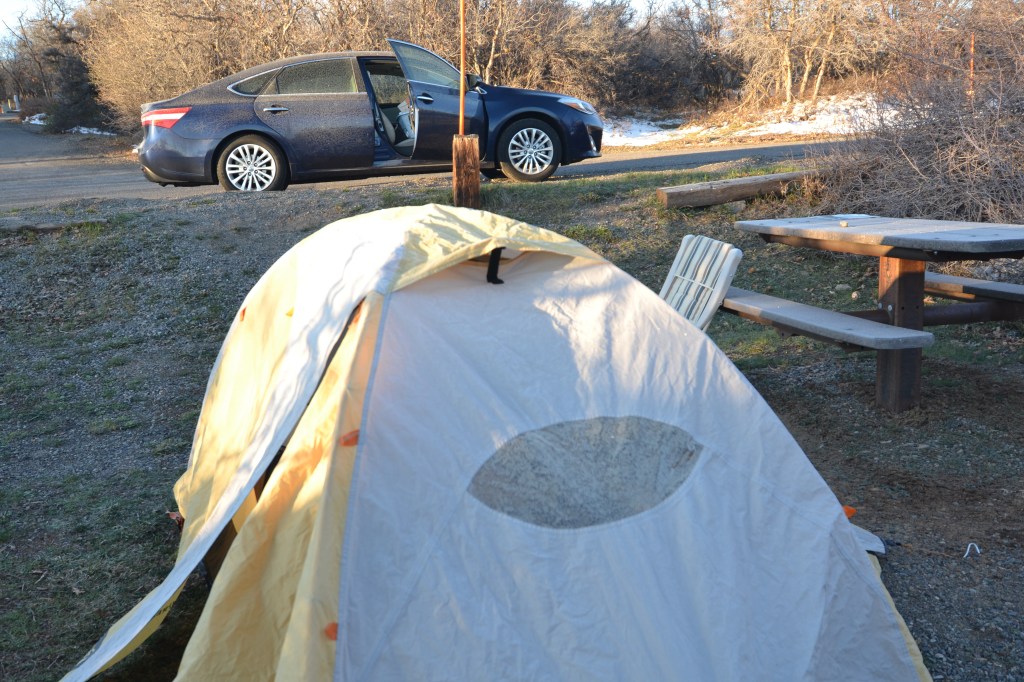
I have spent cold nights in it but none colder than in April of 2014. By that stage of my camping across the country, I was wise enough to to always have two sleeping bags and a wool blanket but not wise enough to know that two bags and TWO wool blankets are a must.

I came up to Black Canyon of Gunnison National Park south of Denver in western Colorado via Montrose where I had visited a hot springs that my daughter Danielle knows about. Montrose and the hot spring were between five and six thousand feet and cold but not freezing the afternoon I drove up into Black Canyon of Gunnison National Park. I was pleasantly warm from soaking in swimming pool size spring of warm water.

Black Canyon of Gunnison National Park

I found myself to be one of three campers atop Black Canyon Mountain. Because I was about out of sunlight, I set up my tent and walked around the three campground loops a bit and turned in as dark and a snow shower settled in. To begin with, I removed one of my outer layers and zipped myself tight into my best mummy bag with my summer bag atop it. I slept fitfully at best adding layers during the night. Worry over snow and cold kept me awake.

What took me back most the next morning when I snapped the photo above was my water bottles: they were frozen almost solid. I used my camp stove to thaw water for coffee and enjoyed my solitude perched atop a sheer canyon mountain that allowed no more than an hour of sun to shine at its bottom.

I like the chance conversations that I fall into with people who like the places I spend my nights. I was on Loop A by myself but came upon a young man on Loop B who was camping in a Chevy Volt. His car led us into a good conversation. Being young and single, the young engineer from Austin took his company’s demise as an opportunity to do what he really wanted to do: drive around America for a month or two before settling into a new job.

My Avalon registered 17 degrees when I began poking around the park beyond the campground at nearly 9,000 feet in the sky.

Valley of the Fire State Park

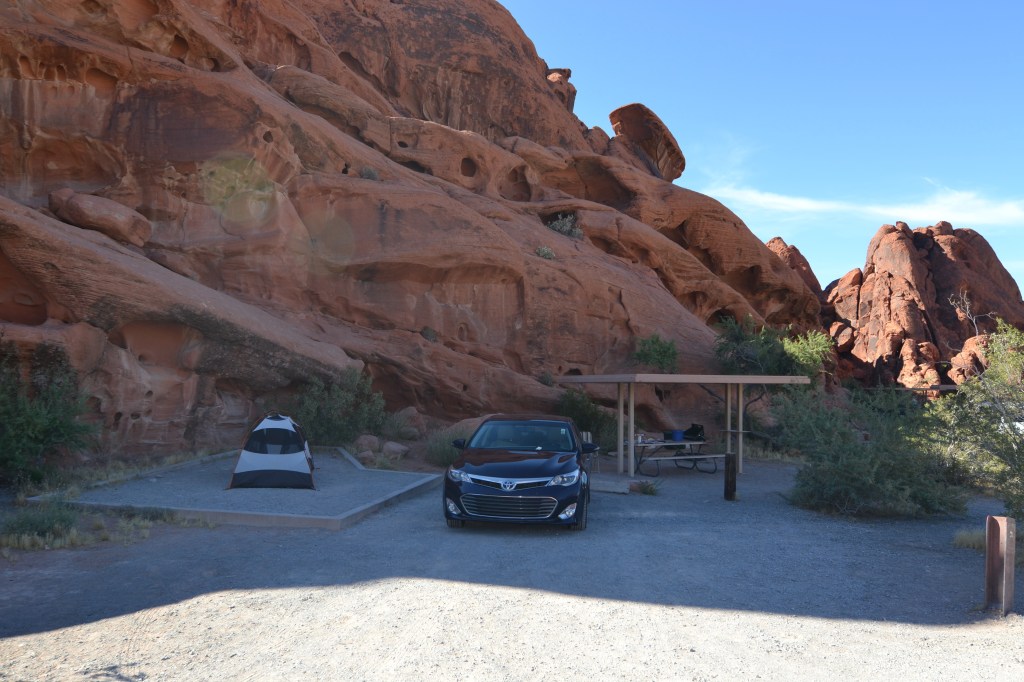
Valley of the Fire State Park is in southeast Nevada near the Arizona line north of Las Vegas. I spent the hottest night of my camping career there on Tuesday, May 20, 2017.

I arrived at 3 P.M. according to my journal, early, and took the time to hike around wearing long sleeves and a broad brimmed hat. Of course, it was too hot to hike but I circled clumps of petrified trees protected by wire fencing. Petrified wood intrigues me. The light was bright white, red approaching the cliffs, and near night black against them.

Arriving early afforded me a chance to pick a shaded sight. I saw 110 degrees at the welcome center and knew that it was dangerously hot, though the dry Nevada heat is not as apparent as South Carolina humid heat. I remember feeling so alive that afternoon in the bright white light but stopped myself from walking after three miles or so. The payoff was a rare bathroom facility with a shower. Cold showers can be just right.

As per usual I retreated to my tent (sans fly) at soon as the sun dropped. I had a view of starlit sky and I saw it plenty because sleeping was difficult. I remember hauling cold water bottles from my cooler near midnight to douse myself with. My journal doesn’t show a temperature, but I guess it cooled to the 80s. I probably should have moved my tent away from the cliff face to escape some of the stored radiant heat and, perhaps, caught breeze in the open.

Sometimes when I have trouble sleeping at my favorite permanent camping site on Ragin Lane here in Rock Hill, I try to remember camping in a particular state at a particular time. These two nights are easy to summon.

Inside My Head at 73

January 20, 2022: I am back at this blog about a year after writing on it last. My idea is to write a record of who I am to come back to for myself that is accessible to others who may wish to know more about me when I die or who stumble upon danielforrest.org on Word Press.

COVID and Trumpism

My life is still limited by the spread of the virus. I am double vaccinated and boosted but many are not, hence the continued limitations that circumscribe my movement. The latest iteration of the virus is somewhat less dangerous than the previous versions. If no new version supplants it, I will enter restaurants again and camp out of state in 2022. Being vaccinated means that I could catch the disease but it would likely not lead to hospitalization.

At my age I try to never be angry but I am. Former President Trump, Fox News, and various other right-wing disrupters continue to spread false information that restrains the influence of factual, scientific data. Because anti-vaccine proponents and Trump worshippers are sealed off in a silo that does not allow rationale penetration, disagreeing with them is impossible. Were I still teaching or a medical worker, I would be a hot ball of anger for sure. Killing others for the freedom to choose not to vaccinate imprisons all of us. Commerce and education suffer needlessly.

The January 6, 2021, Trump-led insurrection based on the plain lie that he really won the election last January damaged the White House and killed capitol policemen fighting off insurrectionists wearing red Trump caps and toting Confederate flags. My faith is America is greatly diminished. An entire society and commerce in general is held hostage by vaccine refusers embraced by former President Trump and his followers.

What I do is avoid others, wear a very good mask, and try not to dwell on what I can not control. In the end I know that the source of the blame is those who voted for Republicans and who think Twitter/Face Book feeds provide accurate information. Beyond that I hope that America will right it itself going beyond insurrection and vaccine denial. I will continue to believe that my individual freedom is fairly and logically constrained by what is good for all of us. Seeking independent factual information is a way of life for me. The Golden Rule is seared into my cortex.

Chinese Immigrants, The O.J. Simpson Trial, Nutmeg, Mammalian Evolution, Poland in WW II

Those are five words from titles linked to ideas that I have held in my head for hours and hours so far this year. They are lifted from two records that I keep: 2022 Viewing Record and 2022 Reading Record. I wrote short essays about the 36 books that I read and 81 movies or television series that I viewed in 2021. My 2022 list is growing.

I am a serious reader and viewer who enjoys science and history. Sometimes I shift through channels to watch old black and white movies that my parents could have seen or snatches of other programs like The Andy Griffin Show. Mainly I stick to serious, worthwhile, critically acclaimed reading and viewing. I am not now and never was an escapist is reading and viewing. My somewhat snobbish approach is likely stems from my degrees in English and habits of a lifetime.

I know more than I ever have. I am well informed and still very curious. Sometime I lament that attainment because I have no audience but I believe being curious is fundamental to being alive. I love ideas, even if they ravage my brain at times.

As per usual Nita and I enjoy some television every night. I watch The Newshour on PBS and Nita joins me form Jeopardy. Then we split and come together to watch something more serious. Last night I watched part of a Nova program about dinosaurs in Alaska. Because I had read Beasts Before Us: The Untold Story of Mammal Origins and Evolution by a young paleontologist named Elsa Panciroli, I was very interested in the hour long Nova program; Nita less so. We returned to streaming The Duchess of Duke Street, a 1976 BBC series about an upwardly mobile cook in Great Britain at the turn of the twentieth century. It is our current joint viewing project.

My brain works by taking in but imperfectly retaining good books and viewing. I then, even against my will, think and think about what I have learned. In can be an affliction but it is part of my constitution. My head turns over the notion that the spice trade, specifically nutmeg, led to the modern capitalistic system etc. I can not stop thinking about ideas.

My Two Cancers

In the last week I have permitted myself to do pushups and pull-ups again. I had a basal cell carcinoma removed from my back in December and another from my arm in January. Surgical excision successfully removed the tumors root and all resulting in a 95% prognosis for being completely cancer free.

For about two months I had to limit the use of my left arm to avoid tearing stitches. I could still walk my usual two or more miles a day but I had to limit myself otherwise. That was not good for my body–or mind. I need to move. So much of who I am is expressed by movement.

Walking to Grocery Stores

Today January 22, 2022, is cold and sunny with a temperature close to 40; yesterday prior to the light snow fall was dark and grey and colder.

Needing nothing in particular other than a change of walking route, yesterday I walked to Food Lion and bought to some bacon and sausage. The 1 1/2 miles took me past the new condominium development. Latino workers were steadily framing the end unit closest to our house in 30 degree weather.

Today I followed the same drill walking on the west side of India Hook Road in the opposite direction to take advantage of the sun that had melted most of the light, fluffy snow. I bought peanut butter, dog food, and beer at Harris Teeter, a two-mile walk.

Walking to the store is unusual around here but I have always loved walking to the store since my days as a boy in Saluda when I could been downtown in short 1/2 mile walk. Am I crazy? Why is what I do so singular?

President Biden: A Step Toward Civility

On Saturday February 20, 2021, President Biden met with former Kansas Senator and Republican Presidential candidate Bob Dole. Dole is suffering from brain cancer and his old colleague Biden visited to pay respects.

The Wall Street Journal reports in “Making Washington Work” (Gerald F. Seib Feb. 22, 2021) that Dole recounted a story about a last-minute pending judicial nomination that he wished to get through the Senate the 1990s. The Senate was about to adjourn and Dole wanted his candidate on the bench, but there was no time for a committee hearing before adjournment.

Was there a way to get her confirmed before the Senate adjourned? Notice what Dole said about Biden. “I believe his response was, ‘Well, if you say so, we won’t need a confirmation hearing,'” Dole recalled. Dole’s desired appointment was a respected qualified candidate and Biden, the Chairman of the Judiciary Committee, trusted Dole’s judgment.

I like that story about trust very much and I like that President Biden took time to meet with Senator Dole. It ties in with the recently deceased Alex Trebeck’s special theme in his last season of Jeopardy. The master of agreed-upon-facts emphasized the importance of building “a kinder and gentler society” as he faced his own death near the 2020 election. He often ended his show with the statement about building a kind and gentle society.

Bruce Springsteen and Barack Obama have set down a series of conversations about their lives and the nature of our current society in a podcast series entitled Outsiders: An Unlikely Friendship. I find myself laughing out loud and being moved to tears as I listen to them talk about friendship and society. They are putting into practice the civility that the recent Biden–Dole meeting demonstrated and that Trebeck emphasized in his show business career.

We can have a civil society. Conversation is possible. This weekend will see former President Trump making his first public appearance at the C-PAC meeting. What will his remarks be like? Will they be civil and factual? I suspect they will return me to the hateful division that I am just now getting over one month into the Biden presidency.

Do I think President Biden will be a very successful president. No. Our country is too divided for him win the support of the opposition, but he will try. He will be a civil president who puts unity above division and that pleases me.

Stories on the Edge of My Memory

Rainy, cold, gray. I am back at my blog of sorts, a document I keep as explained in “What I Plan to Do with danielforrest.org” at the top of my homepage.

I add to my primary reason about wanting to provide access to who I was after I am dead another reason: I want to remember myself and I feel that self fading with age. I lose grasp of who I was and what I did.

A Cold Day in the Pole Orchard

In the winter of 1972 I had moved from Fort Jackson to Fort Gordon for my advanced individual training (AIT): pole line construction. AIT was like returning to USC in a way: class after class in a big building. The culmination of learning how to climb a telephone pole was hands on in the pole orchard.

My guess is that it was about five poles by five poles wide each standing about ten feet apart. Being Fort Gordon it was sandy and there might have been some wood chips on the ground that was not soft.

Its firmness was in my mind as my final climb came. I had done my progressive short climbs partway up and had various instructions shouted at me. Rule one is to watch the angle of your body relative to the pole. The climber should always lean out and never allow his body to form a parallel with the telephone pole.

That knowledge works against the immediate tendency to go up straight or lean in as the gaffs attached to inside of your combat boots bite wood. The belt helps. It is slid up after each two steps but to slide it up requires a quick release of the tension formed by leaning out.

My pole was a mess. It looked like a small child had attempted to hatchet it down top to bottom. Splinters bloomed everywhere. My instructor warned me to be careful and the prior training photos of badly scarred arms from a burnout were fresh in my mind.

Half of us were finished and I was at my last step and among the last to prove out. All I had left to do was to go all the way up to the top, get comfortable, lean out, remove my service cap, and set it on the top of the pole.

Once it was atop the telephone pole, I was to await an all clear to retrieve it and work my way back down.

I do remember it being on the top of the pole. Vaguely I remember the quiver present in my tired arms and legs. (Climbing a pole using gaffs is very hard work.)

I do not remember my slide down. My fatigue jacket was torn and my arms were burned and bloody. I must have remembered to work back against my belt some as I slide because I was able to stand at the bottom still hitched to the post.

I do know I was shaken and tired but no matter. A quick review of my situation by the training officer led to the following indirect order, “What are you waiting on Forrest? Go get it.”

I went back up successfully as tired as I was and donned my cap and climbed back down without gaffing out. For over 48 years that memory has hung on the edge of my memory. I wish I could recall more about what went on in the manner of video recording so that I could elaborate but most details are faded from memory.

Marsha Cockrell’s Blue Bike and the Old Elementary School

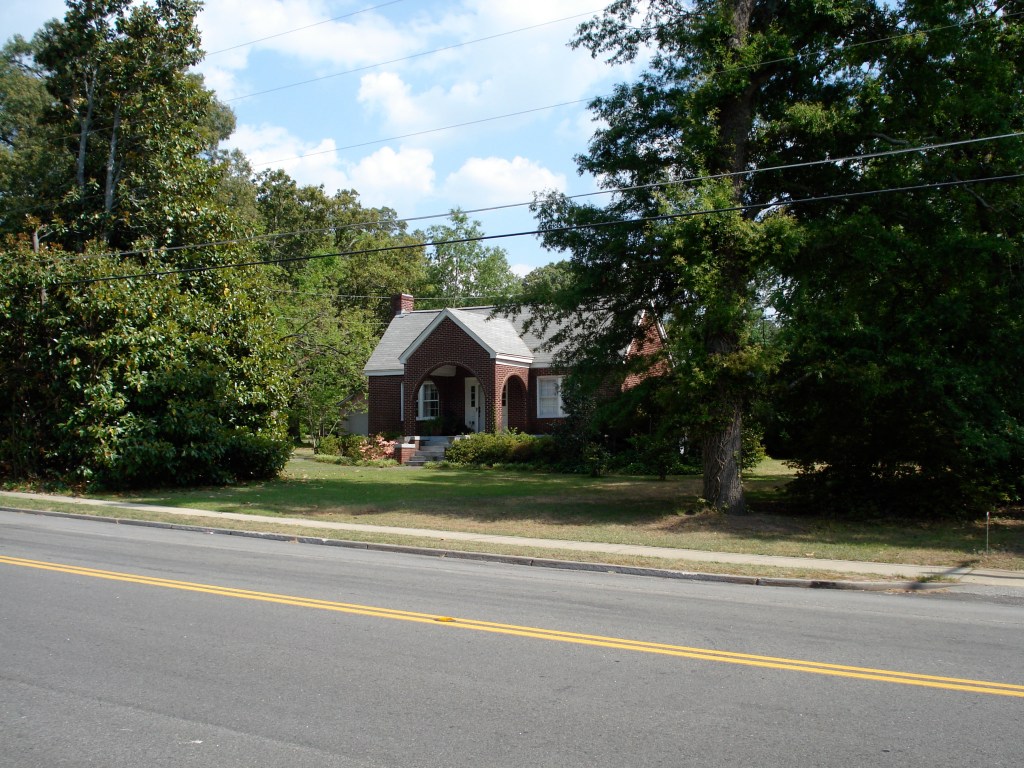
I lived mainly at 513 West Church Street, Saluda, SC for my first 18 years. I remember the path behind my house near Preacher Padgett’s hunting dog pen along the side of our garden. That is where I cut through to the Cockrell’s yard on the block behind my house. Once on W. Eutaw Street I walked east on my way to my first grade schoolroom.

513 W. Church Street, Saluda, SC

I looked forward to the rough macadam road giving way to wider, smooth asphalt just at Bonnie Boland’s house. From there I would sometimes be joined by other walkers. Walking to school was a cool big deal to me in 1956.

Saluda Elementary School was a three-story brick building facing South Jefferson Street and on it last days. During that same year we would be moved to a new low slung modern building adjacent to Saluda High School.

My walk led me to the school beside the unattached cafeteria building behind the school at the intersection of Eutaw and North Calhoun. I liked that spot because it dipped deep on North Calhoun leading up to W. Church where Ben Hazel’s boarding house stood. Sometime I would walk back that way.

Where the bicycle was parked escapes me as does who I was with that day after school. We got out early and for some reason I took the blue bicycle. Who was with me? I have lost names but I think there were three of us involved. We likely just walked by the parked bike and took a notion as we headed home.

I think I was dared to hide Marsha’s bike. I remember walking it, not riding it. It may have been too big for me.

I took the cut toward Ben Hazel’s and scooted off the road to the right. Who helped me? Not sure but I put the Western Flyer in the big culvert that ran under the road and pushed it partway under.

I had been in the culvert before and even walked all the way across under North Calhoun on a dare. Was it a dare that prompted me to stash the bicycle?

Were I old enough for crushes, I would have one on Marsha, who was years older, a tall black-haired pretty girl. My belief is that I did what I did per someone’s dare, certainly not out of animus for Marsha.

When I got home, I did what I always did: put whatever tablet and pencils I had down and went out to play. The days were long enough that I did not get questioned in regard to my crime until close to sundown. Witnesses, phone calls, inquiries? No doubt a criminal investigation ensued while I went on with my after school play.

At about the time I should be squared away from supper and headed toward shared bath water with my brothers, I was on the ropes. My parents needed to talk to me. Asked, I broke immediately under the questioning.

A spanking would have been a given but I lose my memory beyond confession. I think the event comes to my old man’s head because I felt so bad about what I did. To this day I have a propensity for guilt–even about minor events in the last century.

Bloody Sunday February 25, 1968

Nita says we ate with my mother and younger brother in Saluda on that Sunday. She remembers her stomach hurting but put her pain off to eating something. She said she remembered Cally acting odd. Apparently we headed back toward our Newberry home after stopping by her parents’ house.

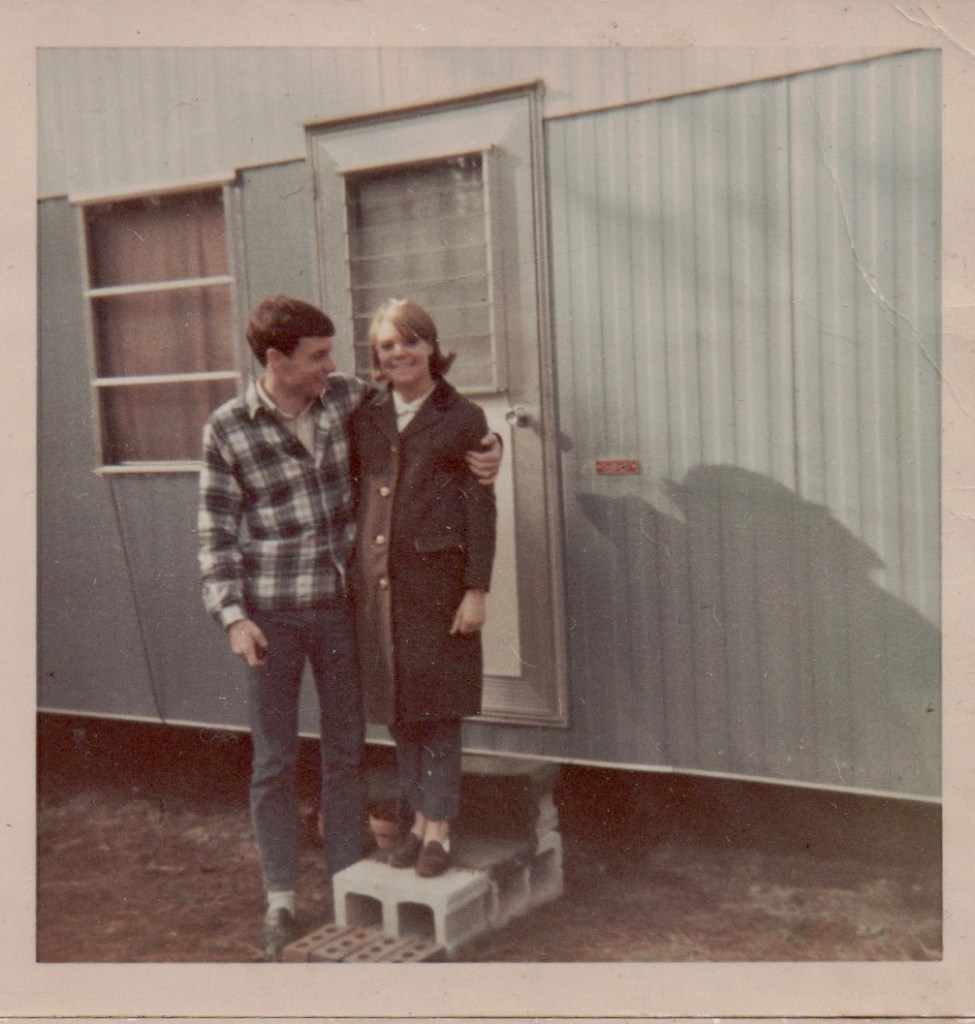
12′ X 47′, our Park Avenue mobile home in Newberry

She says that on the way back to Newberry Bobby Shook drove up behind us, flashing his car lights. We pulled over and I got out to talk along side the highway. No memory–edge or elsewhere. She says he followed us back to Buddy Neal’s Mobile Home Park beside the Newberry airport where we lived.

Her memory is going back to the bedroom to lie down while Bobby, a friend from earlier days, and I caught up. “I was back on the bed suffering and you and Bobby were laughing and talking the evening away,” she told me recently. I worry about my mind because none of that comes back.

What does come back is pulling up in front of Dr. Sawyer’s office across from the agricultural classroom building next to Mathews Field. According to Nita we called and he agreed to meet us at his office. Her stomach pain had blossomed into “I think the baby is coming.”

I saw four or five cars there with people standing around. I left Nita temporarily to go inside and that’s where I came upon blood on the floor, the door and all over people’s clothes.

My pregnant wife was not Dr. Sawyer’s only patient. Knives or razors? I was thinking razors. So many bodies and so much blood. Cars parked haphazardly; people whispering. Dr. Sawyer must have already stitched up several bleeding victims. He emerged from a backroom and told me to bring Nita in.

I think that visit must have lasted less than five minutes altogether. What I clearly heard, what I clearly remember was a sentence something like this from the unflappable, laconic, short Dr. Sawyer, “Get to Self Memorial fast.”

I had just driven 25 miles back to Saluda and faced a 30-mile drive to Greenwood. Nita was going to give birth to my son Chris. We may or may not have dropped by her parents again before heading out of Saluda fast on Highway 378.

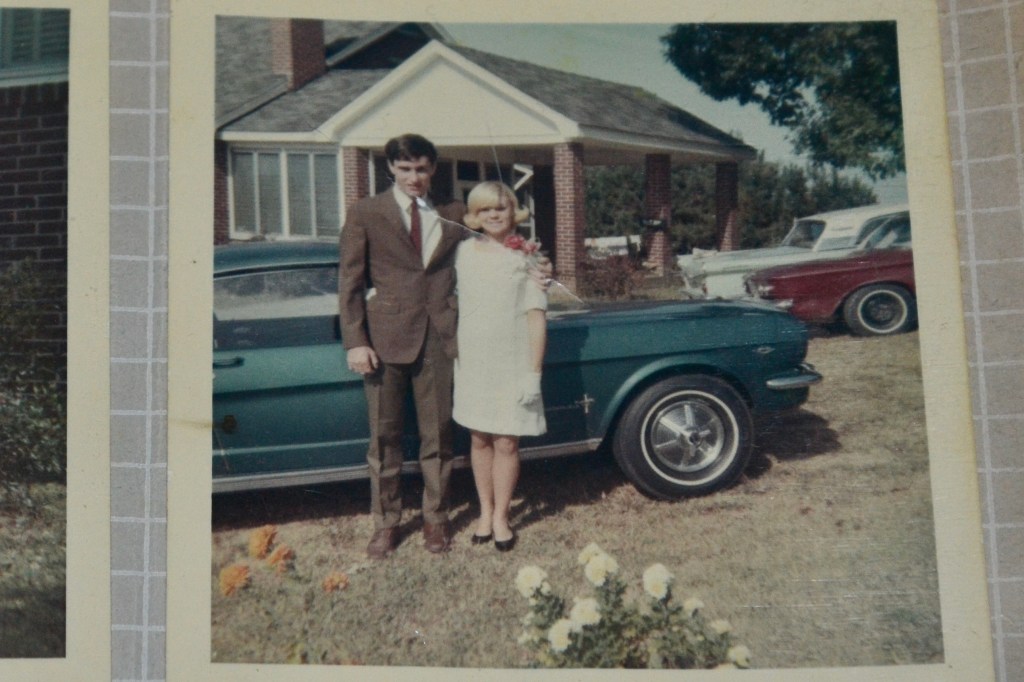
Nita and me on August 6, 1967, our wedding day

The Mustang we drove is just behind us in our one and only wedding photo. It looked like a good car to drive fast but underneath it was just a Ford Falcon, a big economy car, and I never liked going fast. With Nita’s condition in mind as well as Dr. Sawyer’s command, I drove close to 75 for most of the trip. Highway 378 is from Saluda to Greenwood is curvy. I had in my head one particular curve where my brother Butch had totaled a Ford Galaxy a few years earlier.

I pushed 80 mph on straight stretches but my 1965 Mustang was a former wreck that vibrated at 80 and above. A shaky steering wheel gives a driver pause.

I remembered to go straight and not turning as usual when we got close to Greenwood. My memory of stopping in front of Self Memorial is clear as is the car shutting down as we drifted into the visitor parking lot. Somehow Nita walked along with me and the bag she had packed to the front door to check in.

Chris was born a few hours later in the early morning of February 26, 1968. Nita was fine. I could not have been happier.