Seeing Myself Via Time Stamp

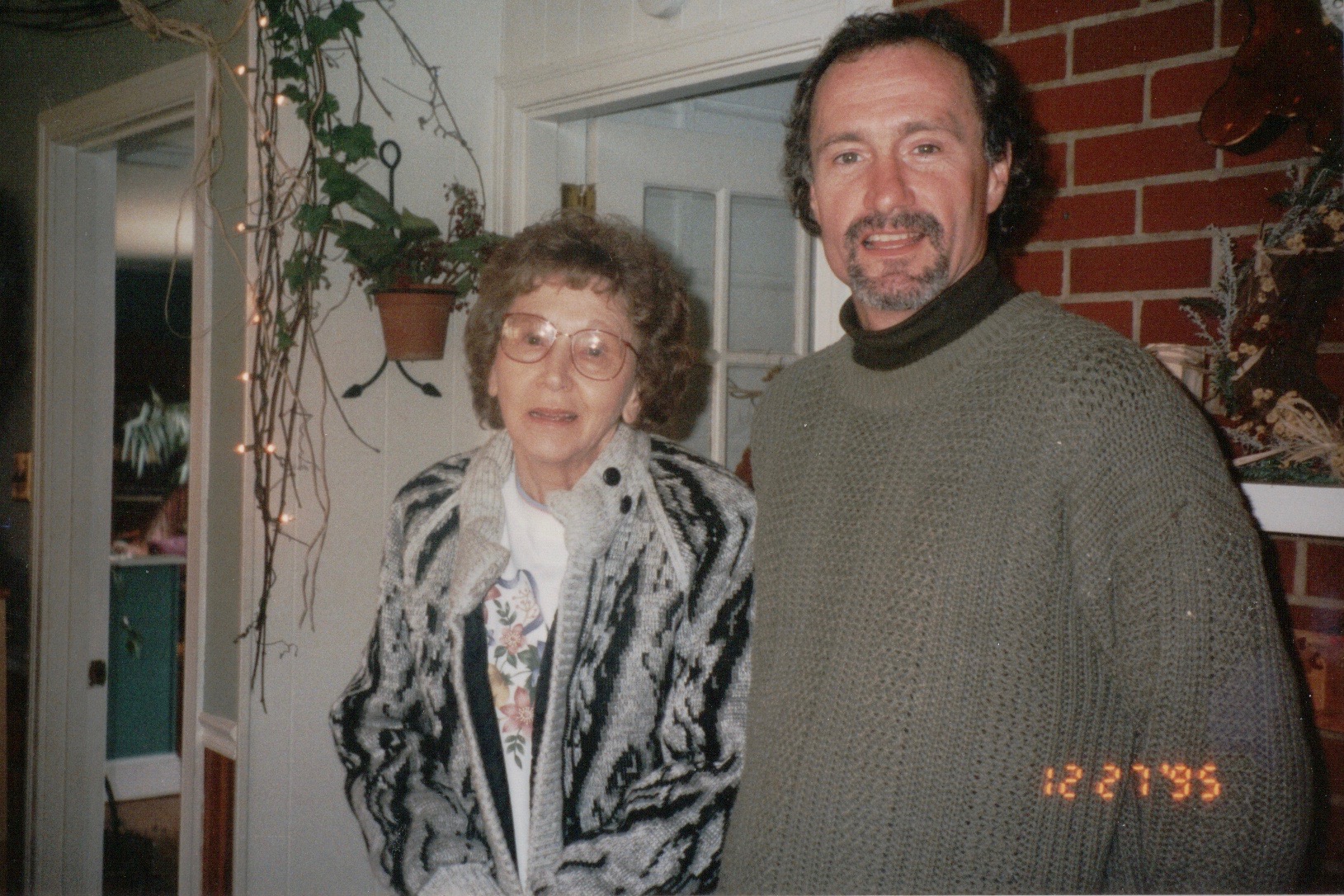
My mother Leona Irvin Forrest Barnes last visit to my home
My mother died in 1999 at 76. In the photo above she was 72 to my 48. I am now 70. Leona had suffered two heart attacks and was residing in Long’s Nursing Center in rural Saluda County. My memory is vague but I think I picked her up and drove her back on 12 27 ’95 so that she could sleep in her own bed that night.

I wish I could command my memory to give me that day back again. My old adult self craves knowledge of my deceased parents. The most salient fact in my mind is my own age relative to hers. By her measure I am not long for my life on Earth and I like thinking about that.

Realizing the shortness of my likely continued existence makes me appreciate the life I have. Unlike Leona, I have good health as far as I know but I like knowing that I will more than likely die soon. Internally I operate as if I am the younger version of myself in this photo. I see myself in the future and I am planning yet another camping trip out West to see Bend Bend National Park.

The time-stamped image sharpens my desire to appreciate my limited time and reminds me that what I perceive as me internally is not what others see. I am a lucky old man now who is using danielforrest.org and dmforrest.smugmug.com to lay down a record of who I am and was in case those who reside on this planet after I am gone care to discover me or remember me.

Advance Obituary

Daniel Miller Forrest died [date] due to [cause of death].  He was born in Greenwood, South Carolina, in December 1948 and lived most of his youth in Saluda, South Carolina.

He moved to Rock Hill in 1972 after graduation from the University of South Carolina and fulfillment of his active duty military obligation.  He taught English for 34 years and held a wide variety of other jobs.

He and his high school sweetheart Nita P. Forrest were married [years] and had a son, Chris, a daughter, Danielle, and two grandchildren, Hannah Forrest Bailey and Grace Forrest.  Next to his family he loved nature, art, and intelligent public discourse most of all.

He was fond of saying “I have had a full life and in no way deserved all of the advantages I fell into by virtue of my birth in the right country at the right time.”  He often remarked that he felt a kind of guilt for being a lucky American with more than adequate material possessions and good health.

He did not believe in God but had an abiding faith in humanity.  He intended for his websites danielforrest.org and dmforrest.smugmug.com to survive him for a while as a way for people who remembered him to know something more about how he lived his life and what he thought.

He loved to camp and pre-selected Site 178 in Passages I at Kings Mountain Preserve for his permanent camp site in death.  His favorite charity was the United Nations World Food Programme (WFP).


Yards of My Youth

I reached 70 yesterday (December 20, 2018) on a very wet day that kept me from being outside much.  Unusual because I spend most of my time outside.  I am a better truer version of myself out from under a roof.

Whitey’s Place in Bellwood

I remember a yard that was part of my temporary home in Bellwood, Pennsylvania, not far from Altoona and on the way to Horseshoe Curve.  Coming to the dirt road that led to it meant beginning a steep ascent on a paved road and turning suddenly on the beginning of a curve into steep descent.  (I revisited the somewhat changed location a few years ago.)

About forty yards down the first turn was left and into the yard of Whitey and Pearl.  She was Pearl Irvin White, my mother’s mother now married to Whitey who looked like an aged Charles Bronson to me.  My mother plucked us down there during one of her departures from my dad Harold in Saluda, South Carolina, my main home.

The driveway was one-lane wide and split in two about twenty yards away from the blue mobile home with an awning and two doors.  To the left was Whitey’s hut or workshop and home away from home.  He spent lots of time there because he was old and sick and did not care for the visit of a runaway daughter and her brood of three.

On the left was an improbably colored blue and darker blue DeSoto, a massive chrome masterpiece.  Going near it was verboten.

The thing to know about the whole place and in particular the yard adjacent to the driveway is that is was low, tree covered, but next door to a swamp.  Walk down the driveway and turn left–which my brothers and I often did to stay out of the way–and the dirt road that brought me to my Grandmother White’s house gave out at a pond that was some sort of recreational fishing club with one or more buildings.  During events we were not to go down there but most of the time it was part of my ten-year-old stomping ground.

I remember walking to the nearest store via the main road.  It had no shoulder and we had to be careful to avoid cars and falling down the slope.  An alternative was to cut directly up hill behind Whitey’s hut and weave through a neighbor’s yard, which was frowned upon.

The store was less than a mile away and directly adjacent to the road the way stores were not in Saluda.  It perched on the side of a hill and hid a residence underneath.  Like all country stores of my youth, it was dark with a dirty concrete floor and a variety of tempting treats.  Hands down, my favorite was birch beer pop.  In a returnable bottle of course, it was clear.  I marveled at being able to see straight through the bottled liquid that was heavy with a kind of root beer taste and so, so fizzy.

The eight-foot wide trailer was blue, white, and chrome with a sweeping modernist flourish that seemed to make one end rise up.  My slot in that rectangular space was an upper bunk bed just past the kitchen on the way to the bathroom.

I remember the cozy wooded quarters that I entered every night but not as much as the swampy yard and its surroundings.


513 West Church Street, Saluda, SC

My guess is that the primary yard of my youth was 75 by 150 feet.  The driveway was left front near the Padgetts.  How many thousands of times did I chase a ball down its slight slope?  I had to fix in my mind the prohibition to keep running directly into the McCormick Highway to avoid being run over.  I did stop a car at least once.

Say three car lengths up the drive, the house started on the right as did my mother’s rose garden on the left.  That ten-foot side yard sloped a bit back towards the Padgett’s and was hedged with ligustrum, which I was regularly sent to pick switches from for routine whippings.  The histrionics and red whelps associated with those is another subject.

Sometime when I was several grades advanced in elementary school, some fill was brought in to park a second car on the spot of the disused former coal pile dump; before that we had just one vehicle that is clear in my memory, a black 1953 Chevrolet BelAire, that was squeezed each night into the narrow garage just beyond the house on the Padgett side.  Beside it was our fig tree and behind was a rocky garden that ran the 75 feet width of our lot.

At one time I believe our house lot was a repository for highway department gravel hence the rocks.  I spend so much time in the garden, weeding, playing, peering beyond to the Padgett’s dog pen or the trees that obscured the view of the Cockrell’s home behind ours.

The backyard had a crabapple tree that always yielded an abundant crop that my mother Leona turned into jelly with a twang.  The only tree in the back was the location of a sandbox that I spent as many hours as a modern kid does playing video games.  I loved building roads to push my trucks along but my favorite pastime there was hauling a sand bucket of water to sprinkle on the sand for frog houses.  I was a master of frog house sand construction.  I can still see the outline of my imprinted fingers in the golden brown sand.

The Hipps lived front right and had a working farm on their place which was twice our acreage as it extended to road behind Church Street.  They raised pigs, chickens, and cows on a lot covered with small barns and had hardwood trees along their property in the front that complimented our two big pin oaks adjacent to their driveway.  I used to spend hot afternoons under our trees watching the dozen or so cars that might pass per half hour, getting up to pump my arm to receive a honk from a passing truck bound for Georgia via McCormick.

If I heard  a jet in the air–a rarity and always military–I darted out to the middle of our small front yard to trace its contrail with my head tilted up until I could no longer hear or see its wake.  Jets and my front yard and riveted in my mind.  On a good summer day I could see a jet and stomp the black, pink, green and yellow hard husk grass hoppers that appeared along the front side walk. The mashed guts of the stomped creatures rose between my toes.

The shade of those twin oaks reached nearly to the angora juniper that brought me back toward the Padgett’s and the edge of my driveway.  I remember my fascination with staring over across the front field of the Mathews’ place across the street into bushy growth that surrounded Old Luke’s tenant house, a tar paper covered shack.

He and his wife were leftover sharecroppers and servants and the only black people in my white boy’s world.  I could, and have in another composition, go on and on about Old Luke and his daily walk up West Church to the liquor store but that takes me away from my yard.

My small yard went away as such by the time I started walking about a mile to elementary school and from that point on I owned every yard in my Mayberry-like world of Saluda of the 1950s.

Altoona Trailer Court

I believe I was in the fourth grade when my mother seemed to leave Harold for good.  The yellow and white two-tone 1958 Chevrolet Nomad station wagon was strangely backed into the drive.  We were stopped and a discussion ensued about Cally’s place within the green interior versus mine.  Butch, of course, was up front with Leona.  The interior was crowded, the afternoon was passing, and we were about to become Yankee residents of Altoona, Pennsylvania.  I took a slot among the luggage in the back and on we went to a new life via a straight-through all night drive.

We moved into a trailer court about a half mile from my maternal grandmother’s home on LeHigh Lane.  We were at the edge of the neighborhood where the homes gave way as they climbed up the low mountain.  Our trailer was the third or fourth on the right side of the one way u-shaped gravel drive through the court.  A college basketball player could have lain down and stretched to join our silver Airstream-type trailer to the next up or down.  (I have written about that home in a composition entitled Houses I Have Lived In.)

What I remember most about that slit of a yard was the empty tree-covered land that gave way in the direction of LeHigh Lane before the field and the dirt road that led up the mountain.  I spent my time in the trees behind my new silver home.  They were superb for climbing and exploring.  To this day a hike in Appalachia always yields a bit of what I internalized in that dark place.  I reckon I felt comforted.  I know I was happy.

So there was no real yard there but I could climb trees and walk the bent road to see all the other shiny metal trailer houses.  Other than the cement block steps, which I replicated within ten years when I brought my own trailer home, my most vivid memory is walking out of the yard on a snowy day through drifts that wet my new Lee jeans up to the knees turning my skin blue toward the bus stop for school about half a block back toward LeHigh Lane.

How cold and wonderful it was to be outside making a path through the snow squinting to see who was already at the bus stop.


Park Avenue Yards

Just after high school graduation at age 18 I gave up Smith Holmes, my designated Wofford College roommate, for my new pregnant bride.  I have never regretted the roommate swap and was swelled with pride in my new life with my son Chris on the way.

Nita and I got out of her upstairs bedroom on Hazel Street by buying a 47 foot 12 wide blue and white Park Avenue trailer with front Jack and Jill bedrooms.  It is still my favorite house. We moved in November of 1967.

Its first yard was under a stand of pine trees adjacent to the Newberry Airport.  I treasured the little time I had outside from my work at the local Red and White Supermarket and studies at Newberry College.  We admired the the surrounding trailers and wondered about their interior layouts.

Our yard was pine straw-covered dirt and narrow and particularly pressed on on one side by a neighbor’s fence.  Directly in front where the hitch jutted out I built a wooden enclosure to secure our two metal trash cans.

I parked our beloved 1965 Mustang just a few yards from the door.  Rambling around my space, my rented yard, was my third best outdoor activity there.  Second was to roam around the empty space out back and in between the near perfect circle of parked homes.

Best of all was to walk along side the paved road by the airport to study the small planes. It was a fine place to walk with my bride.

That summer of 1968 I borrowed Mike Steven’s mint green F-150 to haul my trash can holder and pile of blocks that formed our front and back steps for a move to 2006 Dew Avenue, West Columbia.  It rode so high up going down I-26 that I had trouble holding the road and seeing the way to my new spot for the next four years.

I was waiting for the Park Avenue when it arrived in J.W. Hendrix’s mobile home park, a more compact location in the white sand that said beach more than it did Piedmont.  There I had a king of yard covered with Saint Augustine grass.

We planted canna lilies out front and I bought a sprinkler to water new grass that I sowed out front where I parked parallel to my castle.  All was well and got better.

We had a cement patio out front and I built a sandbox outback for Chris who was too young to master frog houses.  He rode his plastic motorcycle around and around the trailer, stopping occasionally to turn the handle behind the handle bars to make an engine sound that delighted him and me.

From that yard I walked a few hundred yards to catch a green and cream-colored SCE&G bus to USC three days a week.  When I came home, I jumped on my bicycle to ride to work a full schedule at Piggly Wiggly #60 on the Augusta Highway three or four miles back toward Columbia.

I suppose my youth ended there but not my love of yards and being outside.
Face of the Dam

I put my kayak in on the Fort Mill side of the Catawba River yesterday and tried to reach the dam for about fifteen minutes but let myself give up to rest my arms and drift back into the abnormally high water that had formed a temporary lake on the same side of the river.  I got lost in light and in pointing my camera at creatures for an hour.

I tried for the face of the dam again and made my way close to shore to escape the current until I reached the zone at the base that pulls left, right and oddly toward the dam.

The water is fifty feet deep.  The dam is higher.  The sound of falling water is that of a visit to half a dozen waterfalls at once.

I got close enough to touch the wall and just sat there in water that throbbed up and down like the backside of a big wave.  Afraid.  Entranced.  Satisfied.  At peace in the shadow of the Lake Wylie dam on a sunny February day.

Trump’s New America

I came of age as the Civil Rights struggle matured and I identified with Martin Luther King and that struggle as I morphed from a boy to a man.  I suppose that makes me a liberal though I have never thought of myself by that label.  I was and still am for Civil Rights.

I came to love my country deeply during that time.  My love for America has increased as I have aged.  By fortune of geography and historical timing, the United States became the greatest country in the history of the world.  Not superior but for sure special.  Everyone not of pure Native American blood is an immigrant and, truth be told, Native Americans immigrated in pre-historic times themselves.

The heart and soul of America is the notion of a new man in a new land.  We are an immigrant nation.  President Trump and his supporters subvert that notion by preventing immigration reform and demonizing immigrants, most of whom are more law-abiding than established citizens.  Our national debt has been run up to unsustainable levels by a tax cut that benefits the wealthy.

Today President Trump is calling for an unprecedented military parade later in the year and had wished to arrange one for his inaugural.  Supreme Commander and former President Eisenhower must be rolling over and over within his casket.

Trump is thumbing his nose at the goodness of America.  We are not Soviets or North Koreans.   He claimed that a new record for a State of Union speech was set a few days ago when he spoke.  Not true.  He called the Democrats who did not applaud his words during the address “treasonous.”  Within the last few days he belittled the Democratic Leader of House Intelligence Committee by using the word little before his name and called him a liar.

Trump is outrageous beyond belief and challenges my view of my own country.  We have never had a demagogue beloved by 40% of the population before.  My faith in my country is sorely tested by his Presidency.  What kind of new man are we becoming under the leadership of a billionaire bully boy?

Three Terms that Irk Me

“Single mother.”  I like them individually.  I like married mothers.  What I do not like is the response that “single mother” is understood to immediately provoke:  a brave soul who must endure a special hardship.  Women should conceive children within the confines of a marriage or partnership.  The success of children depends upon adequate care.  Children are meant to have two parents.  Children are not meant to be the burden of a lone parent who most often needs the resources of the state to raise the child.   I care about all my fellow human but I have no special sympathy for the many mothers who decide to bear children without a permanent partner.

“First responders.”  Part of a typical news show format is to feature first responders as a breed apart.  Paragons.  Always valorous.  Most policemen and women, firemen, and paramedics are admirable service-oriented people.  I respect them and appreciate the dangerousness of their jobs.  I remember being in awe of the firemen from Dennis Smith Report from Engine Company 82 when I read it in my youth.  I am still capable of awe but cops, firefighters, and paramedics are very much normal people.  They are not paragons automatically worthy of worship; they people with dangerous jobs.

“Wounded warriors.”  I was in the Army.  I was not wounded.  My father fought in WW II.  My grandfather fought in WW I.  Soldiers of all stripes interest me.  I am interested in their jobs, duty stations, and equipment.  Yet I do not genuflect when I hear the utterance of “wound warriors.”  I do not like the false patriotism that the term brings to mind in a Joseph Heller Catch-22 sort of way.  In our times soldiers are people who follow a career path and willingly submit themselves to the policies that political leaders set forth.  Just because someone served in Vietnam or Iraq does not sanctify that person in my eyes.  I respect their service even in the cases of deployment that I do not admire.  Vietnam was such a case as are most of current deployments in the Mideast.

President Trump and the Resurrection of Racial Division

I have trouble remembering my life in the segregated 1950s and 60s.  People who are half my age and less must think of those times as just so many cowboy and Indian stories.

I saw movies at the Indian Chief Movie Theater next to the courthouse in Saluda.  Colored people or niggers as they were routinely called could only sit in the small balcony in hard seats.  I sometimes ate in Frank Hite’s cafe with its twin doors; the right hand side was for colored people.  None of my classmates from the class of 1967 were African-American.  I lived in a racially divided world.

Racial division exploded with the big city riots of the mid-1960s.  Segregationists like Senator Strom Thurmond championed the benefits of separate but equal.  The modern racist Republican party was born to thwart the work of LBJ and MLK.

The leading segregationist of the era was Alabama’s Governor George Wallace.  He is back in the form of President Trump.

I broke out of my childhood bubble at about twelve and adopted the cause of MLK as mine.  My world view was formed in the fervent belief that all humans are equal and much more alike than different.

For me reliving the re-popularization of racial division is painful.  The new segregationists are feeding the beast that led to the Civil War and pulled our country apart in my youth.  Trump is their momentary triumph.

His revival of racism will continue to  wake me up at night and darken my life but it will fade.  Racism and segregation is a walk backwards and young people will not see the attractiveness of the modern Republican’s revival.  They will walk forward.

Trump’s legacy will be the giant tear in the fabric of our country that will take the death of his–my–generation to repair.   Racism could re-emerge but the possibly of its thriving in the twenty-first century as a popular political expression in the United States is likely impossible.

My hope is that as we come to repairing the big rip created by President Trump’s election  a more unified country will emerge.

My Trash Twin

I usually keep one or more plastic grocery bags in my pocket.  On my daily walk around the neighborhood, I pick up trash.

I got started in a big way more than ten years ago when I would use big garbage bags to collect trash around my neighborhood every few months.  I would then circle back in my pick-up to take it to the recycling center. In the last few years I have started picking up trash each time I walk.

I think I first began this habit in the 1970s when my son was a child.  I would pick up trash but concentrate on aluminum cans.  I needed money to supplement my teacher’s wage and we had fun being outside.  He would trail along on a bicycle.

Now I pick up trash out of habit.  I have formed a kind of need or compulsion to do so.  At times I have photographed outlandish juxtapositions of items.  I once found a hundred dollar bill.  I have picked up cartoons of bullets and various electronic devices.  Maybe six or eight times, I emailed photos of my trash finds in an attempt to amuse or astound people.

Motorists do not understand the volume of trash along our roads.  What you see at road speed is just a tiny fraction of trash.

My far neighbor on Ragin Lane is in a wheel chair.  Once he and his wife stopped to thank me.  No once else has.

Yet I do what I do because it satisfies me to see a clean shoulder.  My dog Sun accompanies me on most walks, and we sometimes have short walks when we do not pick up anything.

Today I read letter in The Charlotte Observer about David Bradley.  He is moving from Charlotte to Brevard; the letter writer thanked him for picking up trash in his neighborhood.  He keeps a blog entitled pickupyourpath.com that details his walking work.

He plans to transfer that work to Brevard.  I checked his blog and emailed him to say he had a twin of sorts in Rock Hill.  I like knowing that I am not the only crazy old guy doing what I do.

My friend Barry Neal does what I do on his road along Lake Wylie.  Maybe there are more picker-uppers than we know.

January 12, 2018

Two Wishes

I remember being a passenger in a car full of teachers back in the 1970s.  We had been to a meeting in Columbia, SC, as part of the South Carolina Education Association.  Six of us shoulder to shoulder in someone’s sedan.

“What would you wish for if you had one wish?” posed our driver, a lady named Pat from Fort Mill.  I remember what I said. “A Corvette.”  Conversation flowed and time flew.

I only recall one other answer. “Money to buy all the groceries I want in the supermarket” or something close to that.  I was struck by that humble longing and felt a little ashamed of what I had offered up and said.

Today’s wishes:

Banish Nita’s pain.

Have the magic ability to speak other languages and place myself in another country for a few weeks with my language ability.  I would love to drop into China and see into the rise of the new leading country of the world from the perspective of a native speaker.


Anecdote of the Jar: A Poem That Came Back to Me Decades Later

I placed a jar in Tennessee,

And round it was, upon a hill.

It made the slovenly wilderness

Surround that hill.


The wilderness rose up to it,

And sprawled around, no longer wild.

The jar was round upon the ground

And tall and of a port in air.


It took dominion everywhere.

The jar was gray and bare.

It did not give of bird or bush,

Like nothing else in Tennessee.


–Wallace Stevens


I object to how it haunts my mind all these years later.  I do not want to always see jars.  Now I will put the book it is in up and hope for relief now that I have written Wallace Stevens words down myself.  (December 6, 2017)