I am reading a history written by the Avett Brothers bassist. Bob Crawford is a historian as well as musician. His work has me comparing President Trump to Andrew Jackson, our nation’s pioneering populist.
What I read forms how I see the world. I think through what I read.
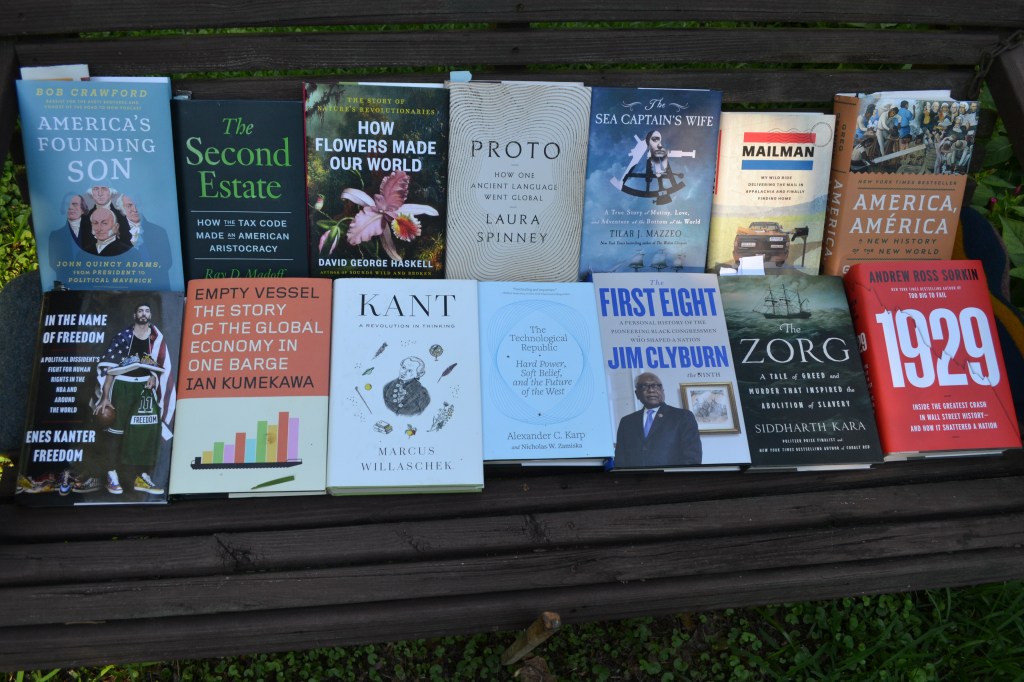
As my statement at the top of the blog site points out, I want to leave a record of who I am for those who seek to remember or to discover me after I die. It may very well help me remember myself as my aging mind crumbles. The photo above is my book mind over the last five months or so.
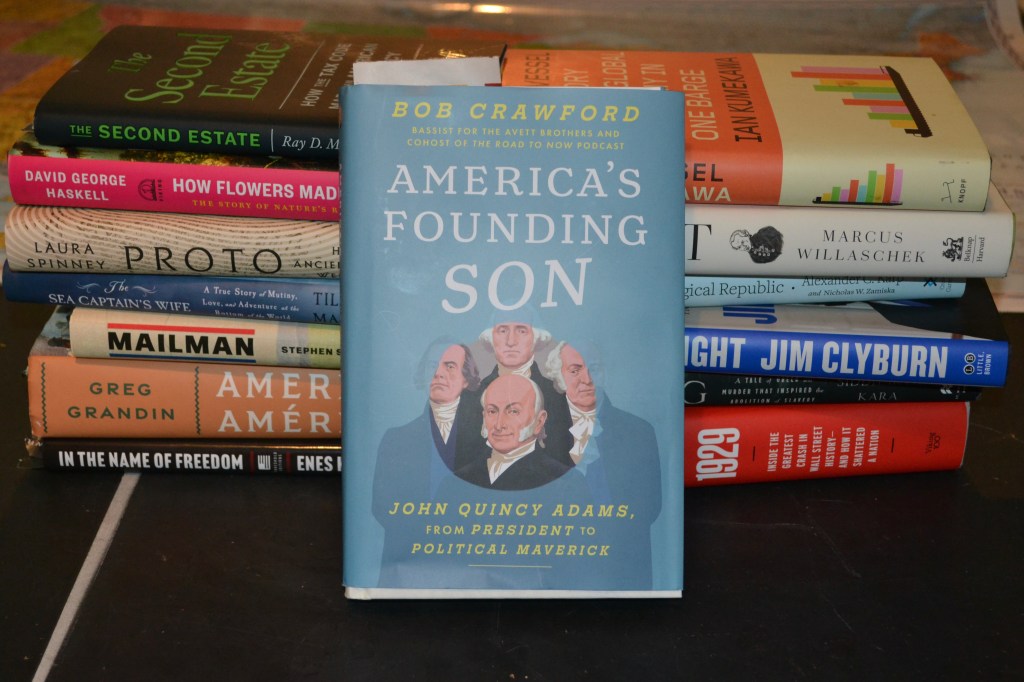
Like Jim Clyburn’s First Eight, Bob Crawford’s America’s Founding Son is not the work of a professional historian or journalist cum historian, but it is a very strong book that I am nearly finished reading. Instead of placing John Quincy Adams in the context of general chronology, Crawford writes about him expansively through the narrow perspective of slavery.
The advantage of a singular perspective and the barely suppressed enthusiasm that Crawford has for his longtime research subject helps me focus in a way that is less overwhelming than most Presidential biographies. The author’s aim in this carefully documented work is to show his Founding Son’s evolving concern with the devil’s bargain that was struck in order to form the nation.
My current reading point has the former President back in Washington as a Congressman during the Missouri Compromise era butting heads with his old friend who served as his Vice President, John C. Calhoun.
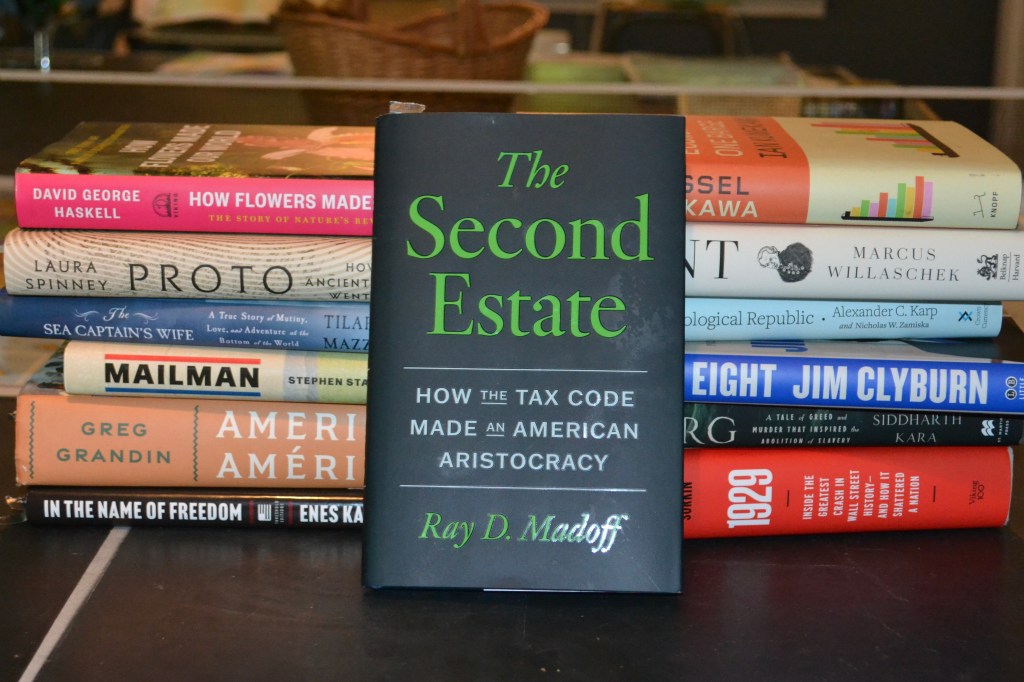
The Declaration of Independence and the U.S. Constitution printed together could run upwards of 50 pages. The U.S. Tax Code is just over 17,000 pages of arcane rules. Madoff, who teaches the tax code to graduate students, thinks, as I do, that the rich should pay a share in proportion to that paid by wage earners. They do not.
Her solution would have Trump, Bezos, Musk, Zuckerberg and other billionaires pay taxes yearly as they make $ just as wage earners do instead of delaying, dodging, and hiding their money to avoid showing earnings all along. I ordered this book just after sending a large check to the IRS because my hard-earned savings bear taxable interest putting me firmly into what President Trump called the class of “suckers” of who pay federal income taxes. Maybe I shouldn’t have read Madoff’s excellent little volume.
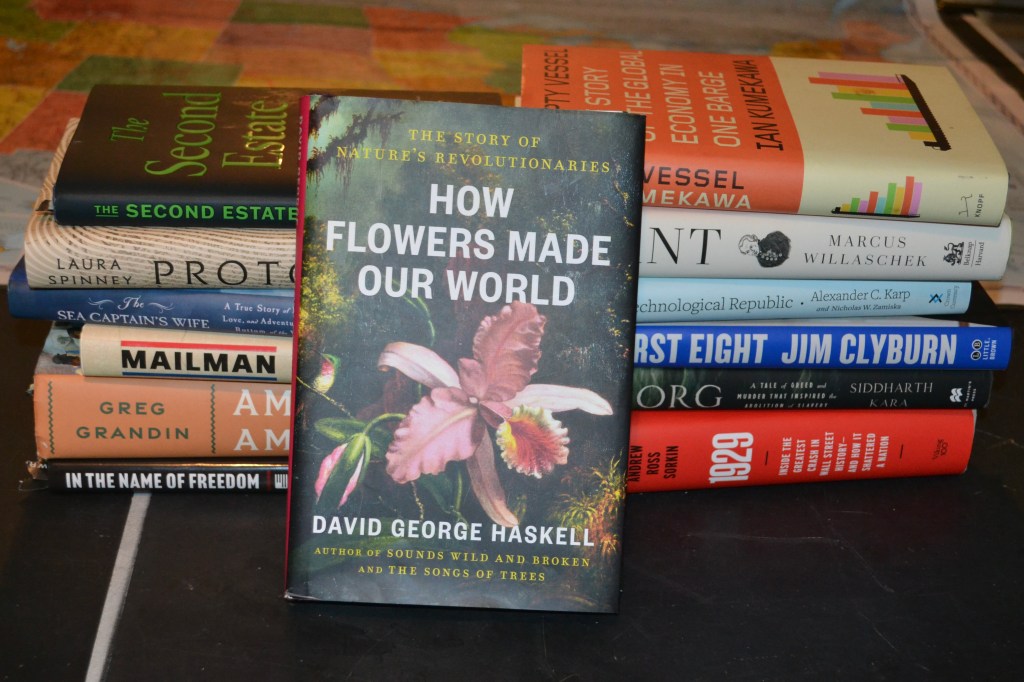
The spread of microorganisms began 2.4 billion years ago; swimming animals, 550 million years ago; and later, about 250 million years ago, flowers came along and evolved for the first humans to use. Haskell, a renowned writer and expert on flowers, begins his book in Atlanta with magnolias. Each chapter is named for a flower which serves for a jumping off place. His work has led me to stop and observe individual blossoms as never before. Orchids are the most numerous in terms of variation and grow in strained circumstances. Without flowers we would all die.
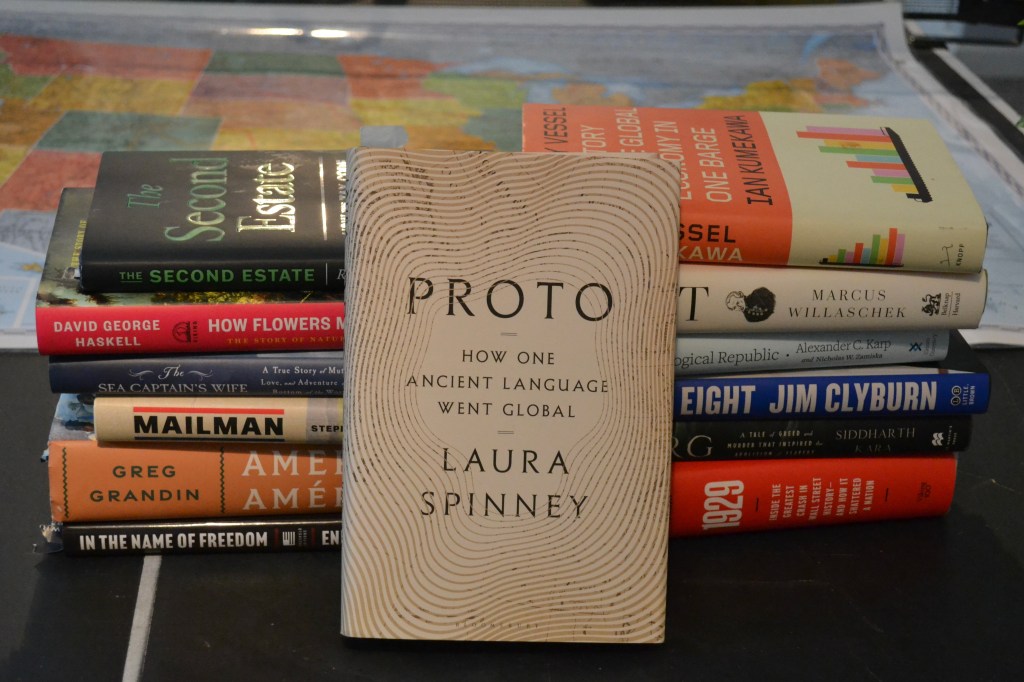
Speakers of Proto-Indo-European close to modern day Ukraine began speaking the language that gave rise to most modern languages. Modern linguistics uses advances in archeology and super computing to fill in how that happened. Spinney’s book almost always floated just over my head but I learned that what I learned at USC is antiquated.
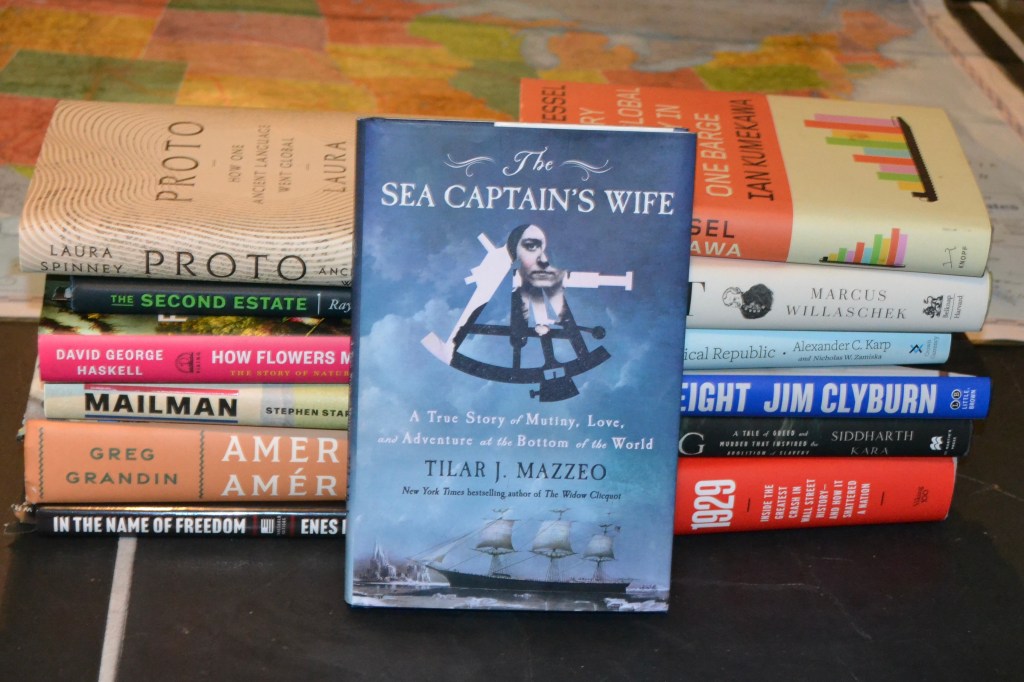
In the 1850s people on the east coast took the equivalent of a jet plane, a clipper ship, to get to California fast to cash in on the Gold Rush. Nineteen-year-old pregnant Mary Ann Patten took over command of her husband’s clipper off of Cape Horn near Antartica to command the ship for her stricken husband. Mazzeo’s work uncovers her forgotten story and provides a history of ships and shipping in the age of U.S. expansion.
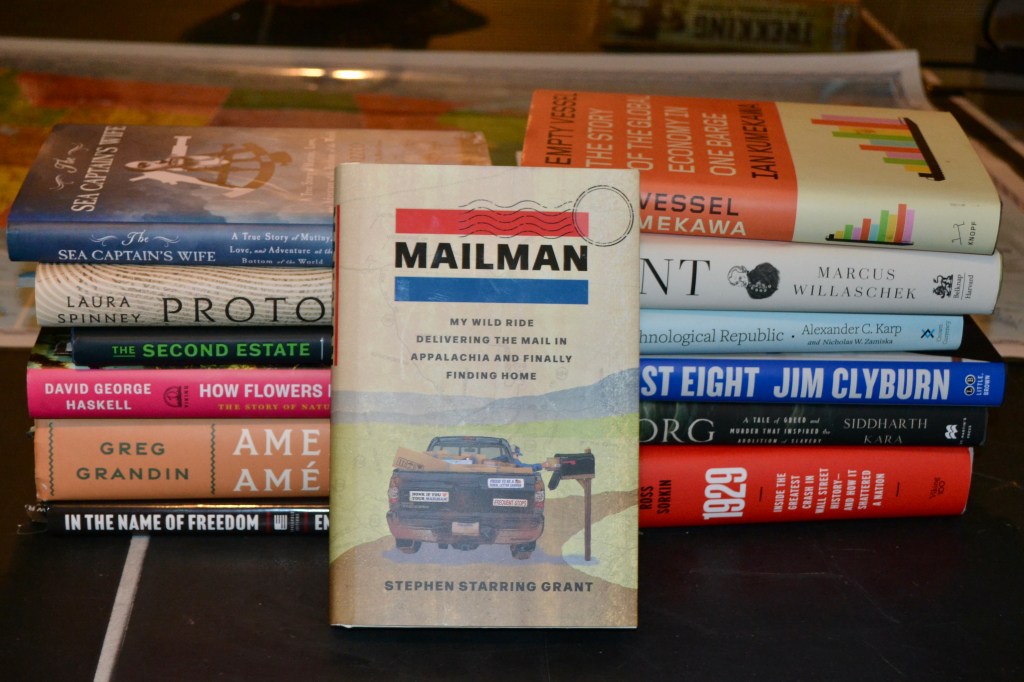
I miss my late father-in-law and former mailman, Frank Pow, so I was drawn to this memoir, not my preferred genre, about Stephen Starring Grant’s time as a rural carrier in Blacksburg, VA. Not a bad memoir but could have been better cast as a long magazine article.
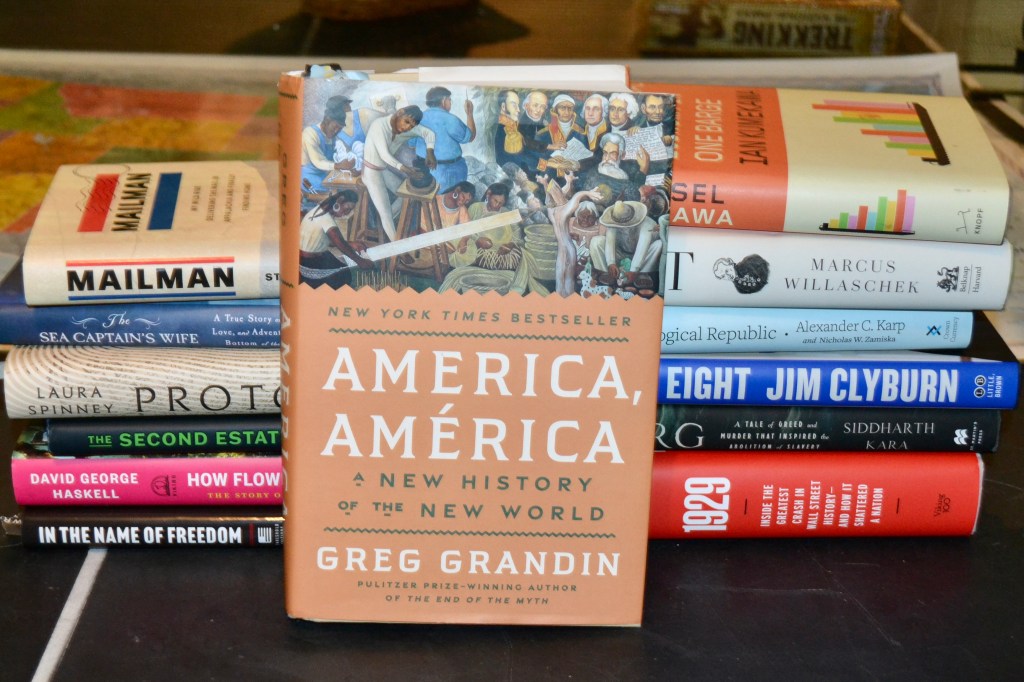
Grandin’s book is a continental history that removes my usual USA me-me viewpoint because it is not about any one country. I liked his representation of natives of the continent and the background on the Monroe Doctrine and FDR’s WWII-era Good Neighbor Policy. Quick summary: Europeans came, waged war on natives, and divided up the real estate.
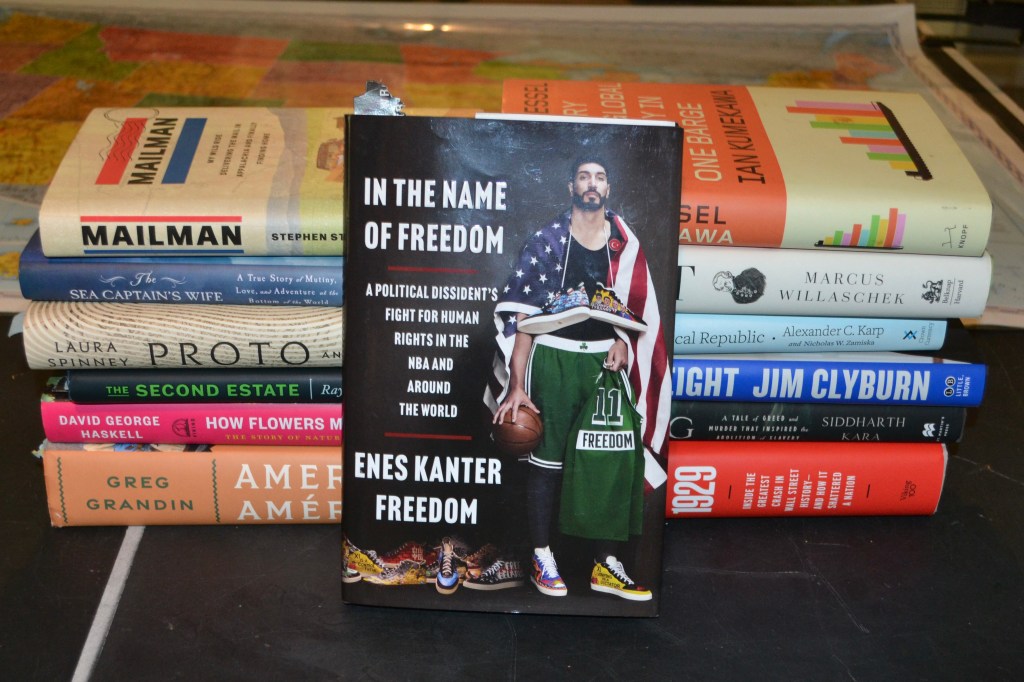
Enes Kantor changed his name to include “freedom” as his last name. The 6′ 10′ former NBA player’s story is about the internationalization of big sports which means Enes got into trouble by taking social media stands counter to what the NBA brass desired in regard to China and Turkey. His home country has forbidden his re-entry. He lost tens of millions and his spot on the Spurs but kept his conscience. I recommend this book to sports fans and people who actually care about freedom of expression.
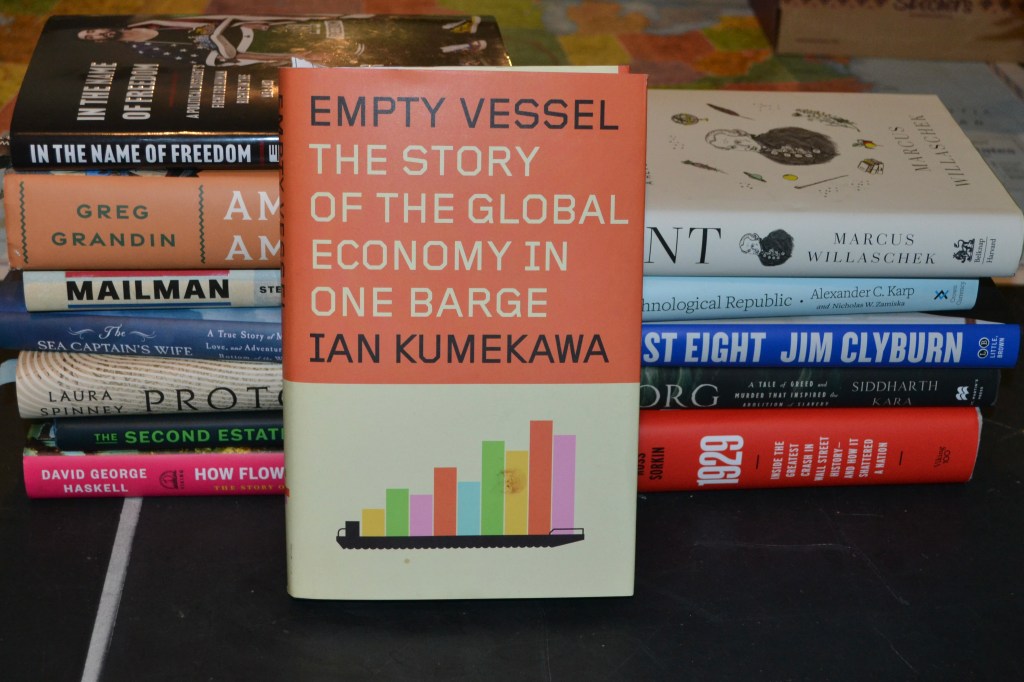
Kumekawa is a historian of economics who followed the history of Newbuild 408, Swedish-build barge, through its life cycle. He encountered it as a prison barge anchored in New York Harbor. The history of a barge is a study in ship-building, economics, housing, and transportation. Most everything we buy is connected to a barge and shipping is at the basis of our economy.
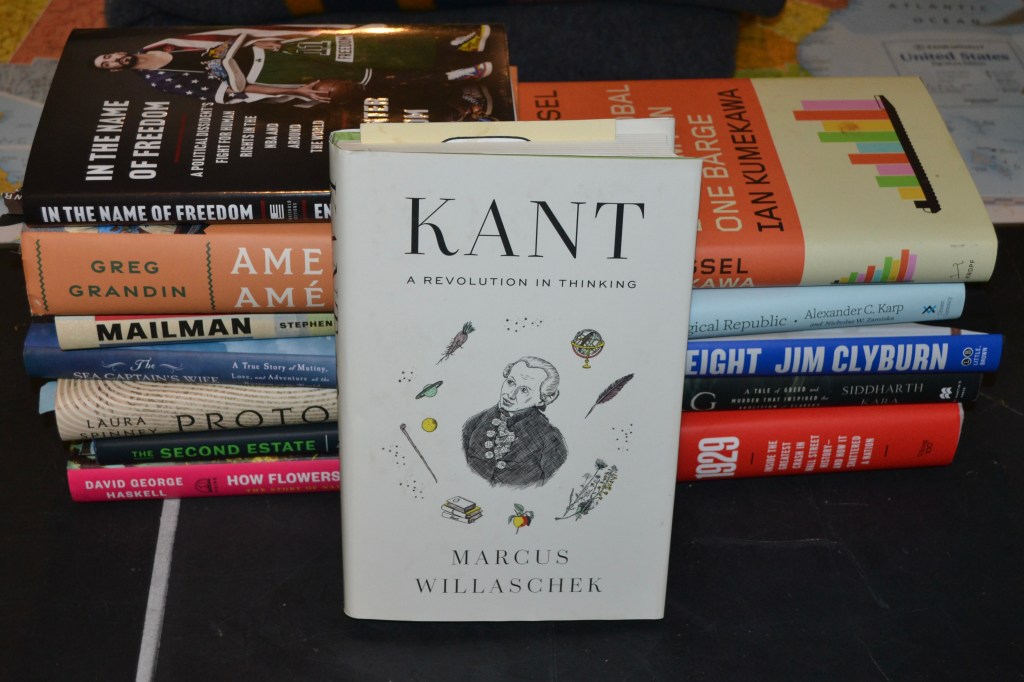
Kant (1724–1804) sits next to Plato and Aristotle in importance. His greatest posit is that all human being have dignity, a radical idea in his era. He is the great philosopher of democracy and his writing is incorporated in the statement of human rights in the UN Charter. Our country was built by Founders who shared his new vision of mankind animated by the then new idea of democracy.
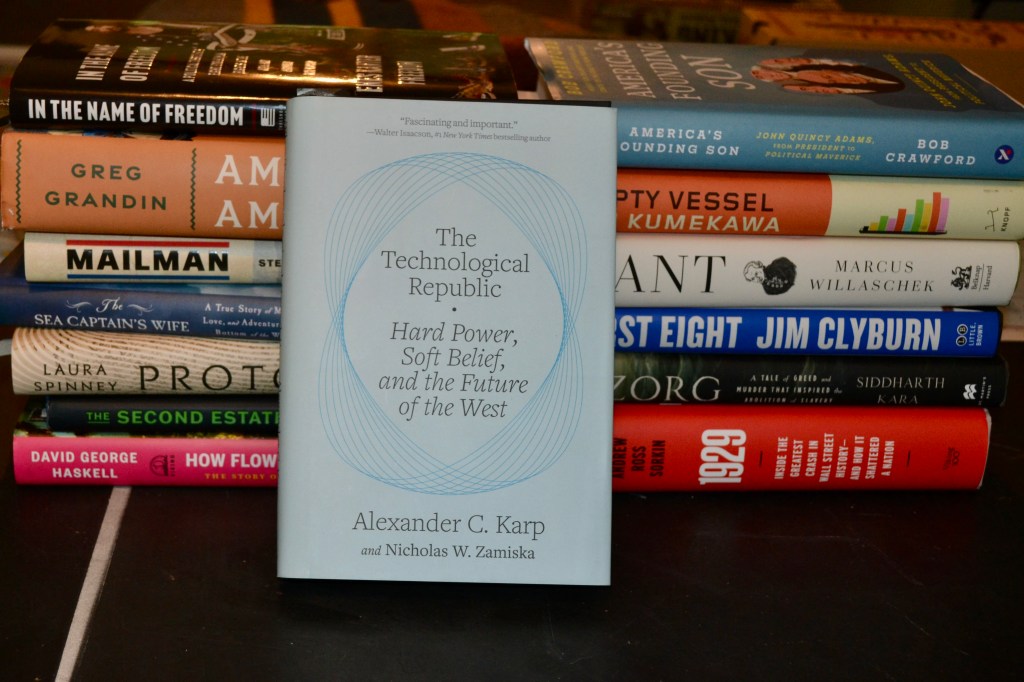
This an odd little polemic book written by two Palantir executives who work for the company that has revolutionized modern defense by developing AI that works with drones to do the work of conventional warfare. I liked the insight into the company but the flavor of right-leaning entrepreneurs mixes in. If Dwight Eisenhower were alive to read the book, he would see a whole new level of the military-industrial complex rising. Karp, Zamiska, and most of all Musk make me uneasy.
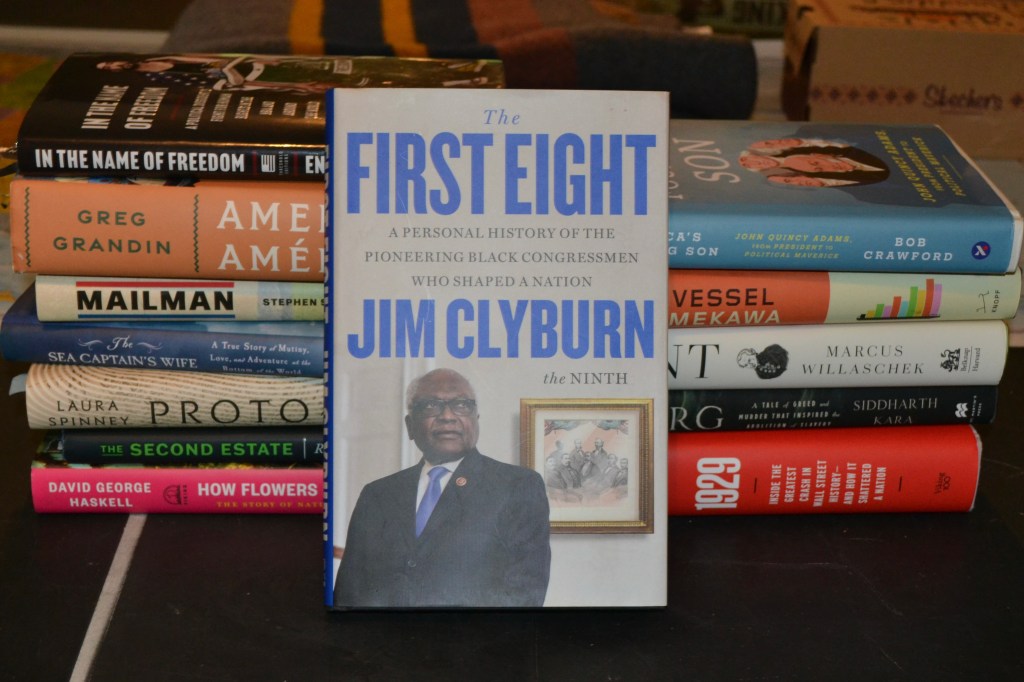
Jim Clyburn is the sole Black U.S. Congressman from S.C. and a Civil Rights icon and a historian of Reconstruction. His book is about the eight black representatives that preceded him during the brief period post-civil war before the Red Shirts and KKK drove them out all of the via lynchings. The book arose out of questions about the portraits of those early Black leaders that hang on the wall of his Congressional office.
Clyburn mixes in stories from his way to power late in the twentieth century before S.C. went from moderate to hard right again. He is a hero of mine whose humbleness and direct talk remind me of Jimmy Carter.
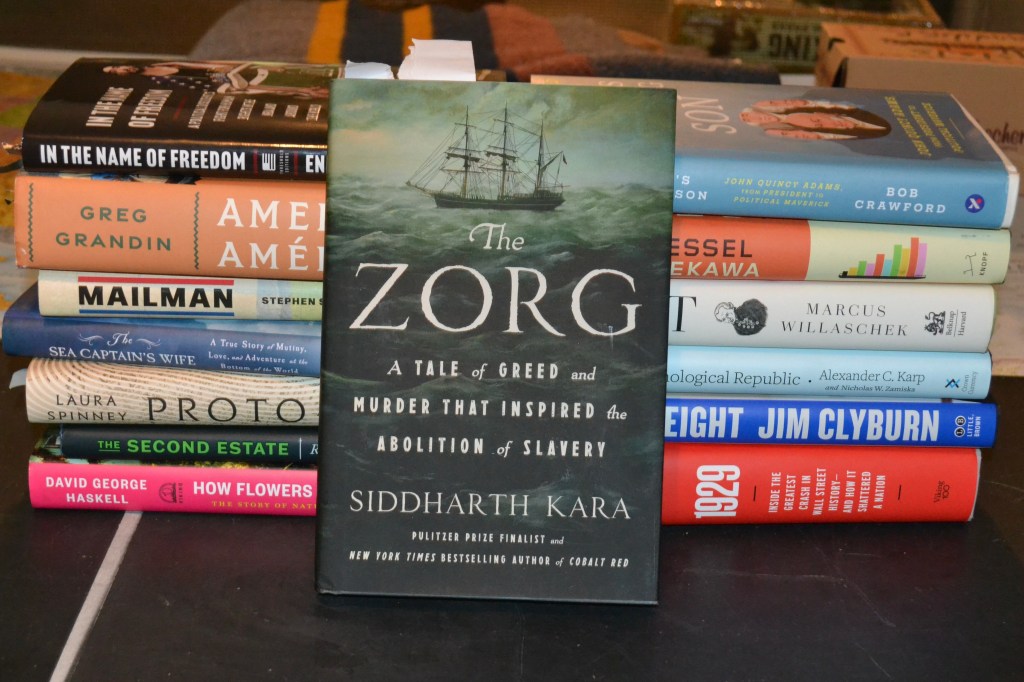
Now I have a clearer understanding of how entrepreneurs in Manchester, London, and Liverpool procured slaves on the Gold Coast of Africa and brought them to the Caribbean and the South to crop cane and cotton. The goal was to keep close to 80% alive so that they could be sold for about 35 pound sterling each.
An insurance claim for dead merchandise filed by the owners of the Zorg led to the public exposure of the process and the ending of slavery in Britain. Kara’s book is beautifully written and reflects the updated scholarship on slavery.
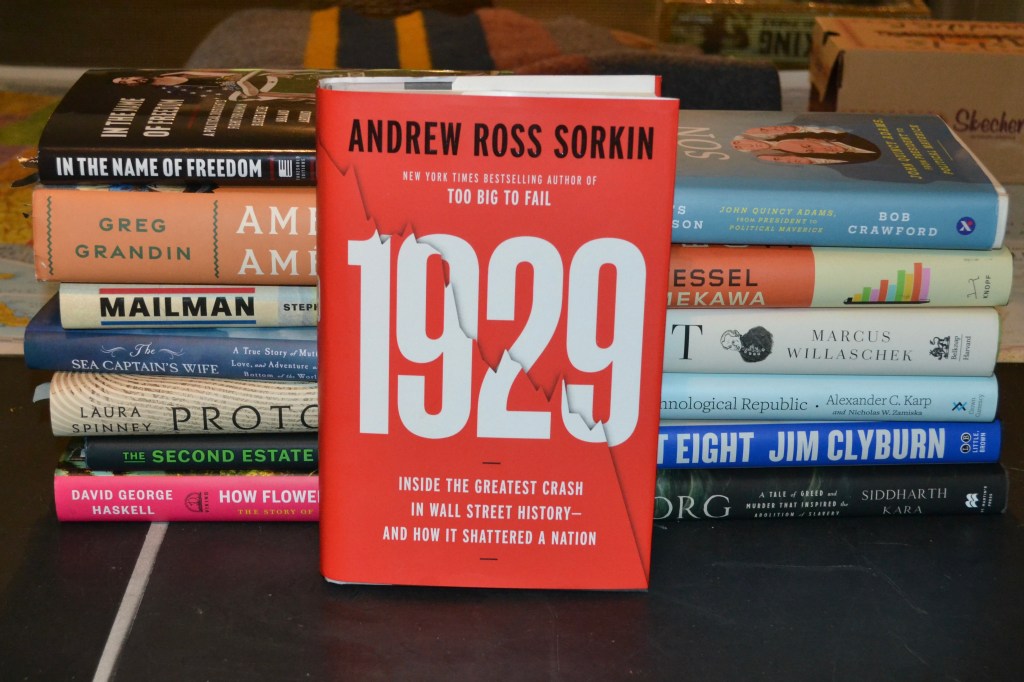
Sorkin’s big book brings the reader the story of the Great Crash by picking up the half or dozen or so biggest players on Wall Street who orchestrated and failed to take action to stop what everyone saw coming. Big capitalism hates regulation is a quick way to summarize. Sorkin an excellent writer who has put down a story that has never been told on a personal level before: the market did not just crash–people crashed it in plain sight.
I remember becoming a reader by lying on the floor over comic strip pages puzzling out the strange text boxes in Snuffy Smith and Li’l Abner through association of words with sketches.
Around twelve I fell into reading my mother’s novels. In high school I critically read The House of Seven Gables and The Scarlet Letter and took The Catcher and the Rye to heart.
To this day my sense of morality and empathy proceed from those books. I have swapped my long quest to read great works of fiction for the world of mainly nonfiction. I am always becoming who I am through my reading.

