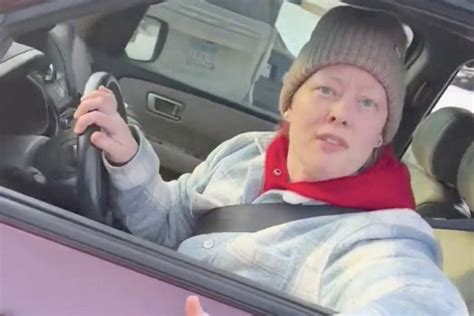
On January 7, 2026, a masked ICE agent shot Renee Good three or four times at point blank range as she steered her Honda Pilot away from ICE agents walking the streets of her neighborhood looking for dark-skinned people. She was making a three-point turn in the middle of street full of agents and their vehicles.
In the strictest of terms her actions could be called harassment of law enforcement. As she turned hard to the right, she was talking through an open window and smiling. Her spouse was directly behind the maroon Pilot videoing the scene on her phone. The smile on Good’s face and her banter could be considered mildly provoking the way a back-talking kid is perceived by an authority figure.
She was not armed. She was not charged with breaking the law. She was upset that thousands of Federal agents whose numbers far exceed the number of Minneapolis police officers were trolling for possible illegal immigrants going to school or work. She was standing up for her neighbors against masked Federal bully boys.
The various videos–including the one from the shooter’s cell phone which was tossed away and pointed skyward–show that she was in no way trying to run over an officer, but suppose she was. Dozens of agents were viewing the scene adjacent to their vehicles. Good’s face and car tag were on camera.
If she was somehow attempting a getaway, what harm would she pose? She could be easily followed and apprehended, though that arrest would be problematic because she broke no law. She was not a danger to the public.
She was murdered Gestapo-style on orders emanating from President Trump. Why?
One could blame the Christians–mainly Lutherans–who gave temporary aid to Somalias who were being mass-murdered during the 1990s. Clinton and Bush allowed temporary immigration, mainly to Marshall, Minnesota, near Minneapolis where Somalis worked in meat-packing. They are refugees of a violent civil war, not “garbage” as the leader of our nation calls them. They do labor-intensive work in refrigerated plants that are very few Americans will undertake.
Counting descendants, 260,000 of our total population of 348,000,000 population is Somali: .0002 %. How are they a problem?
The Trump administration is apparently correct is saying that some Somali daycare operators were part of the questionable use of stimulus funds during the first part of the Biden administration. Fraudulent use of taxpayer dollars should be investigated, not racially profiled. Why are thousands of Federal agents actively trying to cause trouble in an American city?
The short answer, switch and bait: Epstein looms. Minneapolis is a progressive city that does not elect MAGA candidates. Video footage and commentary “entertain” and divert the masses. The long answer may be that the President who incited a riot on Congress over an election that he lost is preparing for a takeover.
I genuinely believe that President Trump wants to be America’s Putin or Hitler. If he gets away with the murder of Renee Good, he will continue his escalation. I hope the country endures until this November elections. I hope that the election turns out to be a clear repudiation of his strongman tactics.
We may be closer to a twenty-first century Fourth Reich with a new Hitler than we think if my long answer is correct.
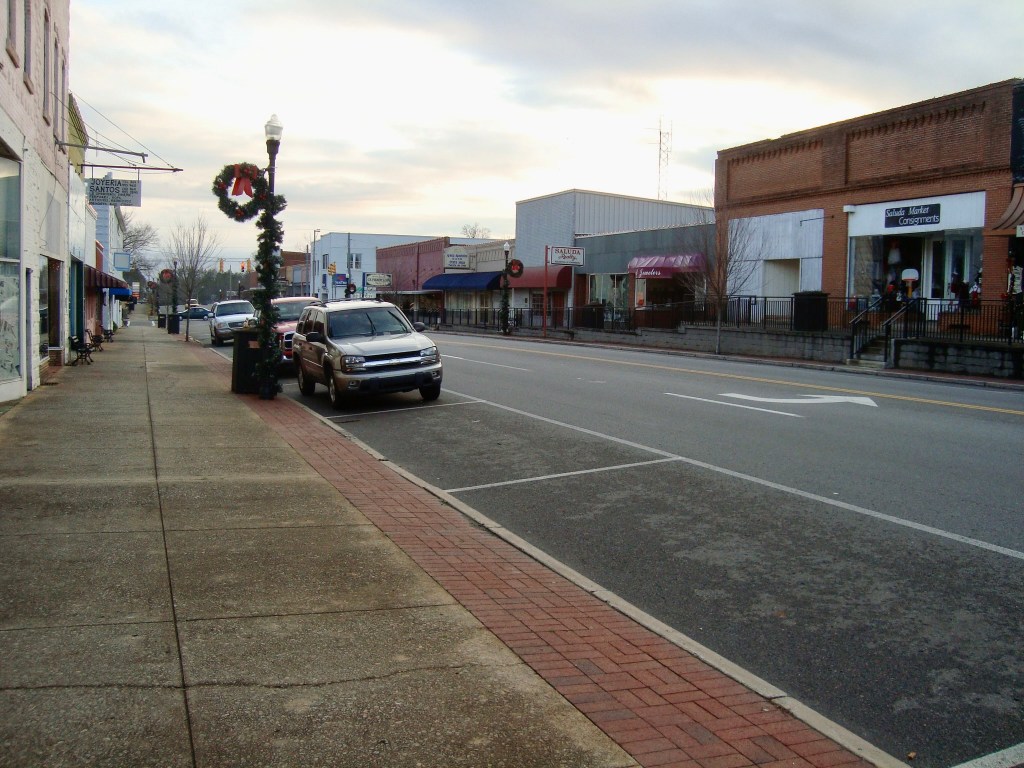
I grew up mainly at 513 West Church Street where downtown ends and gives way to the McCormick Highway three blocks from the beginning of the heart of Saluda. One of the three children of Harold and Leona Forrest, I was ushered outside at every turn, though I was not one stay inside. To this day, I feel better outside than inside.
I can still mentally walk through spaces I once inhabited. I have never seen an episode of The Andy Griffith show that did not kick up Saluda memory dust. Places attach to my mind more than people. Why is the Saluda of my boyhood so present in mind?
My age, I suppose. Nostalgia grips my melancholy soul from time to time. The loss of an age is another possibility. On my zig-zagging tours of the United States to visit National Parks and historic sites, I have come to prize the small towns that still seem close to vibrant. The age of the electronic screen and ordering on line has sapped the vigor from towns and I yearn to see them still thriving.
I found my tent camping spots mainly via two-lane, non-interstate highways to stare at countryside and small towns. They are still out there but most are ghosts of themselves. Pick a state. Most of its citizens are clustered in a handful of key cities surrounded by suburbs. Relatively few of us live in the type of space idealized on The Andy Griffith Show and in my mind.
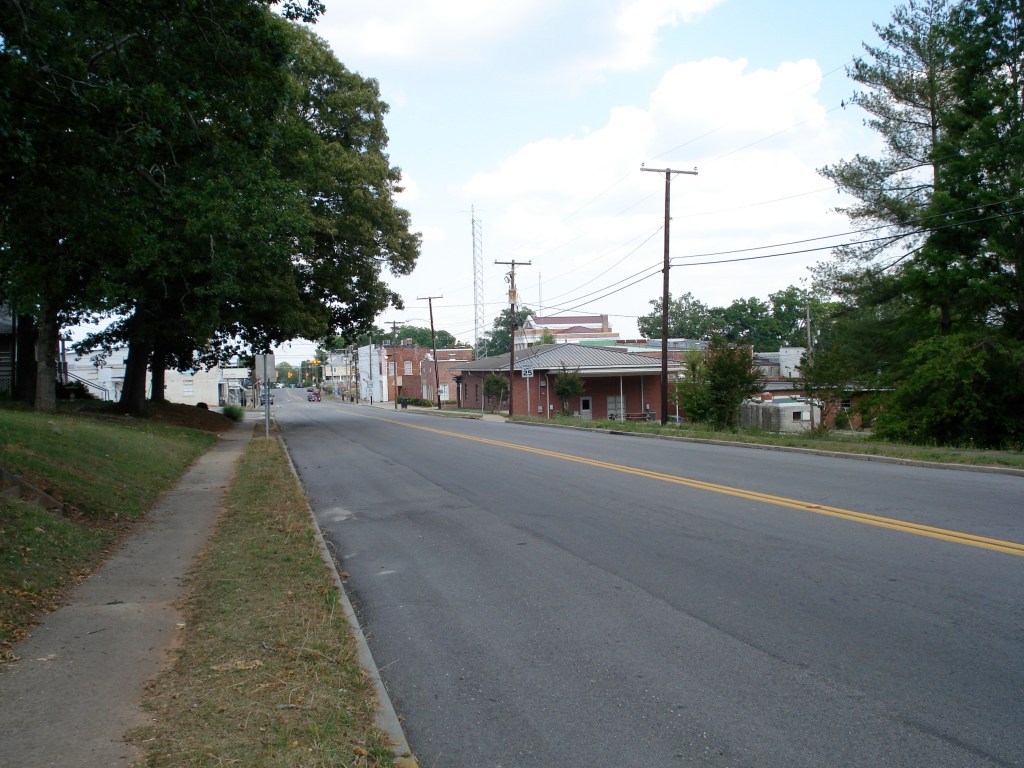
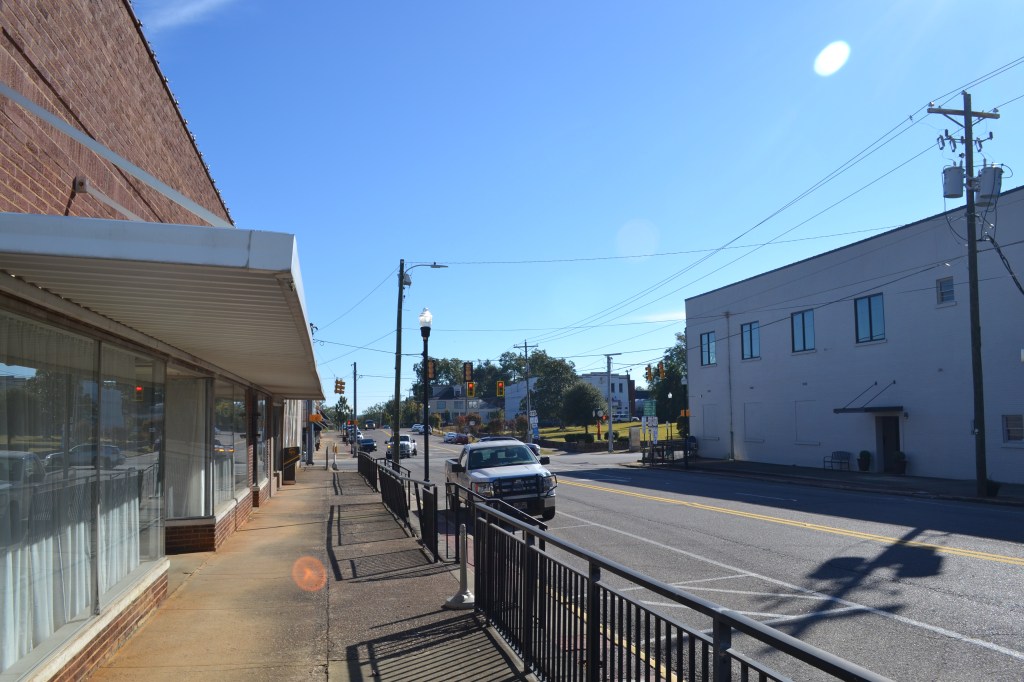
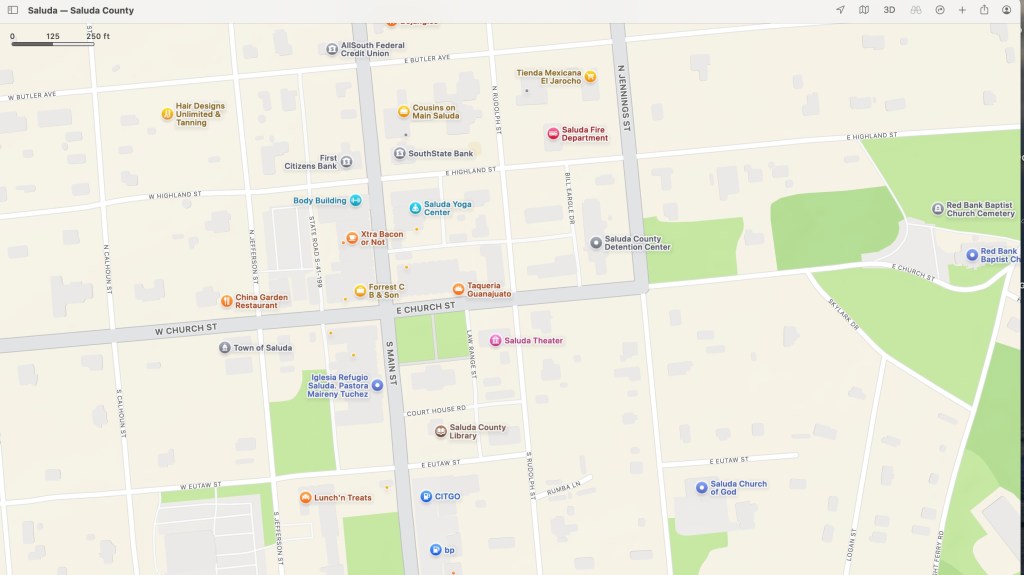
At ten or so were I on the sidewalk above, I would be in site of the post office across the street on the right and in front of the old Red Bank Baptist parsonage. I was friends with Reverend Thomas’s son Mike and I remember his house as I do all of those along the way. In most cases I knew the inhabitants personally. I could be on an important errand and I loved important errands at ten. My mother would give me a dollar and bid me bring two packs of Viceroy cigarettes home.
Just beyond the trees is the site of Preacher Bryant’s corner gas station. Preacher was always glad to help me. I liked the looks of his shiny black hair slicked back with waves on the side. “Why was he Preacher?” I wondered to myself. He readily bought all the three-cent returnable soft drink bottles I found on bicycle rides on my Western Flyer by searching the ditches along side the McCormick Highway. Of course, I gave most of the earnings back to him for a soda pop and candy bar.
I felt secure somehow in knowing that Preacher knew me, Harold’s boy. I don’t know anyone now who runs a gas station but I knew the proprietors of the town’s four or five gas stations. The corner of Preacher’s Shell Station was where J.W. Adams 1958 aqua and white Corvette burned and melted down to the frame and motor block. I still remember the fierce black plume of smoke that hung in the air and weird new-to-me smell of plastic/fiber glass burning that drew me to the improbable sight of a melted car.
The brick building across the street was the post office and next to it was Henry’s Cleaners and a washeteria. I was often in and out of the post office on errands. I loved looking back into the work area where postal employees would put letters in the line of rental boxes.
The Saluda police chief and jail were opposite of the post office. I doubt that I ever passed without checking for cop car, of keen interest to a small boy.
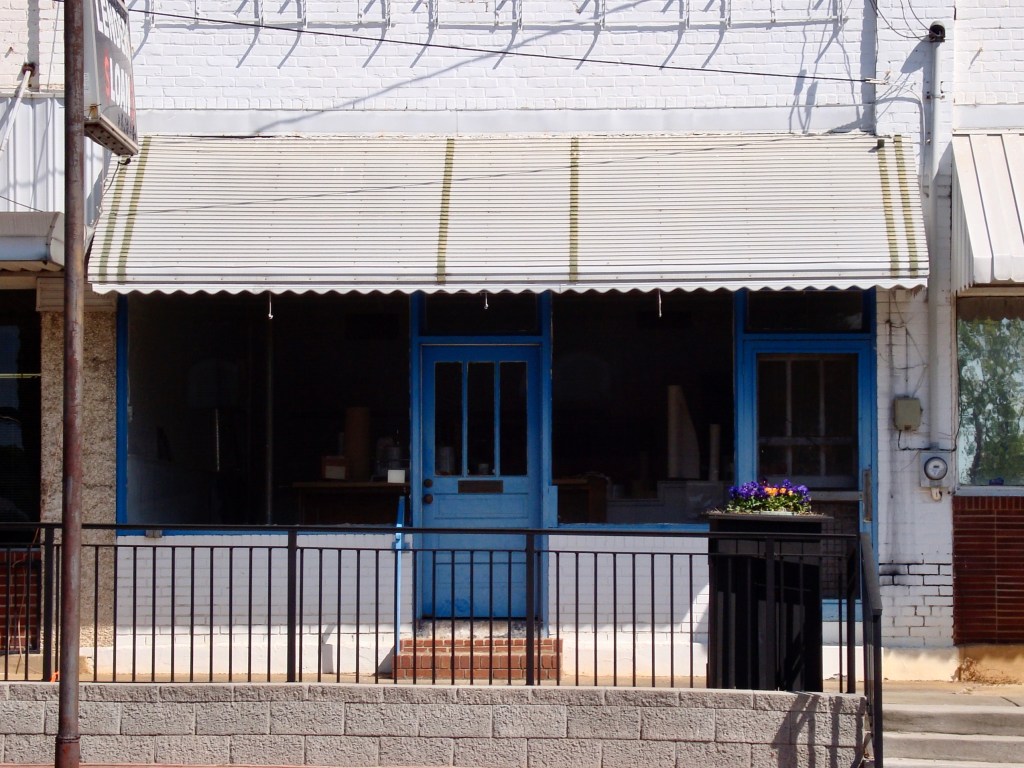
Duffy’s Cafe sat on the corner across from Preacher’s facing W. Church and N. Jefferson. Cars usually lined the N.Jefferson side. My youth was pre-interstate and travelers on the way to and from Atlanta pulled in under the green and white awning to eat a restaurant that offered booths and counter seats attended by uniformed waitresses. Did I ever eat there?
Not sure but I ate next door at Frank Hite’s double door grill when I was older and working at the downtown Red and White. The right-hand door was for African-Americans only. I wish I had the nerve to do what I wanted to: go into the right-side.
I was sometimes forced to eat at the counter, but it had the advantage of being able to watch Mr. Hite, cigar in mouth and Merita bread service cap on head, press the grease out of the burgers he was about to serve. Me, I was a chili dog man and preferred the tables that lined the walls because I could fiddle with juke box playlists that were wired into the big machine. I loved listening to Ray Charles and Johnny Mathis in those left-handed side Jim Crow days. Seemed so ironic. Looking back, I think Mr. Frank must have been brave to run an establishment that allowed African-Americans to eat buy food in the shrunk right-hand side stand up portion of his establishment.
Across W. Church from Hite’s was Mathews Chevrolet, my favorite place when the new cars started arriving. The late 1950s and 60s was a time when automakers innovated by changing sheet metal in odd ways and decorating their creations with two-paint jobs and plenty of chrome. I remember walking down the alley by Mathews to look at the half a dozen or so new models that were still covered waiting their fall introduction date. Exciting times for car crazy kid.
Crossing back over W. Church would place me in front of a building that housed Ben Hazel’s Grocery Store. The Hazels ran the boarding house that I passed on my way to town which may have come after they closed their store. Groceries stacked impossibly high caught the eye upon entering. One of the Hazels would take the customer’s order and pull the items from the shelves which sometimes required a sliding ladder to reach. It is the only pre-self service grocery store that I remember as a small boy. I think that my mother Leona mainly handed over a list that would result in the order being delivered by Lucious Carrol later in the day after I dropped it off.
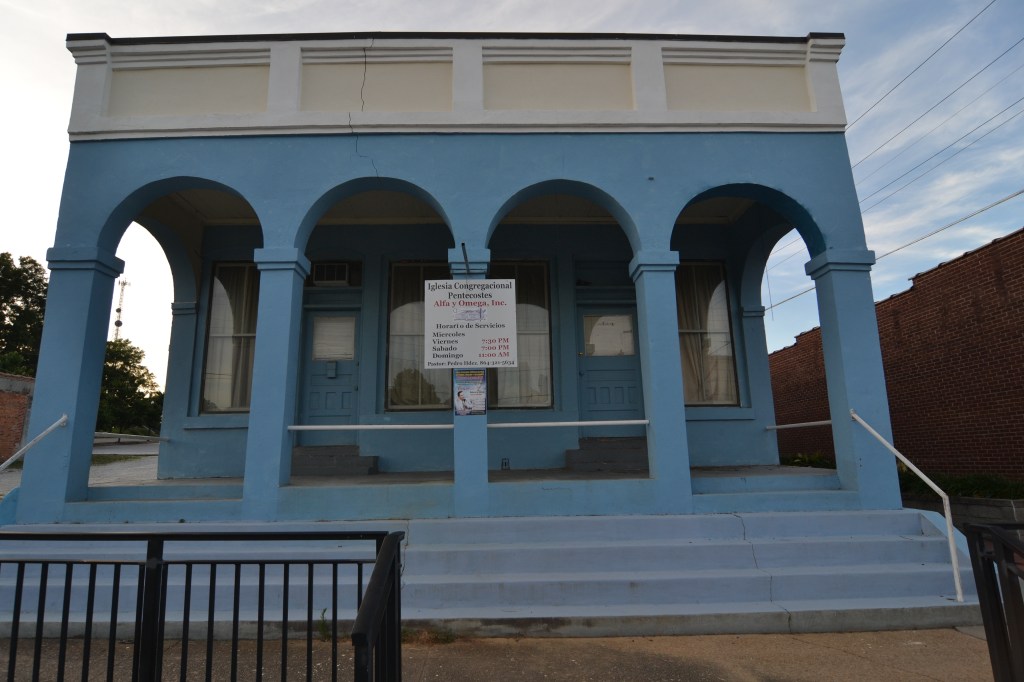
The next building had an elaborate set of steps in front of it and once served as a skating rink. Beside it ran an alley street next to the Red and White, a downtown supermarket with plate glass windows that had the weekly specials affixed.
The old Red and White used to be Ruff’s Red and White before a young couple, Miriam and Alfred Adams, bought it. I was 13 when I went to work for them and remained in their employ until I left Saluda in 1967. I have memories of sorting soft drink bottles in the back near the frozen food storage and busting out a mop to clean up broken brown glass Clorox bottles.
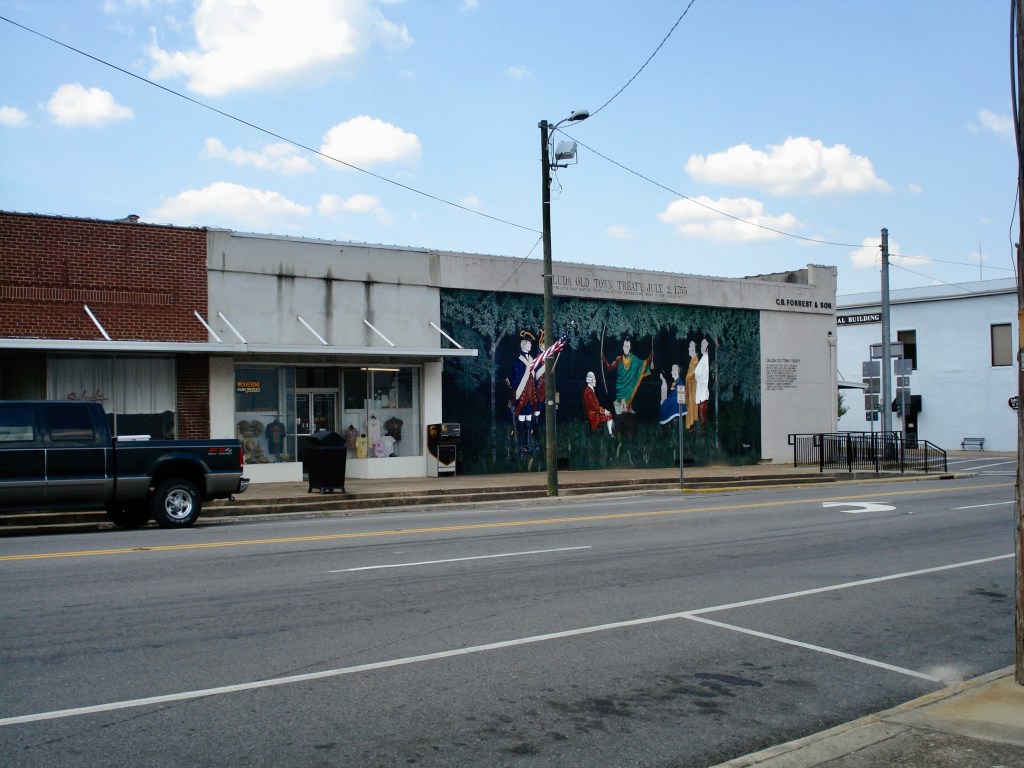
Just beyond it was another most familiar place next to C.B. Forrest and Sons: the barber shop where Truman Trotter (my favorite) and Oscar Forrest cut hair. What a privilege it was to sit and look at hunting and fishing magazines while three or four grown men sat and talked while having their ears lowered. My favorite cut was the astronaut look, a crew cut achieved by using a wide metal comb across the head and a pink concoction called Butch Wax.
Across the W. Church Street from these building was the Christian Science reading room, which I never understood, and the bank. I can remember going into the bank on my lunch break from the Red and White and using $750 of my accumulated money in December my junior year to buy a used 1965 Mustang in 1966 for $1200. I was so proud, so nervous. My mentor Alfred Adams had talked me out of buying a beat up Falcon convertible for $600 cash and going for the newer car. Likely Mr. Adams spoke to Holmes Hurt who ran the used car lot. Alfred Adams was a bit of a car buff himself and soon traded his beautiful SS Impala for a 1966 Mustang.
The side door of C.B. Forrest and Sons next to outside mural was suddenly locked one Saturday when I was inside just beyond the Adam hat rack by the men’s suit section making up suit boxes to fill the cavities on both sides of the three-part mirror that I loved looking at myself in. “Am I the person I see?” I thought to myself.
A man dressed in D.C overalls who had been trying on hats had fallen to the floor backwards. Mrs. Edwards, a clerk, fetched my dad who ordered the door locked and went across and up the street to get the police. One of the man’s hands was grazing the sports section and pushing back against the colorful fabric of bright blazers. After seeing my first dead man (heart attack I presume) I was sent home via one of the two front doors.
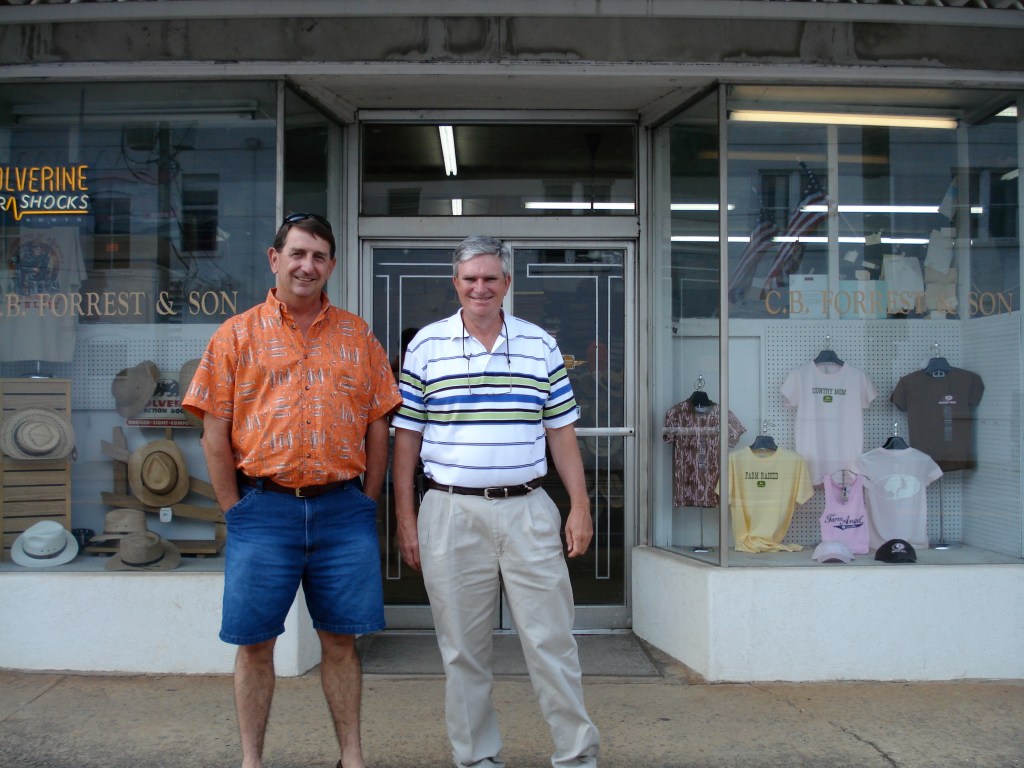
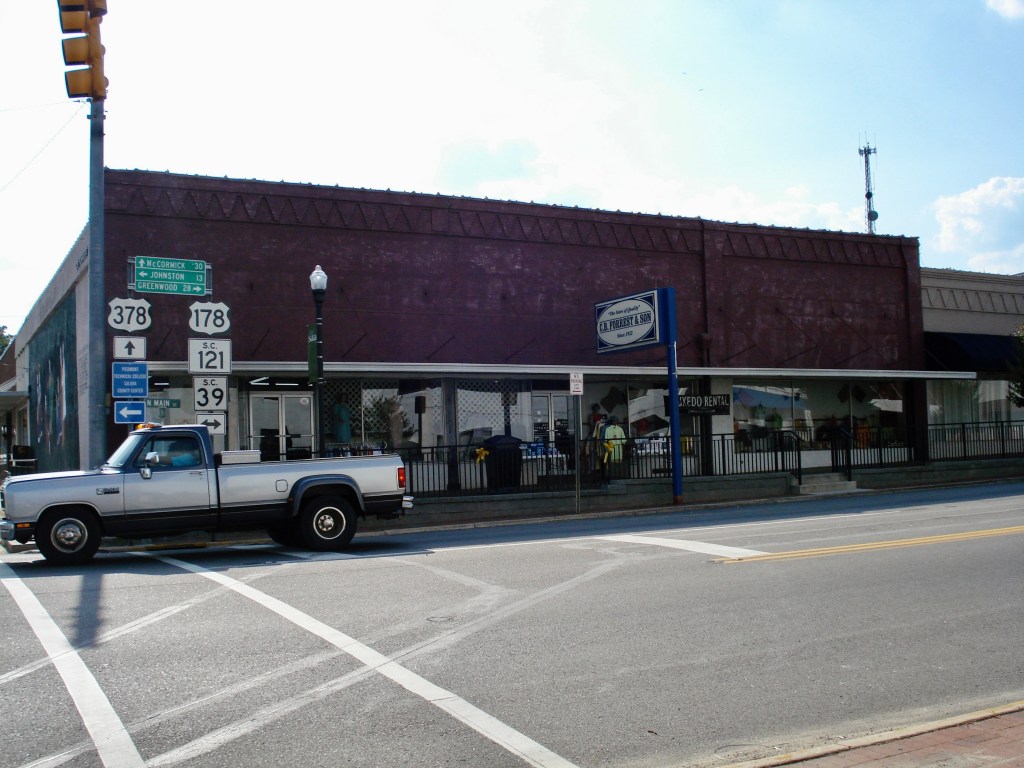
This 2007 shows Alan Harmon and my first cousin Brad Forrest just outside the side door. I have many memories that come alive when I enter that space. Because it is on the corner of Church and Main Streets and faces both, it is still one of the best known landmarks.
Turning left just past the side door would lead me to one of my favorite places from the Saluda in my mind. Three store fronts up Main St. back then just past the Piggly Wiggly and the insurance agency that so graciously helped my boyhood self navigate car insurance is a building that housed the jewelry store. Mr. James Pough or Mr. Hubert Humphries helped me pick gifts for my mother and more importantly watches, radios, and rings. I remember purchasing more than one friendship ring which I sought to bestow on one girl or another.
The proprietors like all those in the stores I frequented were proof of the African proverb that Hillary Clinton used in her Presidential campaign: it takes a village to raise a child. Unbeknownst to me I was being guided into adulthood.
Across Main Street from the jewelry store sat store #1, hands down: the F & S Drugstore. Sure I went in there to get Dr. John to fill prescriptions for my mother and I enjoyed a cherry soda now and again made by Mrs. Francis Rankin, but I came in for the comics. Just inside the door to the right was the You Tube of the era for my young self: a magazine section with a generous comic selection. My brothers and I shared a bedroom and a closet. I tried to keep my stack of comics separate and neat and was more than a little cross if Cally or Butch borrowed without notification.
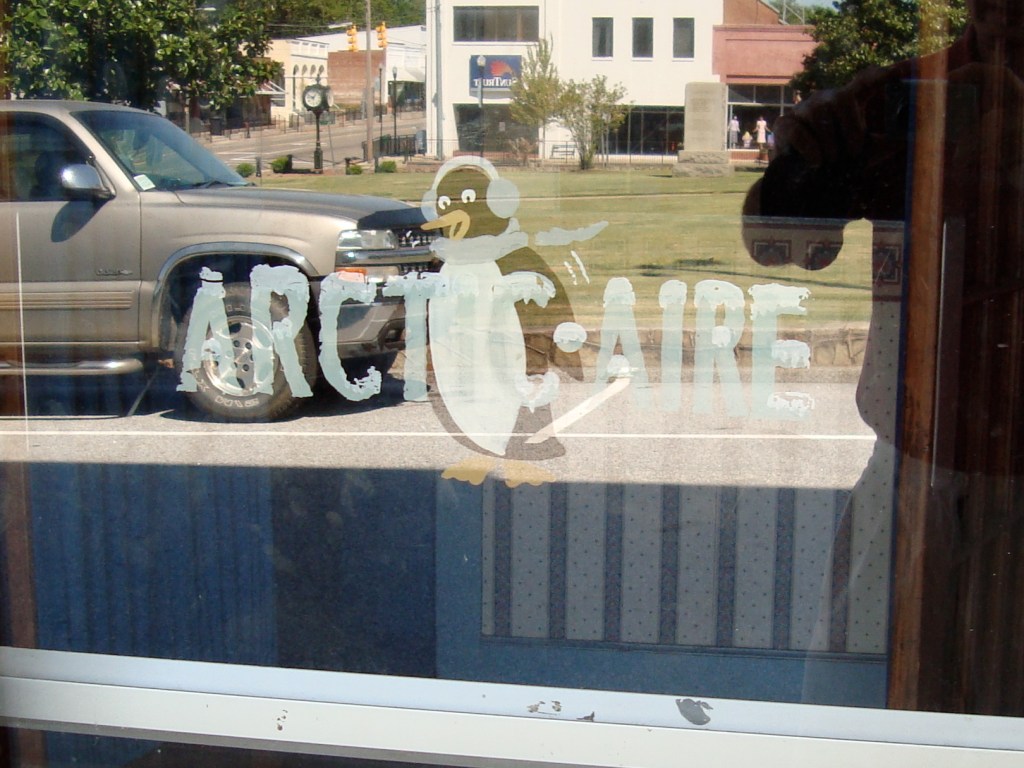
Nextdoor to the F & S was Shealy’s Barber Shop and then the library I knew as a boy and next to it on the right was a small attached hut that served as snow-jo stand in hot weather. Some of my downtown destinations had something brand new and not part of homes yet: air conditioning. I loved chances to visit penguin territory.
I am mentally walking back toward the red light intersection of Main and Church now astride what used to be Luke’s Apparel. I often took a sharp left there to find myself across the street from the Saluda County Courthouse. Just past Luke’s was the clothing spot to visit for sure: Simon and Henrietta Wolfe’s store.
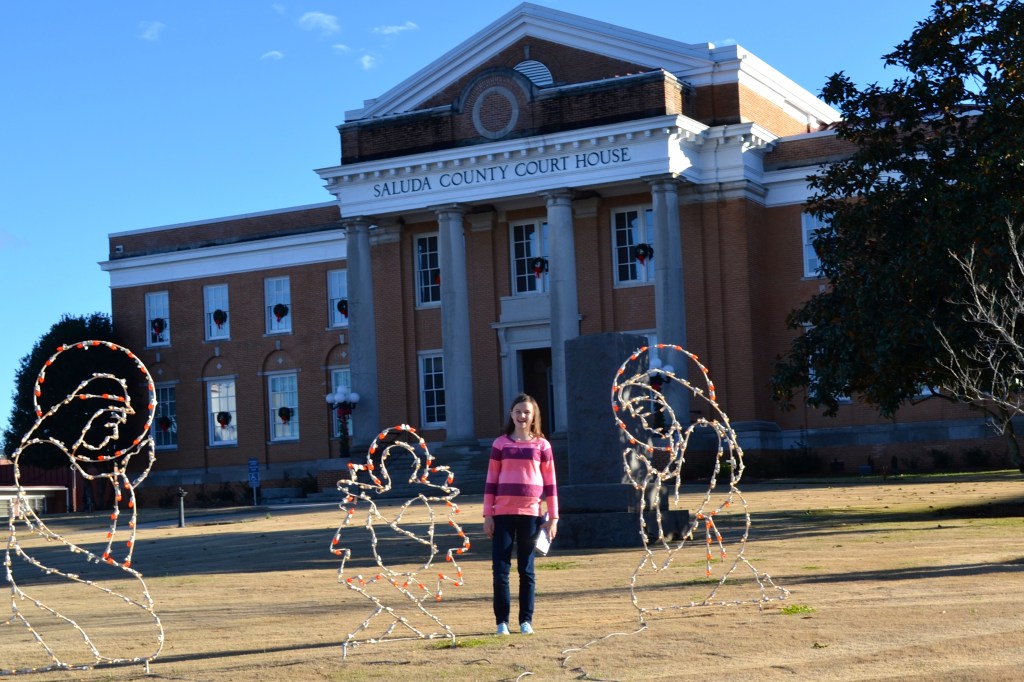
My granddaughter Grace in the front of the court house in 2014
My friend Johnny Wheeler and I used to take our narrow brown pay envelopes with the $20 or so of our Red & White earnings into the store after the market closed at about 7:30 P.M. on Saturdays. The Wolfes had a good eye for what young men wanted to wear. I remember Jantzen sweaters and Gold Cup socks.
Across W. Church which had become E. Church on its way down to Red Bank Baptist Church stood the court house which was in front of one of my favorite shopping destinations: the Stuarts’ Western Auto Store. I shopped baseball gloves there and could count on a clerk named DeWitt to help me with my bicycle. Beyond it on the same side was a cafe and Bank’s Supermarket.
Just past Bank’s along N. Rudolph St. was the segregated world that Jim Crow had imposed which picked up and again on Boughtknight Ferry Road. African-Americans were part of a separate world back then with their own business and dwelling zones. Only in my high school years did I begin to understand the separate and terribly unequal system when I adopted Martin Luther King as my hero.
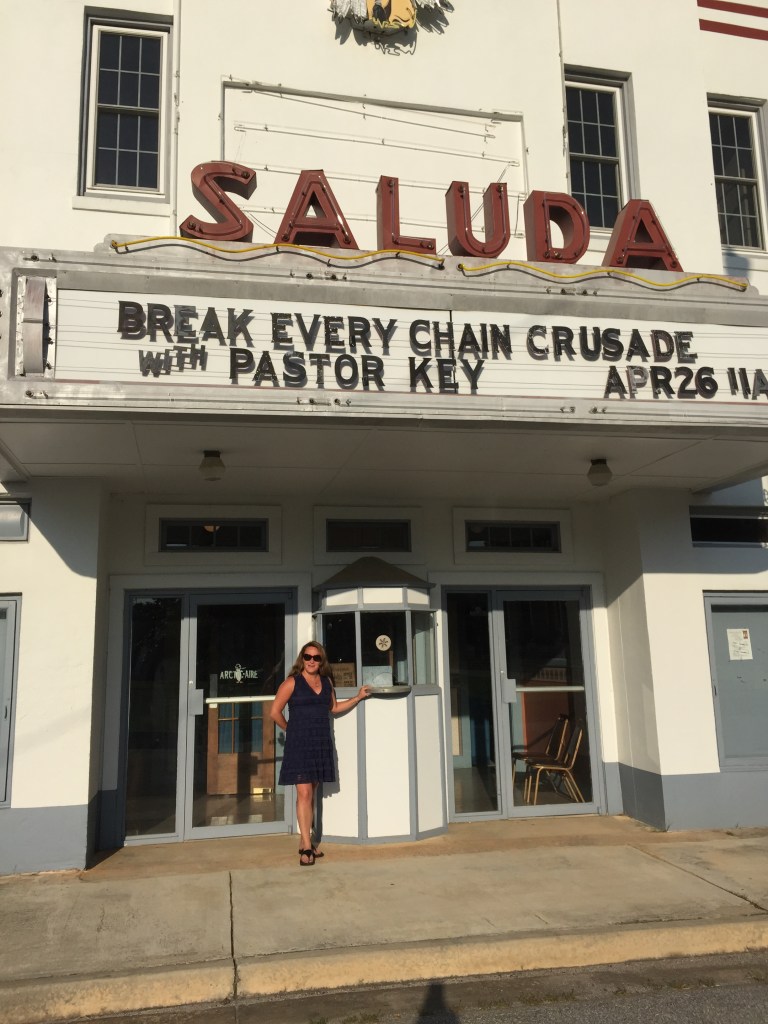
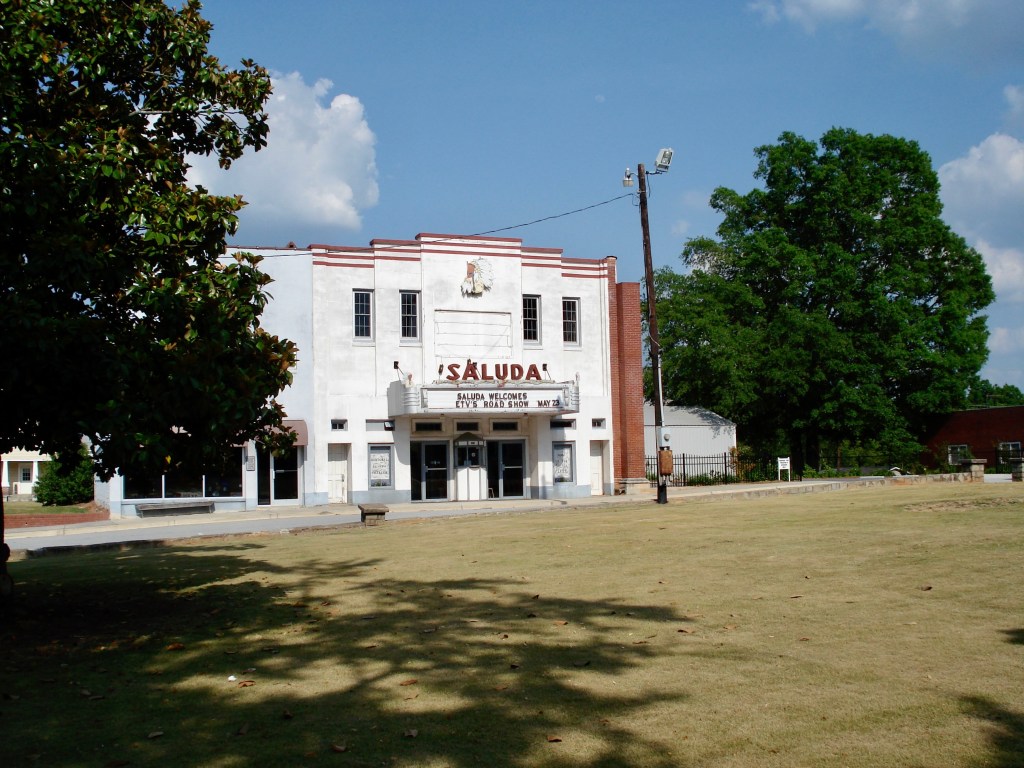
Crossing the E. Church near Bank’s and heading back toward the court house led to a one-way lane in front of the Indian Chief Theater. It drew me to town in my younger days almost every Saturday for a double-feature.
My daughter Danielle (Elle) stands in front in this 2015 photo. She has some vague idea of my childhood Saluda but her theaters and stores were in malls.
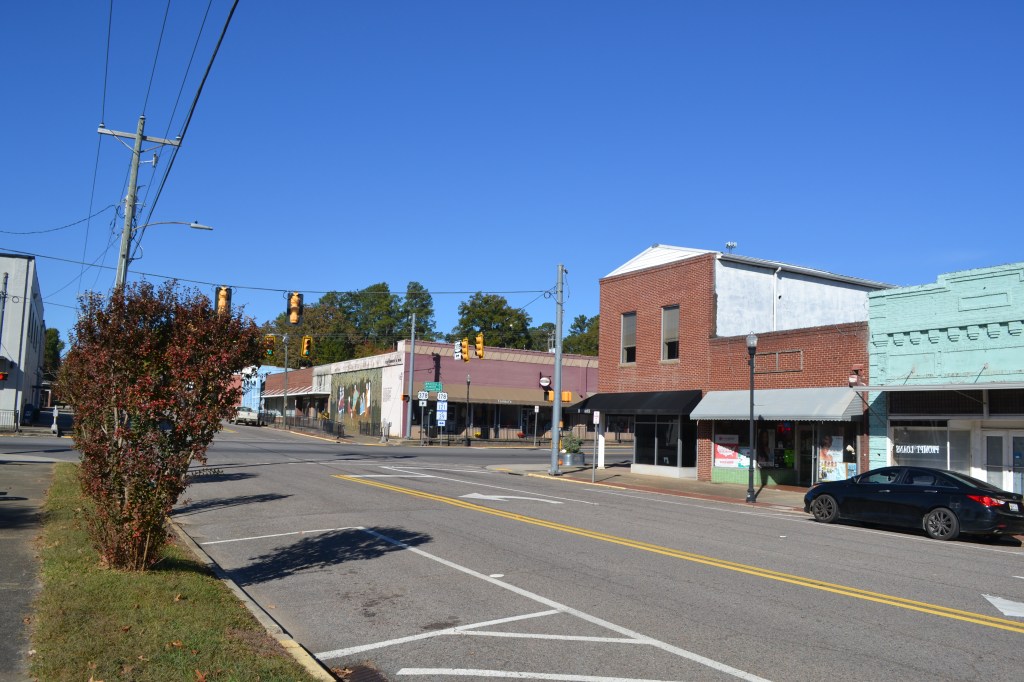
Mentally I am now back to my free-range ten-year-old self at the corner of Main and Church in front of the courthouse with a view of what used to Wolfe’s and C.B.Forrest and Sons at the one and only red-light. The photo shows the corner with the bank on the far left.
Time to cross Main in front of the bank and take a left toward where the roads lead to Ridge Spring, Johnston, and Batesburg. I had some interest in Pitts Drug store where I won a date with a pretty girl who worked there but my big stop was farther down the street past the flower shop to B.C. Moores. I think it was part of a small chain of clothing stores and back in my early teen years I would go inside to peruse the latest shirt fashions.
The core of the town of Saluda dropped away at W. Eutaw Street at the stand-alone diary stand in the vacant lot across from what is now the Saluda Library. I would turn west on Eutaw to walk home past Davis Tire where I later bought recapped tires and the site of the old Saluda School–later the new Piggly Wiggly–where I began my academic life. I walked shady streets on my way back home, unless I peeled off to find myself hanging out with the myriad young kids in post-WW II Saluda who were growing up in our Mayberry.
Screenshot
In high school I secretly wanted to be a farmer, not a town kid. My friends Gehrig Minick, Randy Robertson, David Hallman, Morris Jones, Jones Butler, etc. were a cool crew in their blue corduroy Future Farmers of America jackets. I longed to be a farmer’s son, but my town life was a rich experience that taught me in the way life in the country teaches its young through agriculture.
The kind of tight-knit village life I knew then is gone– outside of dense city neighborhoods that can be found in places like Brooklyn. Most of us live sterile suburban lives more alone than joined. I was a privileged youth of Saluda at its height in the 1950s and 1960s.
Most of this walk through Saluda can probably be laid to nostalgia for youth period, which brings me to a few lines from Dylan Thomas’s Fern Hill, an eloquent statement about youth from the remembered point of view of a rural youth.
Now as I was young and easy under the apple boughs
About the lilting house happy as the grass was green,
The night above the dingle starry,
Time let me hail and climb
Golden in the heydays of his eyes,
And honored among the wagons I was prince of the apple towns
And once below a time I lordly had the trees and leaves
When I was a student, rote memory work was fading but I did have to memorize beyond obvious mnemonics like ROYGBIV. I remember committing some Longfellow poems to memory on orders from elementary school teachers. A Longfellow poem about the village blacksmith standing under the spreading chestnut tree comes to mind.
At 76 my memory is worse than ever. That is worrying because thirty-four years of teaching school taught me that having a good memory was a key to academic success. Most of my brightest students had strong memories.
My friend Jim Every (83) knows hundreds of songs by heart and many poems. When we talk movies, he often quotes dialogue from favorite scenes. He insists that his memory skills are from use, development more than an inborn gift. So I have started memorizing again for brain exercise.
Recuerdo —Edna St. Vincent Millay
We were very tired, we were very happy–
We had gone and forth all night on the ferry;
It was bare and bright and smelled like a stable–
But we looked into a fire, we leaned across a table,
We lay on a hill-top underneath the moon;
And whistles kept blowing , and dawn came soon.
We were very tired, we were very happy–
We had gone back and forth all night on the ferry.
And you ate an apple, and I ate a pear,
From a dozen we bought somewhere;
And the sky went wan, and the wind came cold,
And the sun rose dripping, a bucketful of gold.
We were very tired, we were very merry–
We had gone back and forth all night on the ferry.
We hailed, “Good morrow mother!” to a shawl-covered head,
And bought a paper that neither of us read;
And she wept,”God bless you!” for the apples and pears,
And we gave her all our money but our subway fares.
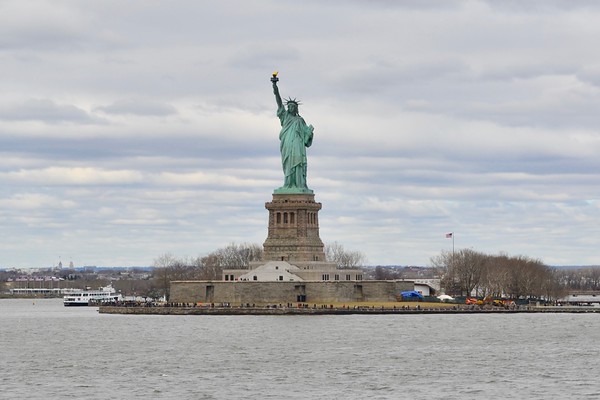
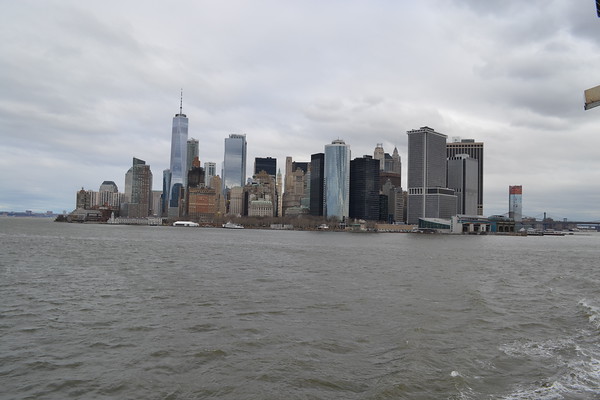
Recuerdo was my first effort. Spanish for something like a souvenir, “recuerdo” is a recollection of riding the Staten Island Ferry. In 2018 I rode the Silver Meteor from Charlotte to Grand Central Station and spent close to a week walking around Manhattan. Of course, I walked across the famous bridge to Brooklyn, too. Of course, I rode the ferry to Staten Island to see the Statue of Liberty and claim another borough.
More photos at dmforrest.smugmug.com, Hiking Manhattan
I wrote the poem longhand which started the memorization and kept a copy in my pocket. When no one was around, I said it aloud. I am not sure what effect committing Reucardo had on my attempt to help my aging brain, but I enjoyed thinking about. The root of memorization is memory and I resurrected my own Statin Island Ferry memory and came to value each line, each word. In the end all we have that makes us human is our memories.
My next poem was shorter and a way to fight the silly times we live in where the puffed up are constantly in our faces media-wise. The meek are not inheriting America in 2025.
I’ Nobody –Emily Dickinson
I’m Nobody! Who are you?
Are you–Nobody–too?
Then there’s a pair of us!
Don’t tell! they’ll advertise–you know!
How dreary–to be–Somebody!
How public–like a Frog–
To tell one’s name–the livelong June–
To an admiring Bog!
Other than dmforrest.smug.mug.com where I post photos and this site I do not have a social media presence. “What I Plan to Do with DANIELFORREST.ORG” sits at the top of this site and explains my reasons for this body of writing. I am not a social media person but I reckon I have some Frog in me. Anyhow Dickinson’s poem speaks to something about how I feel about the current time.
My next handwritten poem for memorization is a famous Frost poem which I knew well back in my teaching years.
Stopping by Woods on a Snowy Evening –Robert Frost
Whose wood these are I think I know,
His house is in the village though;
He will not see me stopping here
To watch his woods fill with snow.
My little horse must think it queer to stop without a farmhouse near
Between the woods and frozen lake
The darkest evening of the year.
He gives his harness bells a shake
To ask if there’s some mistake.
The only other sound’s the sweep
Of easy wind and downy flake.
The woods are lovely, dark and deep,
But I have promises to keep,
And miles to go before I sleep,
And miles to go before I sleep.
Much more elegant on the page than the Dickinson poem, it calms me. I always managed to provoke my students into unraveling it but I enjoyed teasing them that it could be Santa talking. For me it is more than a beautiful statement about resting: I see it as a statement about summoning the will to continue.
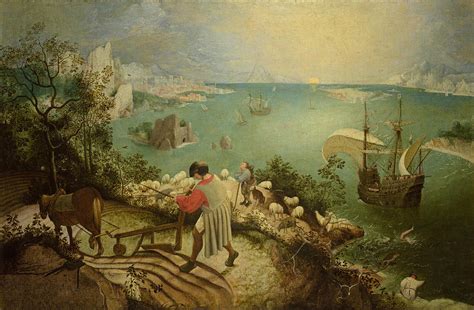
Wikipedia reports that Pieter Brueghel’ Landscape with the Fall of Icarus is likely a very good copy from about 1558 of his lost original. Icarus succeeded in flying with wings using feathers attached by beeswax made by his father Daedalus. He was told not to fly toward the sun but did so. Look bottom right to see his legs, one bent the other nearly straight fading into the water.
The painting hangs in The Fine Arts Museum in Brussels where W. H.Auden saw it. I am now working on memorizing Auden’s Musee des Beau Arts. Jim Every said to memorize words that mean something. I like what this poem says about our perceived self-importance.
My pocket copy will likely be with me a long while because the poem is not repetitious or rhyming. Auden’s syntax is as bent and provoking as Dickinson’s.
. . .the ploughman may
Have heard the splash, the forsaken cry,
But for him it was not an important failure . . .
The words give me perspective about all my worries and suffering. They keep me in my place.
Time will tell how my memorization experiment goes. If I continue, I may next work on Article 1 from The Constitution as per my concerns expressed in my last blog, “July 4th, the Sermon on the Mount, and Joe Biden’s Definition of America.” Learning the major bones and muscle groups from the old anatomy book I own appeals to me, too.
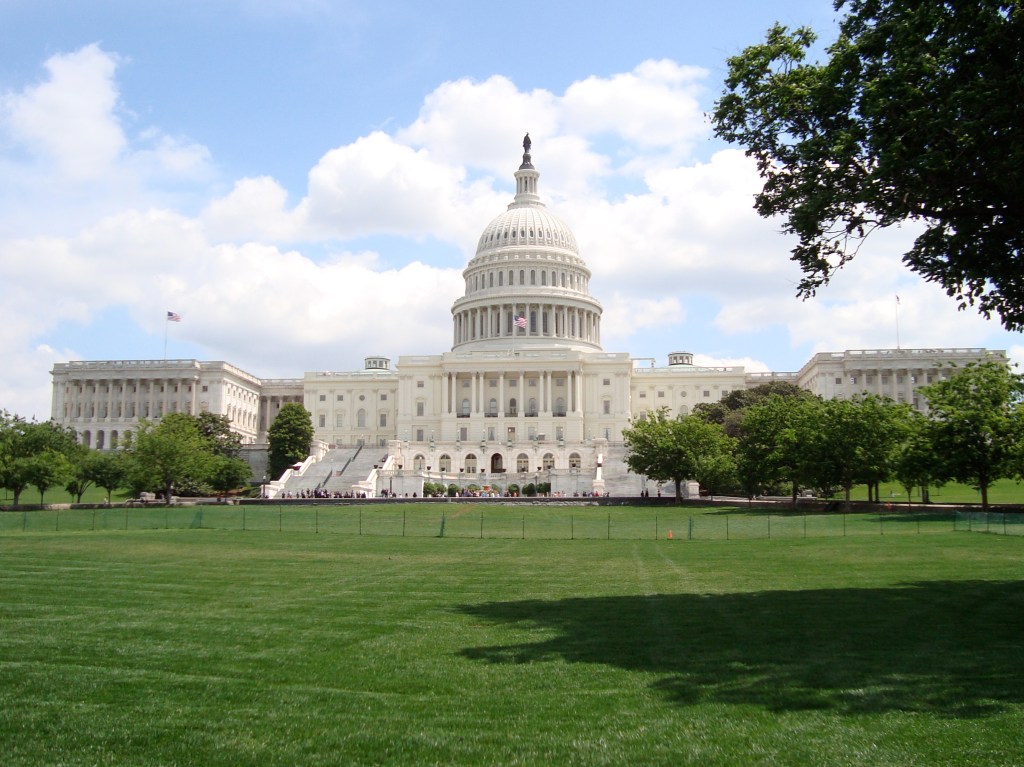
My favorite holiday is normally July 4. My inner patriotism comes out when I watch A Capital Fourth (PBS). The playing of patriotic songs before a large crowd in sight of the Capitol with fireworks in the background moves me. I most like seeing the various service bands and chorales performing their divisions’ military anthems–makes me want to go find my old Army uniform.
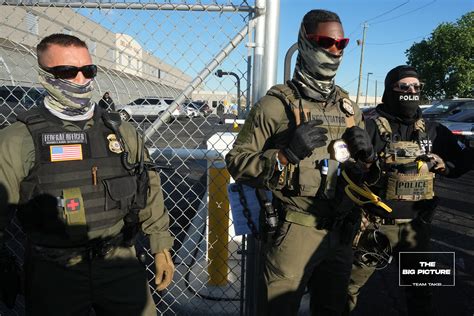
This year my patriotism is at its lowest ebb as our nation seems to move in same direction that Nazi Germany did in the 1930s. Recently President Trump flew to Florida just to visit the construction of a “concentration camp” in the middle of the Everglades. ICE agents wear masks and work in swarms to arrest brown-skinned people in California who are waiting at a bus stop to go fight fires or outside a Home Depot seeking day work.
Some of them are criminals but very few. Some are American citizens. Most are likely illegal immigrants who in most cases have been living in the US for years escaping climate change, political oppression, and working very hard at jobs most Americans will not take.
The secrecy surrounding their arrests prevents us from knowing who they are. The Constitution has been suspended. The Supreme Court allows the Trump administration to ignore the right to a trial.
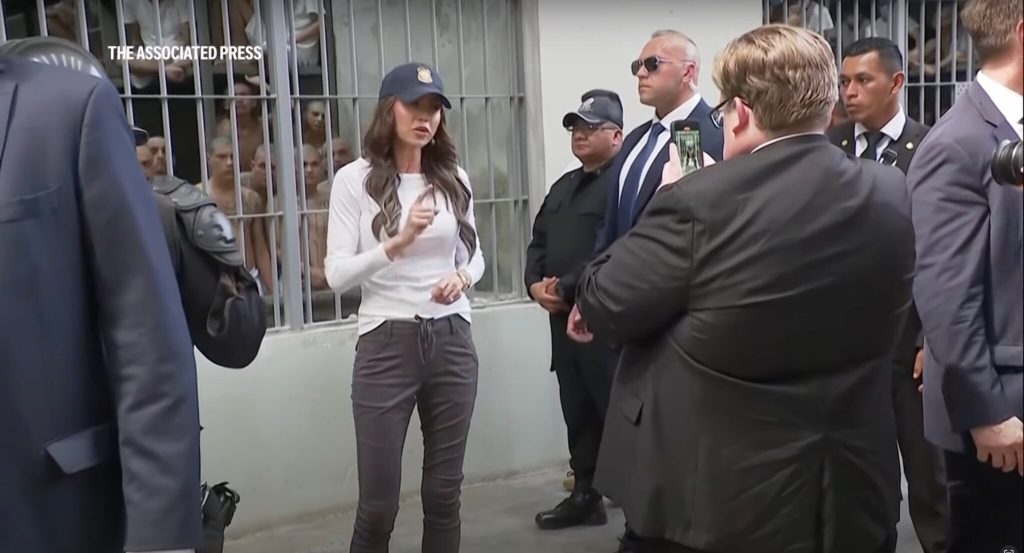
Homeland Secretary Kristi Noem is one of President Trump’s favorite props for media shows of the captured. I am sure he knows my male gaze will go toward Homeland Secretary Noem: she shows off her fine figure in tight clothes.
Screenshot (AP photo)
Her cuteness is juxtaposed with shirtless young men and husky cops. One photo shows a group of the captured squatting uncomfortably while manacled. I find the images repulsive, though I admit they pop on websites and Entertainment Tonight.
Joe Biden is famous for saying over and over throughout his political life that “America is the only country founded on an idea.” That idea is summed up in The Declaration of Independence and has served us well for 249 years. We are supposed to be the country that is different. We have an idea about the equality ofall people that binds us together in a system of law and order that has been working pretty well since of our invention by the open-minded enlightened founding fathers.
The MAGA-controlled Congress is now an extension of an administration that is literally afraid to buck the boss. Our Constitutionally mandated deliberative body is an arm of the Executive branch. I see more than a few parallels to the Fascist and Nazi dictators that were as popular in the 1930s as MAGA has become. The trains did start running on time in Italy and Germany. Order was restored via strong man dictatorial control.
That new order led to WW II and my parents’ participation in an effort to save democracy. I took pride in that as I watched A Capital Fourth but deep down I am very uneasy about the MAGA movement’s steps toward what could set up a totalitarian state that replaces our democracy.
The essence of the Christian roots of America is best said in the Sermon on the Mount. I reduce all the “Blessed are the . . .” to the Golden Rule: Treat others as you want to be treated.
How have we become a nation that sanctions the cruelty of concentration camps in Florida and banishment of brown-skinned people by ICE agents wearing masks to cruel prisons in the dictatorship of El Salvador?
I hope that the only country founded on the idea of equality of for all is not becoming a country gathering around an idea of hatred for the other and permanent division.
The Rock Hill Herald, The Los Angeles Times, The New York Times, and Le Monde start off my day. I love journalism because it makes me feel part of something bigger than my puny self. I look forward to The New Yorker and National Geographic because I find them even more mind-expanding.
My longest mental conversations occur via books. I take my time in figuring out what to read: if it is not a well-reviewed worthy book, I keep looking. My looking yields a list of potential reads that I order upon further consideration.
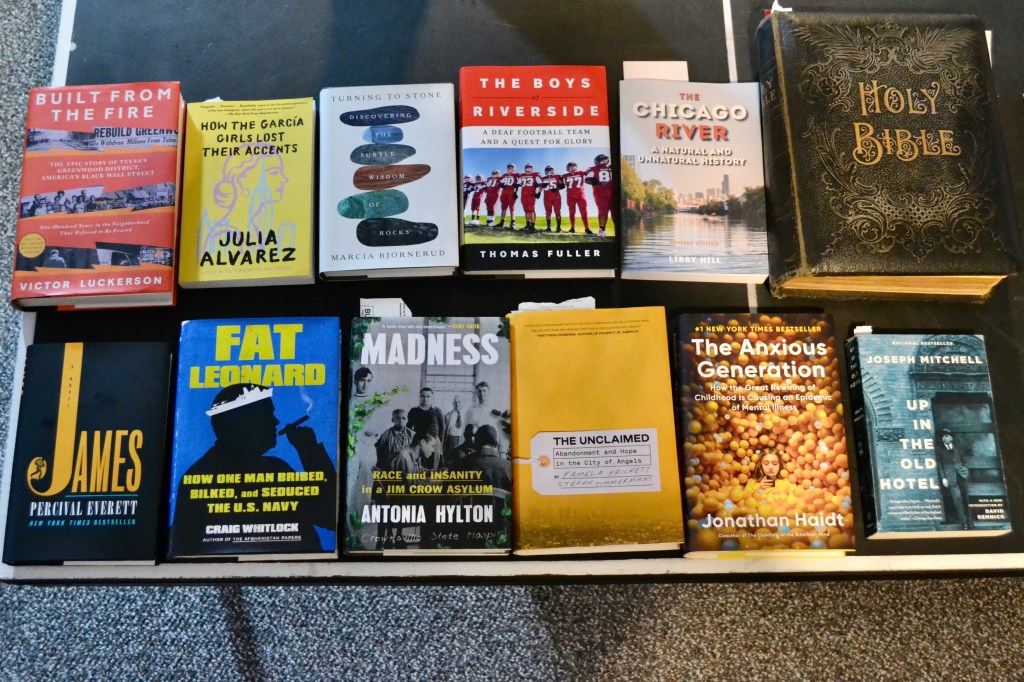
Up in the Old Hotelby Joseph Mitchell is a collection of nonfiction and fiction pieces by the person considered to the finest journalist ever to work for The New Yorker. Mitchell was from rural Eastern North Carolina and recorded the most vivid people who populated the greatest city in the world from just after WW I to the turn of the century. I still can’t get the sketches about the Mohawk ironworkers who wielded the steel for New York’s sky scrappers out of my mind. Mitchell felt the pulse of the center of the universe by recording the experience of ordinary people.
The Anxious Generation: How the Great Rewiring of Childhood Is Causing an Epidemic of Mental Illness (2024) by Jonathan Haidt is an objective, data-driven argument against the use of smart phones, especially by children. His argument against phones is schools catching on.
The Unclaimed: Abandonment and Hope in the City of Angels (2024) by Pamela Prickett and Stefan Timmermans looks at the over 150,00 Americans who die unclaimed each year; the 1,500 or so who die in LA in particular. I have known people who died alone to be discovered and unclaimed, except by York County, SC.
Race and Insanity in a Jim Crow Asylum (2024) by Antonia Hylton tells the story of the African-American prison laborers who were forced to build their own asylum near Crownsville, Maryland. SC’s Bull Street was no picnic; segregated asylums were similar to plantations: total white, racist control.
Fat Leonard: How One Man Bribed, Bilked, and Seduced the U.S. Navy (2024) by Craig Whitlock is set where most of our Naval fleet is: Indonesia, Malaysia, Thailand, Singapore, and the Philippines. A dogged Washington Post reporter uncovered billions of dollars worth of bribes to Admirals and Commanders. I am still trying to trust the Navy again.
James (2024) is a novel by Percival Everett that lies on the back of the great American novel The Adventures of Huckleberry Finn. Backwoods Huck Finn’s first person narration gives way to Jim’s, who has learned to read and speak standard English on the sly in Judge Thatcher’s study. His viewpoint expands the view of slavery and African-American characters and is a worthy parallel volume to the work that still tells the truth about our nation’s dark soul by using an innocent boy to reveal what our frontier was really like in the mid-1800s.
Built from Fire: The Epic Story of Tulsa’s Greenwood District, America’s Black Wall Street(2023) by Victor Luckerson tells the story of one of the United States great racial massacres where whites used the National Guard and airplanes to burn down block after block of Tulsa’s Greenwood neighborhood in 1921. A black man was accused of looking at a white female elevator operator as he sought a restroom. Anti-Black, Polish, Italian, Catholic, and Jewish populism fueled by populism brought the KKK to territory that had been accepting of others.
How the Garcia Girls Lost Their Accents (1991, 2019) is a novel by Julia Alvarez that tells tells the story of how she and her two sisters assimilated into U.S. culture in three periods: 1989–1972, 1970–1960, and 1960–1956 in reverse chronological order. The first section, then, represents integrated young Dominican-American women growing up America but with a foot in the past. As the autobiographical novel ends, it recalls their earliest Dominican memories. A modern classic for all of us. We were all immigrants.
Turning to Stone: Discovering the Subtle Wisdom of Rocks (2024) by Marcia Bjornerud is a combination of her life story in a rural Wisconsin town similar to my own Saluda, SC, her work as a geologist, and a cogent explanation of the science of modern geology. Her superb work teaches me that to see the world in biological way is to misunderstand that everything on Earth is rock first.
The Boys of Riverside: A Deaf Football Team and a Quest for Glory (2024) by Thomas Fuller reports on the eight-man football team of Riverside School for the Deaf in California. The excitement of eight-man, high-scoring football is front and center but the glimpse into a deaf culture is an even more lasting part of this sport story.
The Chicago River: A Natural and Unnatural History (2019) by Libby Hill is a history of the flat place along side Lake Michigan that linked the east to the midwest and became Chicago. It is a history based on the technical manipulation of the Chicago River so that trade could flow to establish one of the most important port cities in the world.
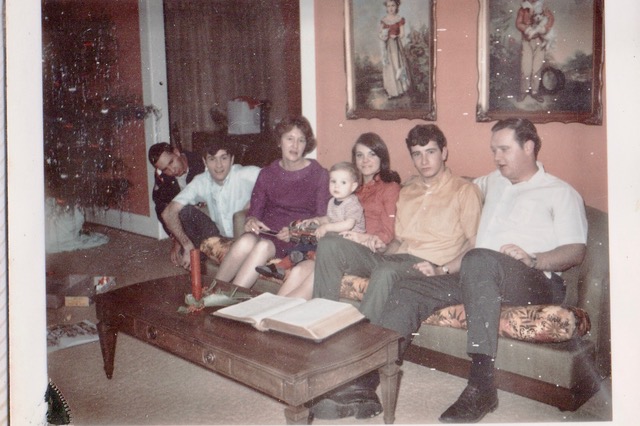
Holy Bible: Pictorial Family Bible (A.J. Holman Company) is a King James version that belonged to my mother. I read it as a small boy for the illustrations the same way I read comics, working back from the illustrations to get at the meaning of the words.
It is lying of the coffee table of my mother’s home in a photo from 1968 or 1969. The person on the far left is Nathan Powell who was inducted into the Forrest family. I can tell that it is open to the NewTestament, likely the Christmas story from St. Mathew.
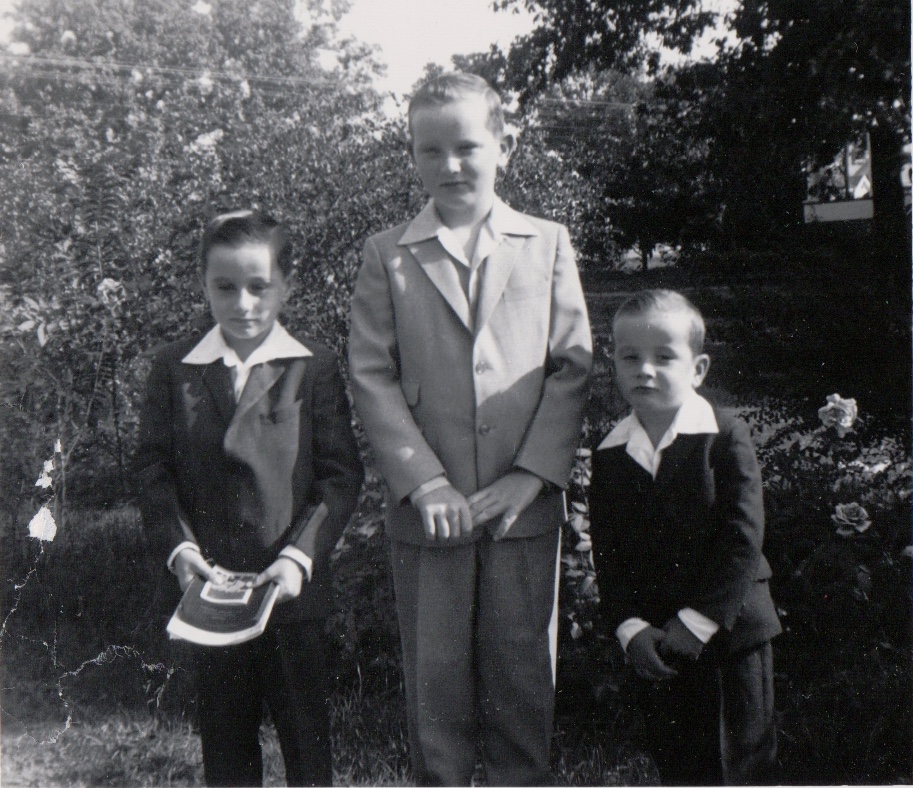
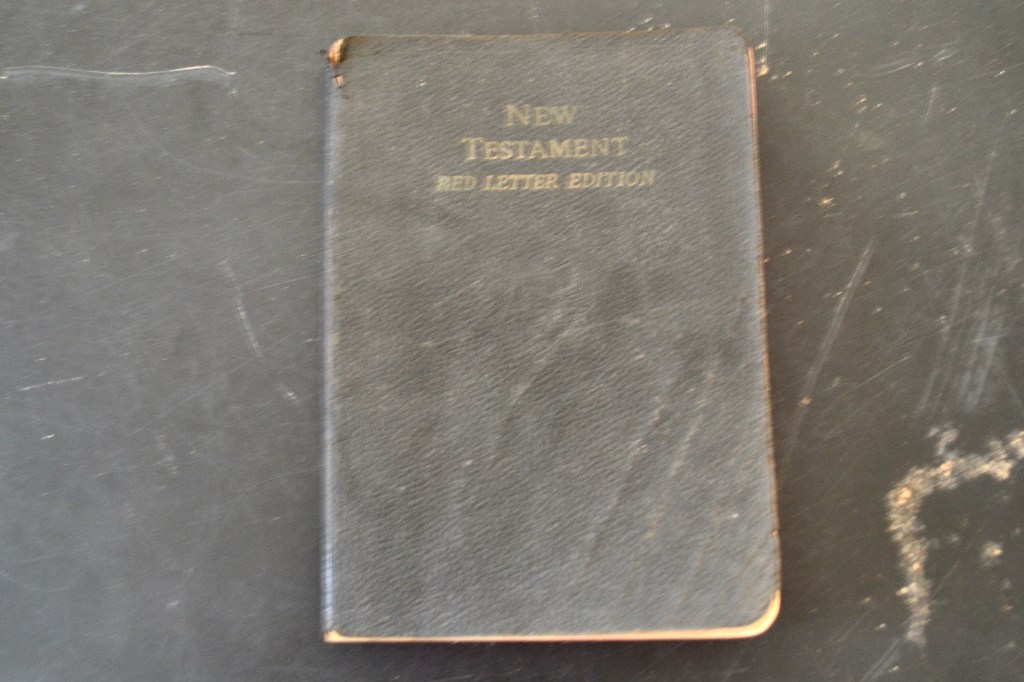
I read Leona’s big clunker daily for about a year a lunch. I liked its large print and my long association with the big book. It was not my favorite or personal Bible. I much preferred my skinny copy of the New Testament which I am clutching in the next photo.
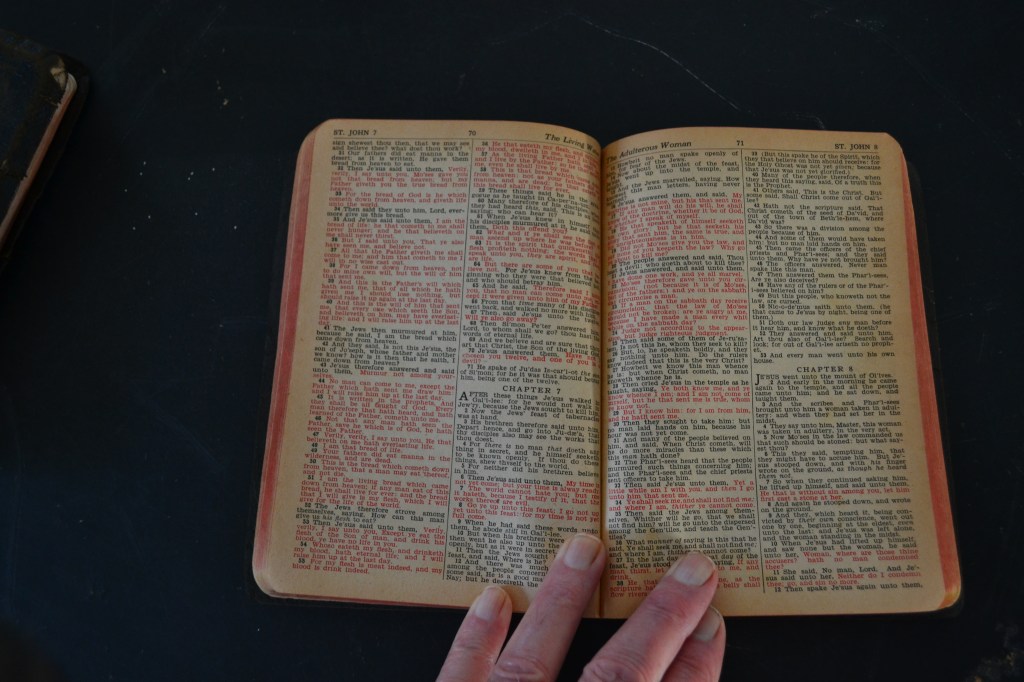
My brothers Ernest (Butch) and Cally are to my right. I reckon that the extra material in my hand is from Sunday School. I liked the skinny New Testament because it was light and could be folded into a coat pocket. The red print fascinated me because I believed then that they were the actual ones spoken by my early hero Jesus..
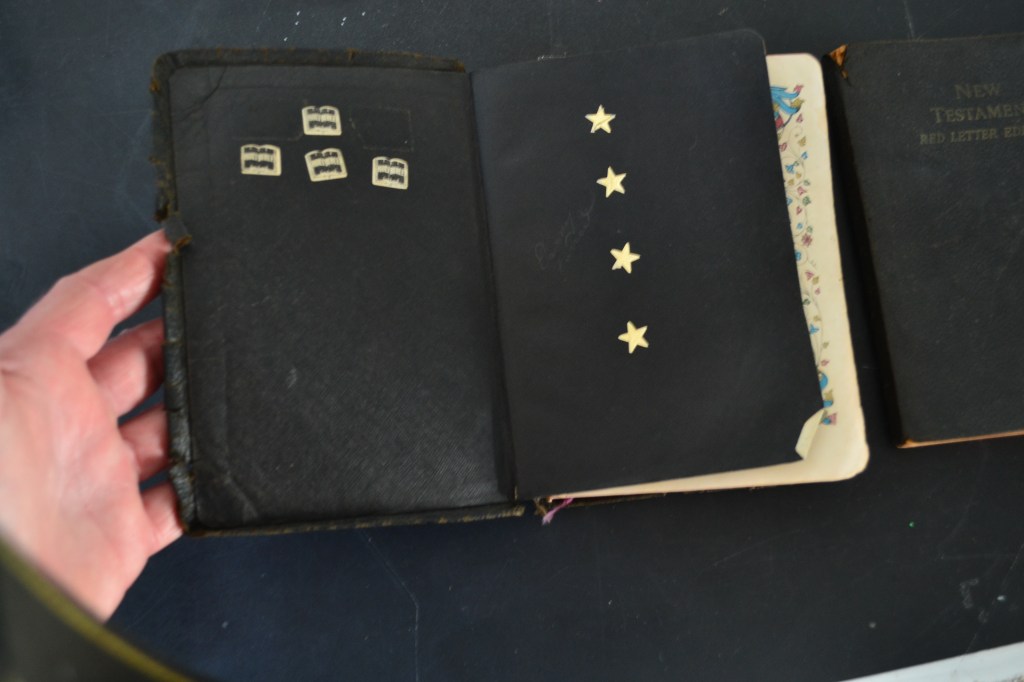
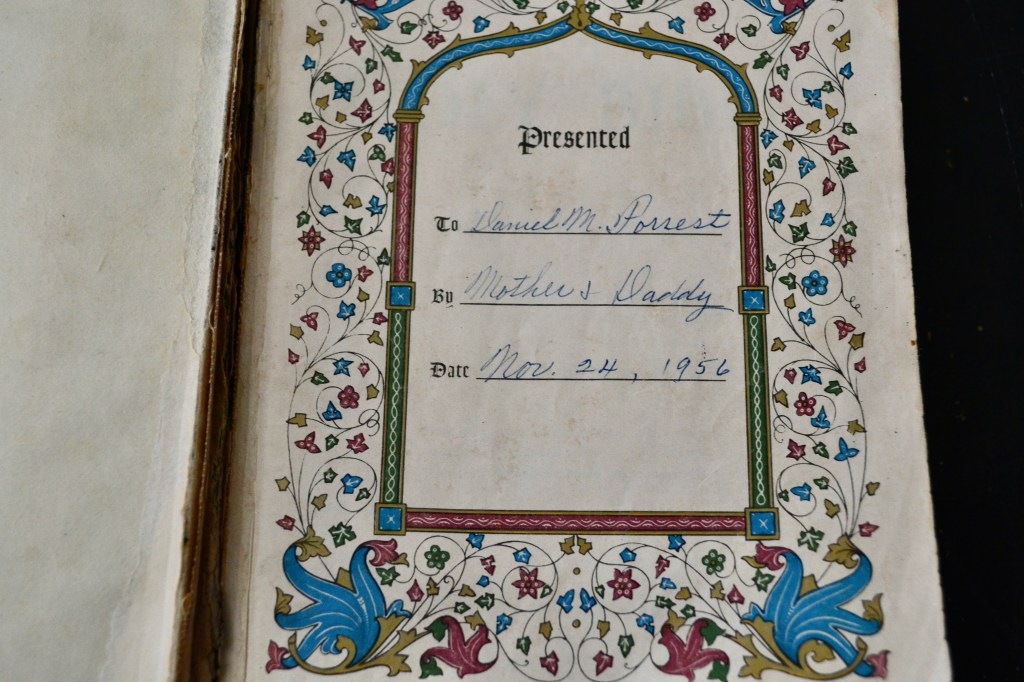
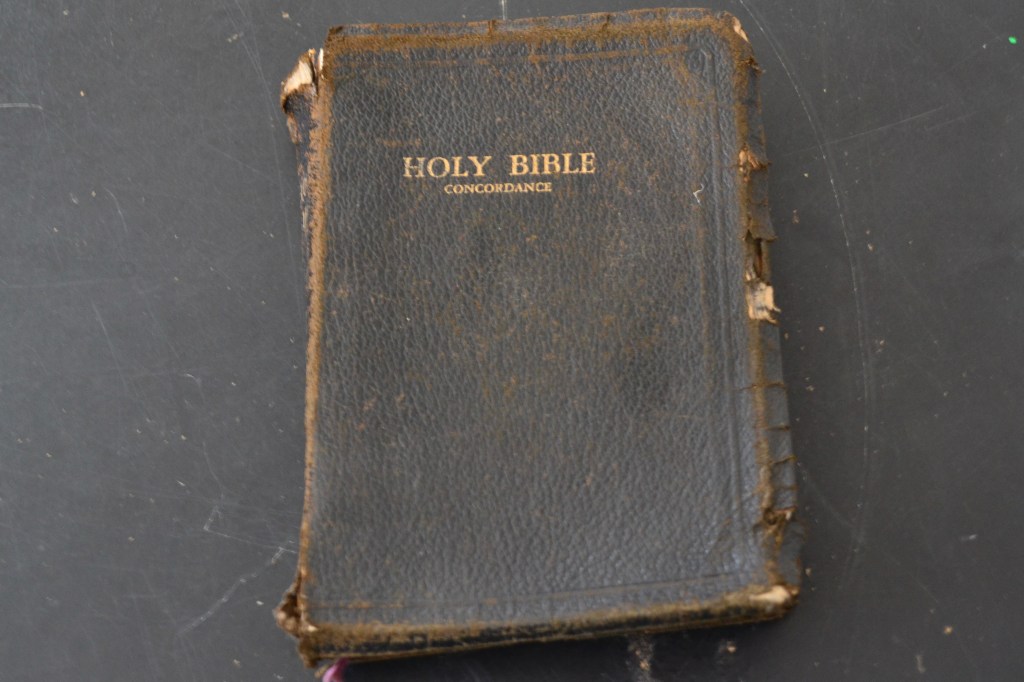
That New Testament and my old main Bible from 1956 are still with me. They were part of my research shelf in most every classroom that I ever taught in. Teaching English for 34 years led me to a lot of scriptural references for the literature under discussion. Christian references dot both English and American literature.
My old main Bible still holds some gold stars and Bible stickers. I seem to have lost my Sunday school medals along with my Army medals.
Sunday School, Preaching, Training Union, Revivals, Royal Ambassadors for Christ, and Vacation Bible School are the main forms of worship that I engaged in. For sure I loved Royal Ambassadors (RAs) most for the chance to engage in a kind of Baptist Boy Scout organization with my peers.
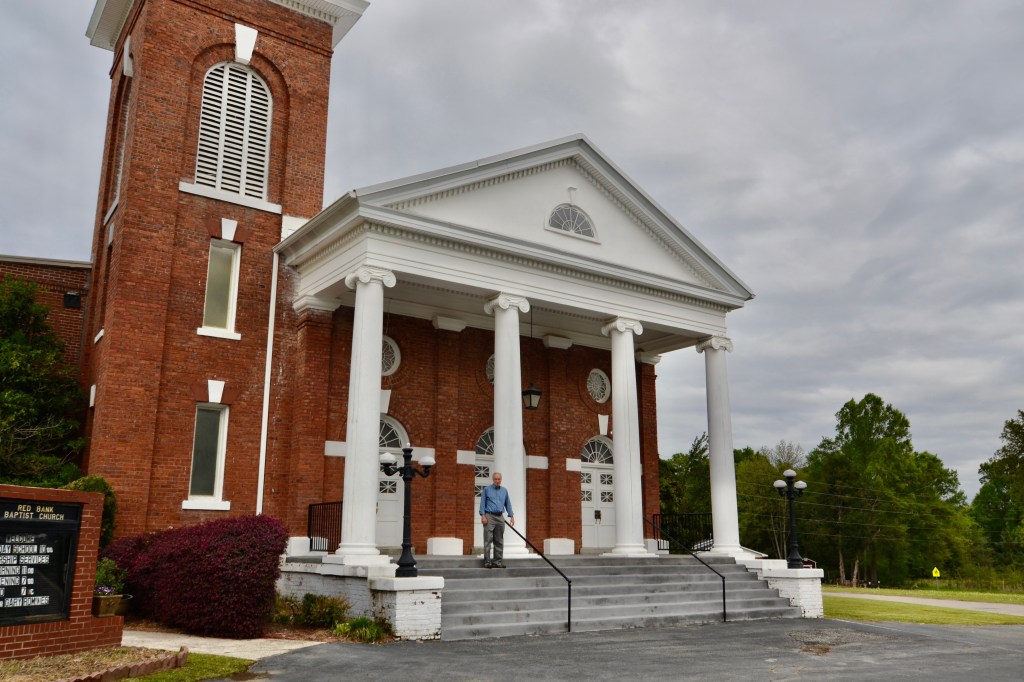
I did my worshipping at Red Bank Baptist Church which lies at the end of Church Street in a small valley along side a creek just two blocks from where Main and Church meet to form Saluda, SC’s main intersection.
My recently deceased brother Butch took this photo of me a few of years ago when we visited my father Harold’s grave space which is also the grave site for my younger brother Cally. I vividly recall singing Onward Christians Soldiers while marching with my fellow Vacation Bible School classmates up the steps into the sanctuary to stand on the pulpit stage for Bible drill. I reckon I got a star or two for getting to a verse before others. (Think spelling bee meets Jeopardy.)
I came to my nearly year long reading of the Bible via a book by Tim Alberta, one of our best objective writers on Christianity and the son of a famous mega-church minister in Michigan. The Kingdom, the Power, and the Glory: American Evangelicals in an Age of Extremism (2023) was my first formal attempt to answer a riddle that still puzzles me: “How can Christians support the profane liar who is now our President?”
I gave my copy to a minister friend who is likewise puzzled. MAGA has merged with evangelical faith. John 8:44: When he lies, he speaks his native language for he is a liar and the father of lies. Trump is a father of lies. He never stops. Do Trump’s followers really believe that Ukrainian President Volodymyr Zelensky started the war when Russian invaded his country, not vice versa? Trump is now preaching that doctrine on his own social media site, Musk’s X, and Fox.
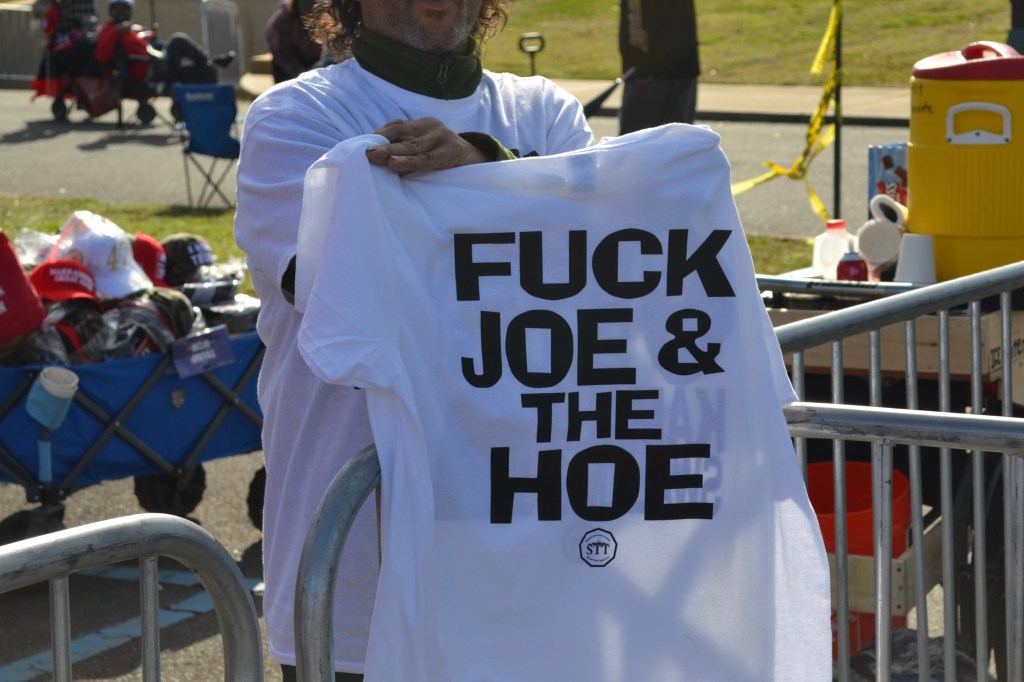
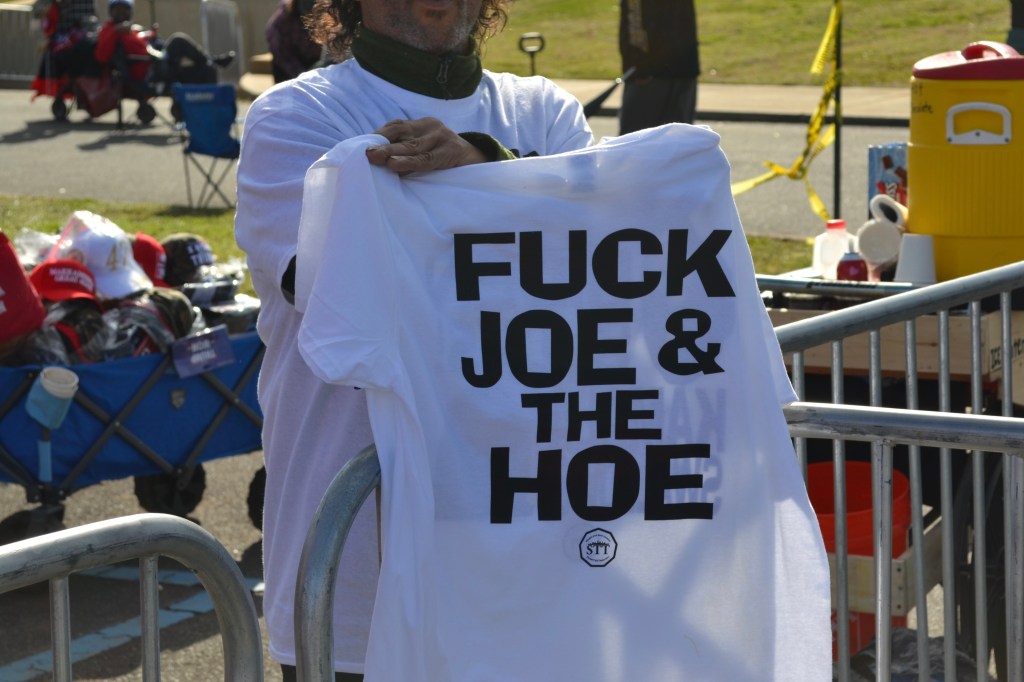
Trump’s big lies bother me most but his bearing and language cling to my imagination. In person he is as vulgar and ugly as video clips show–and audiences, many Christian, eat it up. His fans openly wear and sell apparel that disparages others in profane ways. Vice President Kamala Harris is a “hoe.” I have been to two of his rallies in person to confirm what I could not believe. He mocks those who oppose him by use of the kind of name-calling associated with seventh graders.
With the evangelical full embrace of Trump foremost in mind, I read the New Testament first. I enjoyed my first straight through complete textual reading. I like to walk through my old home town occasionally and my reading felt like walking physical street blocks that I knew. When I was young, I had many street addresses/verses committed to memory. I often smiled at what I knew by heart in my youth.
The supernatural miracles were vivid in my mind and more numerous than I remembered. I used to hold what I learned at Red Bank Baptist in my head as I watched Oral Roberts on WJBF in my youth. I remember pestering my mother about Roberts’ instant healing of blindness etc. but no substance remains. “In the name of the Holy Ghost” he would say to start a prayer and off came the polio braces of a stricken person down front that Roberts gripped with a free hand while raising the Bible with his other.
My adoption of Jesus as my first hero formed my life, which at 76 is now clear to me. I used to want to be a Lottie Moon-type missionary and go to the poor in undeveloped countries to help them. That love for Jesus gave way to my avid embrace of the most pubic Christian of the day: Reverend Martin Luther King. For real, I wanted to be him. I wanted to help heal humanity. After graduating from USC and serving in the Army, I turned down two lucrative job offers to become a teacher. Jesus was a public servant as teachers are.
Trump is not in the New Testament at all. My reading of the work–Revelations aside–confirmed what my seeing Trump and reading about him in hundreds of objective accounts had led me to know: Trump is an egotistical opposite of my first hero who suffered all of the little children to come unto him and sought always to unite, not divide.
Revelations was a good prologue to the Old Testament where I saw Trump baked into the batter. Isaiah 33:22 For the Lord is our judge, the Lord is our lawgiver, the Lord is our King; he will save us. Substitute “Trump” for Lord. Trump is a strong man. In the last election he narrowly won out over a strong woman, but women are always below men in the Old Testament. The male hierarchy always seeks a strong man to vanquish non-believers and deliver vengeance.
Despite living in a post WW II era where until recently a new model for nations based on democracy emerged, the old fundamental desire for a strong man lives in the heart of voters who select candidates based on the their gut feelings, not rationale policy built upon data. Then and now a candidate must be a star and a bully boy who can beat back transgressors.
The idea of cooperative government does not exist in reading of the Old Testament. The strength to kill and destroy those outside of faith is fundamental to the record of king after king and king which is the basis of most of the books of the Old Testament.
Of course my first handle for picking up the ideas from my reading gave way to various others. Early on I became fascinated by the foreskins of penises. Like scalps and heads, they were often collected as proof of the slaying of those outside of Jewish faith. The enemy had foreskins.
So do I. I am scanning my notes to remember if shepherd boy David of the slingshot fame was sent back to collect 200 foreskins of the uncircumcised Philistines as further proof of his right to become a leader after embedding a rock in the forehead of the giant Goliath. He got those from the slain whose ancestors now inhabit parts of modern Iraq, Turkey, Iran, and Syria. King Saul was pleased and gave him his daughter ensuring his eventual rise to power.
I Samuel 18:27 Wherefore David rose and went he and his men to slew of the Philistines two hundred men;and David brought their foreskins , and they gave them in full tale to the king, that he might be the king’s son-in-law. Saul gave him Michal his daughter to wife.
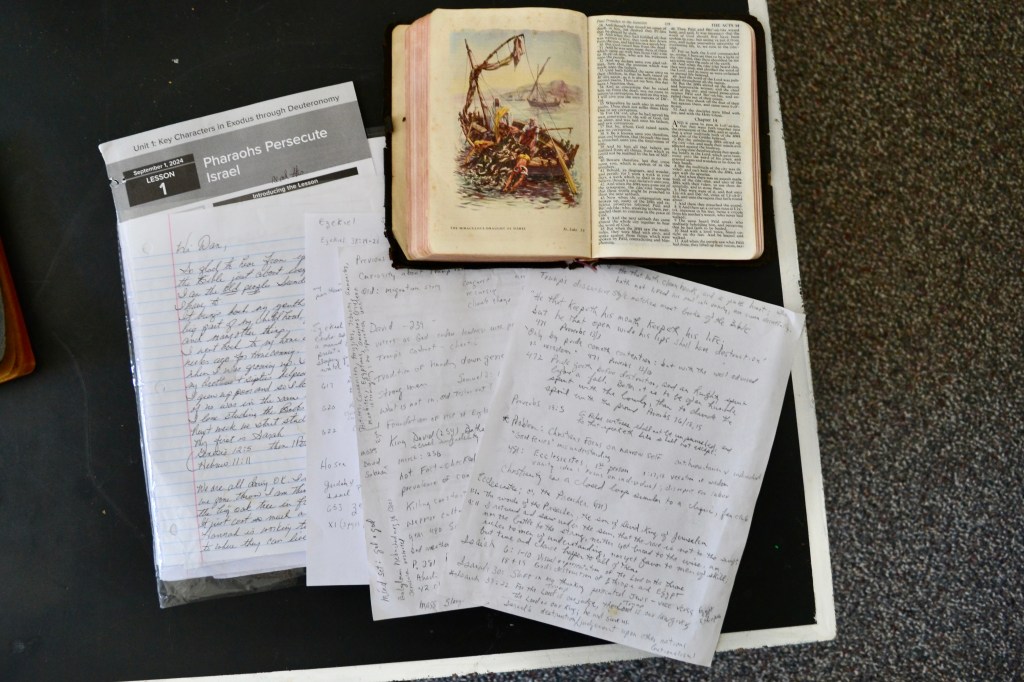
Counting the notes sent to me by a friend who teaches adult Sunday School classes, I have about fifty pages of handwriting that are as hard to follow as the various books they were extracted from. To read the Bible as a book requires the imposition of reading goal, something like the handle on a suitcase that allows one to pick it up.
That uncircumcised handle gave way to the Mexican border or any border handle where desperate people try to escape oppression. Using American munitions and military technology, the modern day inhabitants of Israel have been exterminating Palestinians who unfortunately have angry young men turned warriors embedded within their homes and hospitals. To pay for Bibi Netanyahu’s poor border security that allowed penetration of insurgents that killed and took hostage about 1,700 Israelis living on what until recently was part of Palestine, the modern day state of Davids have killed north of 50,000 Palestinians, mainly women and children.
The constant repetition of the Jewish migration out of Egypt and into the promised land forms the bulk of the “plot” of a whole reading of the Hebrew text. The Jews were folded into the Egyptian population as a result of climate change. (Climate change is another obvious handle to grasp in reading the Hebrew story.)
Objecting to the country and culture that took them in, they revolted and migrated to what they call their holy land. The point of conflict in the narrative is eliminating the other, that is destroying nonbelievers. That conflict point loops back over and over as successful Jewish strong men rule gradually gives way to sin. The sinning sets up a new cycle of fighting.
The chief sin, almost the only sin outside of whoring, is failure to worship the one Hebrew god as per rabbinical law. Constant war and mass killing of the other forms story after story right down to one of my favorite books, the Book of Daniel. A succession of heroes curry favor by showing more obedience to the Jewish god than others and thus are lifted up as leaders. Proverbs 19: A false witness shall not be unpunished, and he that speaketh lies shall not escape.
I suppose I ended up my reading by merging it with the nightly reports of mass killing of Palestinians in the West Bank. The destruction I witness on programs like The News Hour and daily newspaper reading burns deeply into my soul as does the Ukraine coverage.
Gradually I have come to see Egypt, Syrian, Lebanon, Jordan, Iraq, Iran, and Syria as as modern nations whose early formation and history is one of conflict with a sect that demands adherence to their god. The Hebrews literally brought avenging angels into conflicts to kill and successfully prayed for their god to bring famine and starvation to those outside of belief.
Isaiah 37:36 Then the angel of the Lord went forth, and smote the camp of the Assyrians a hundred and fourscore and five thousand; and when they arose early in the morning, behold, they were all dead corpses. Isaiah is reassuring Hezekiah that their god will not tolerate Assyrian influence in the Holy Land. This is one of numerous references to the Hebrew god fighting the other in a time of migration, famine, and climate change. 185,000 lost their lives because they were outside of Hebrew faith. I fear strong man government that assumes its god is righteous for killing the enemy.
I have now and have had many Christian friends. I am thinking of Robin who is a lay preacher, newsletter writer for her church, and baker of the first order. She drops treats by and leaves us literature. Never would I want to upset her by asking a question about Christian support of what is beginning to look like the rise of a Neo-Nazi populist party. I did recently bring up Trump-Christian bonding to Jason two doors down the street but quickly sensed a tenseness entering into our friendship that I do not want to cloud. Penetrating the minds of those who already know the truth and regard questioning as heresy and a form of hostility seems pointless.
My weird mind loves rational discussion of data and opinions that seek to flip what I think I think. A good discussion or piece of writing that causes me to re-formulate my received information and opinions delights me, invigorates me. I suppose my mind has been so conditioned by science that it welcomes promising hypotheses. I used to long to be Jewish or Catholic to be member of a tribe and filled with sureness of my view but my old age and recent reading of the Bible tell me that I can not set aside thinking for blind belief.
My main operating set of beliefs align with those set forth the allies in the post-WW II world. I believe in social cooperation, mutual respect, the Declaration of Independence and Constitution, and free trade within limits. I believe in what MLK and Jimmy Carter dedicated their lives to. I believe in the golden rule.
Growing up, kids born in the late 1940s and early 1950s took westerns for granted. Watching them via television was hard for me because tv was in its infancy and set reception was problematic. Today I typically watch more tv in a day than I did in a week as a child.
I saw most of my westerns as part of double bills on Saturday afternoons at the Indian Chief theater in Saluda, SC. 25 cents, two shows. Nothing stuck in particular but cowboys chasing Indians was embedded in my head from what I saw and translated into moving plastic figurines of western figures on dirt in play formations. That and, of course, small plastic Army figurines. Hours worth of imagination were born from movie shots and translated in movement of plastic heroes and villains in dirt patches surrounded by grass.
What I distinctly remember is Larry Powell and some other kids getting into trouble for standing up beside their front row seats and pulling out their caps guns to shout “Bang, bang!” during exciting parts of cowboy action. I preferred to sit a few rows back and was more retrained: I left my guns and holsters at home. Sometimes Mr. Buck, the theatre manager, had to walk down front with his peculiar flashlight that showed red along a tube and came to a spotlight of white. He quieted down the excited kids.
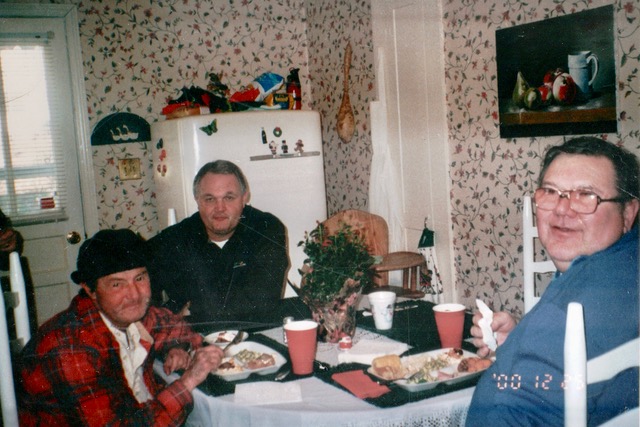
Larry Powell was a classmate and is shown above in a photo from a Christmas at my in-laws in Saluda decades later on the right. Nita’s brother Jerry invited adult Larry over to eat some holiday fixings. The memory of cowboy Larry remains vivid as does my first “date” at the Indian Chief. I wore my new corduroy jeans and whatever shirt I primped in last for a chance to sit with Glenda. I remember waiting for her out front and the meeting of our hands during the picture. She was so beautiful and I was so shy but that is another essay.
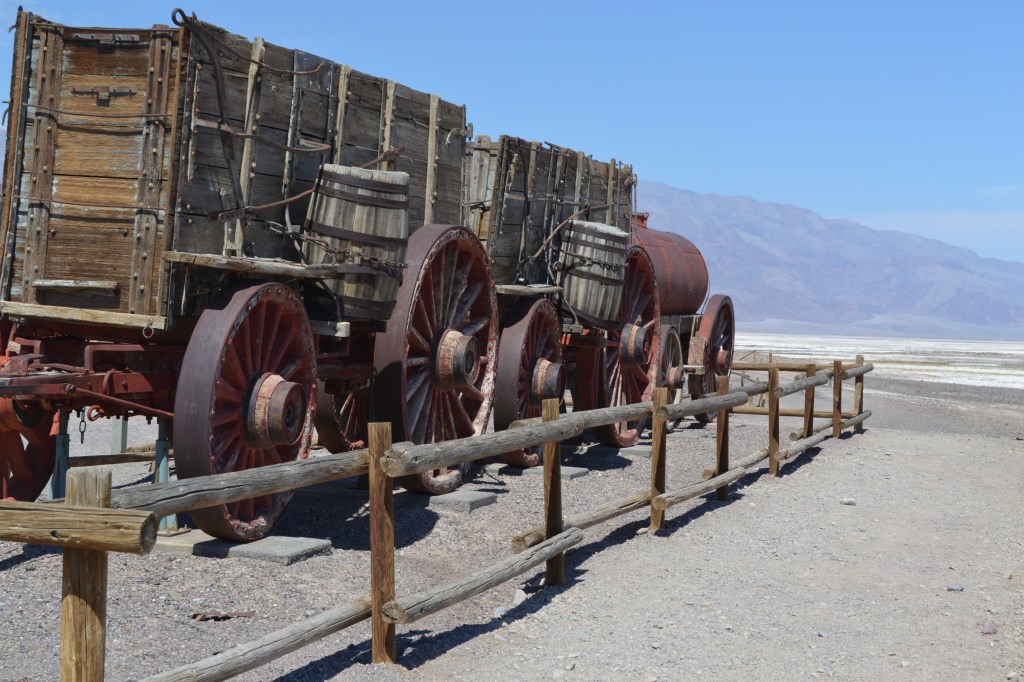
About a year ago I fell into watching Death Valley Days, a show that I sometimes saw on television. It is an anthology series created by Ruth Woodman that played from 1930–1945 on radio and on tv from 1952–1970. It was sponsored by Twenty-Mule Team borax, a type of detergent additive that my mother used to get my Lee Riders free from grass stains on the knees.
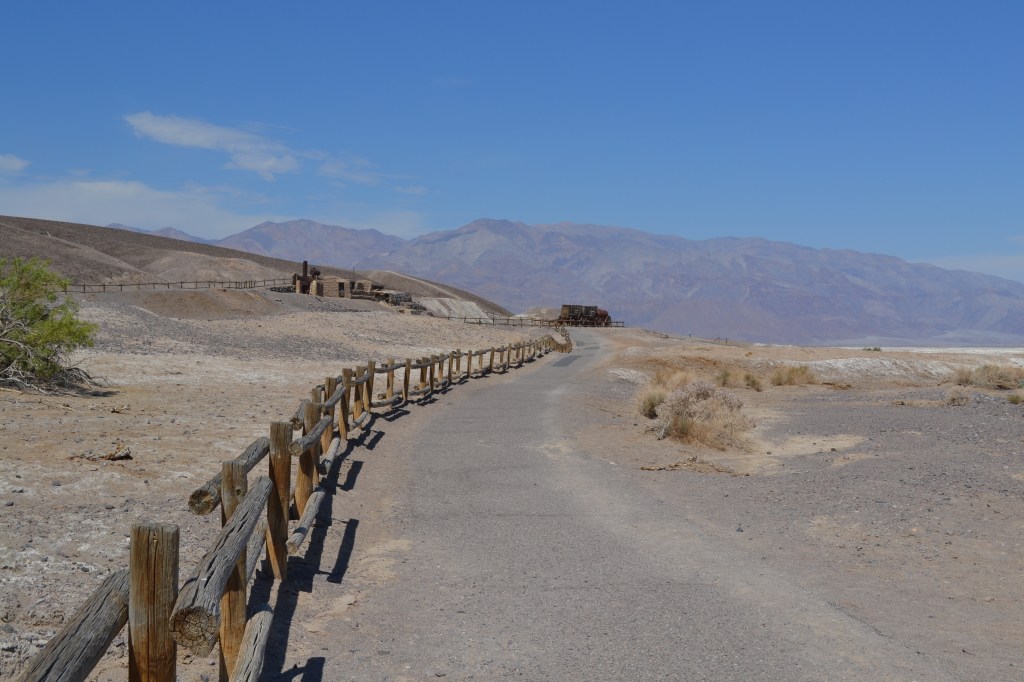
The photos show remains of the borax industry in Death Valley, California from my May 2017 camping trip out West. Death Valley Days begins with filmed shots of the twenty-mule team at work but includes programs related to all of the western United States. Each show is a discreet presentation that re-enacts stories related to that part of the country.
Death Valley, California, is on the eastern side of the Rockies not far from the Nevada border. Go once and never forget. The arid heat makes breathing hard but the short hikes to historic sites with artifacts preserved by the arid environment is first rate. Death Valley Days was filmed mostly in the park.
Each program was introduced by a host starting with Stanley Andrews, Ronald Reagan, Robert Taylor, and finally Dale Robertson. The black and white landscape shots satisfy me as much as the history explored in each episode. For nearly thirty minutes I leave the divided current time of impending turmoil to find release in America’s expansiveness. Respect, dignity, telling the truth, and human kindness show up in each program.
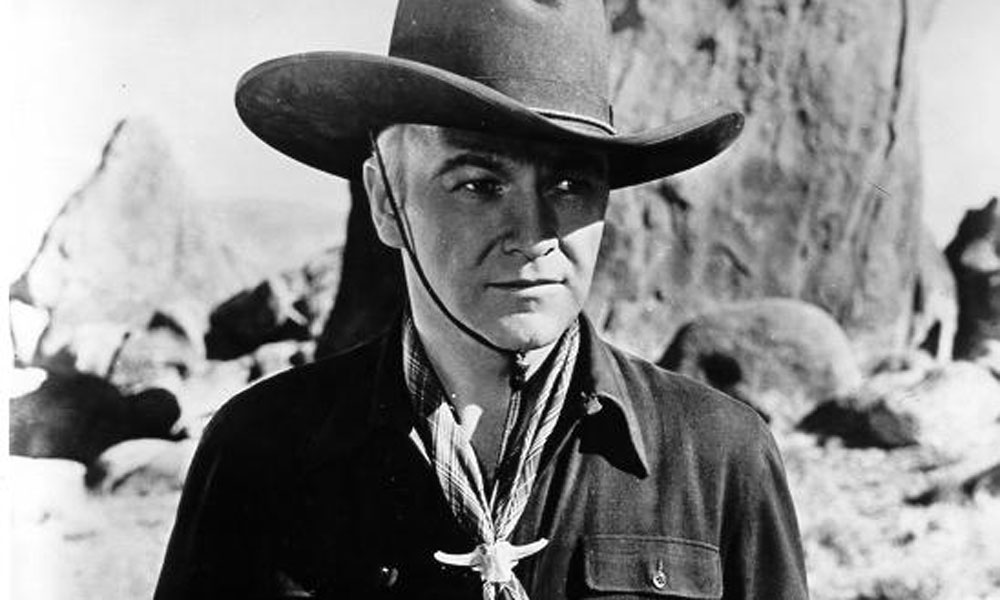
Unlike Roy Rogers, Hopalong Cassidy was just a vague name from childhood until I fell into my daily dose of The Hopalong Cassidy Show. I had seen his image and likely one or more of his movies but they reach far back for someone my age.
“Show” is misleading because the first part of the series is actually a collection of sixty-six movies that the show’s star, William Boyd, bought along with the rights for the series from Clarence Taylor. (Most factual attribution is taken from Wikipedia). Boyd saw promise in the new invention of television and went station to station in 1948 to rent his acquired properties that rapidly lead to the shorter tv series and the explosion of the western on America’s new at-home small screens.
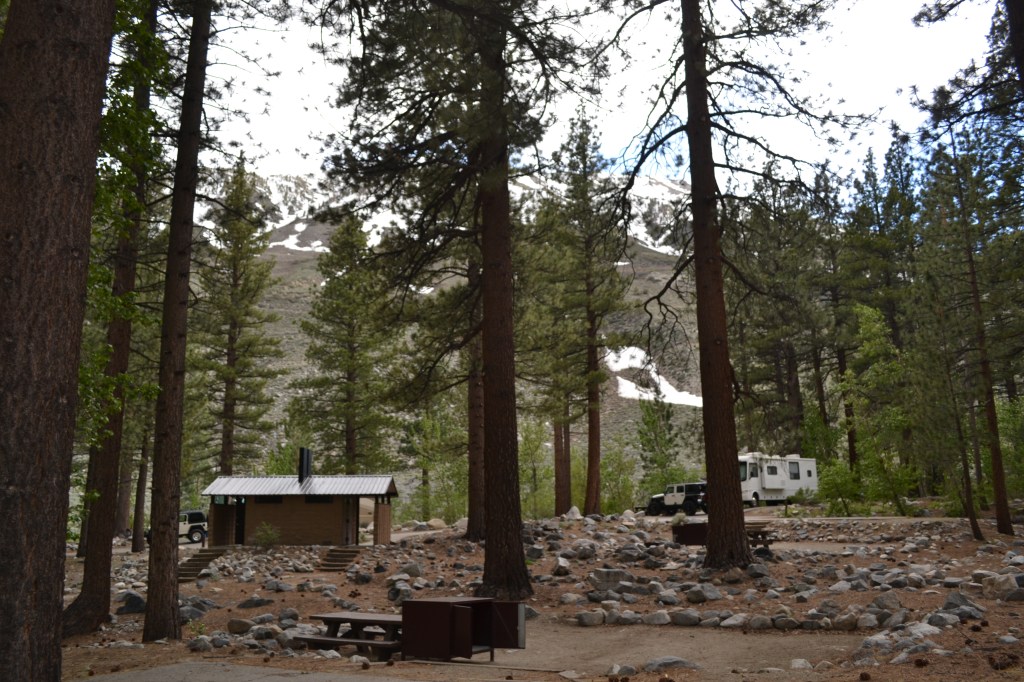
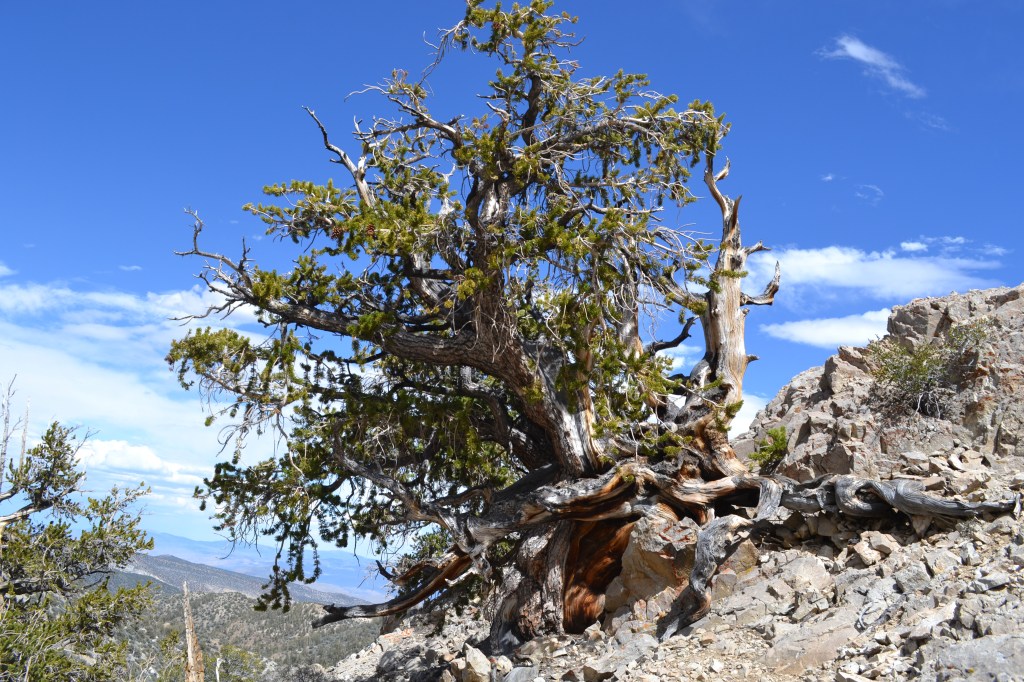
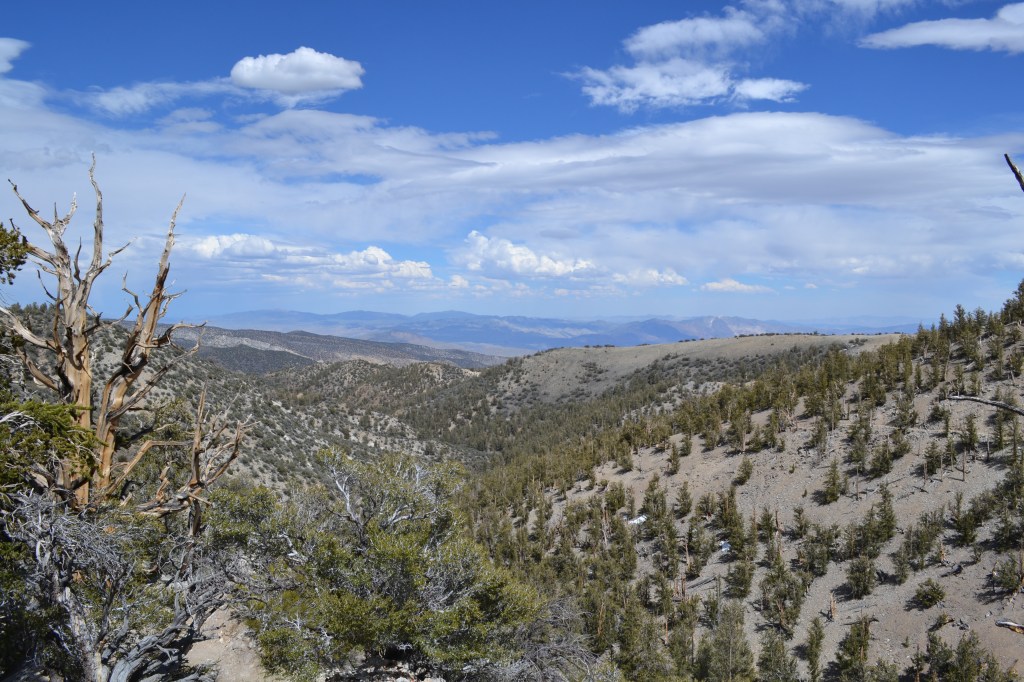
Sage Flat Campground north of Death Valley is in the Owens Valley near Kings Canyon National Park south of Lake Tahoe. Owens Valley was home to most of the filming of Hopalong Cassidy. I camped there after leaving Death Valley on my way to seeing the nearby Methuselah trees or bristlecone pines, the oldest living trees on the planet (probably). Difficult to access Shulman Grove is close to Sage Flat Campground.
The stunted bristlecones of Shulman grove appear half dead but are living remnants of time before the United States and Jesus Christ. They grow at altitudes from 9,800 to 11,000 feet. The oldest one known in Shulman Grove is 4,856 years old (unmarked). The giant mountain redwoods in nearby Kings Canyon are younger.
The Hopalong Cassidy Show took advantage of this landscape with giant panning shots surrounding the characters, especially in the movies that are appended to the beginning of the tv series. It became the first network series and sold a lot of metal lunchboxes for Aladdin. Hoppy is played by William Boyd as a mature adult. Hoppy’s character is lot like that of Sheriff Taylor on The Andy Griffith Show: he mediates disputes and reserves gun fire.
Most cowboy heroes that linger in memory fail to capture empathy. The roles of John Wayne come to mind. Way too much swagger for my tastes. William Boyd’s portrayal of Hoppy has a pureness. He comes across like Jimmy Stewart in It’s a Wonderful Life. He does not run off at the mouth. The camera follows his gaze as he looks around in a problem situation and seems show his mind working. He thinks more than he shoots. He cares about others and fairness. Call him the Golden Rule personified.
Watching these Westerns–I give myself a small but steady dose daily–takes me away from time I live in when American justice seems like a joke to this kid from the late 1940s. They lighten my mood and give a view a vistas with twenty-mile sight lines that clear the clutter in my brain.
Until recently I would have responded “The United States of America” in an eye blink. I am the son of a WW II veteran and a veteran myself. Born in the late 1940s, I imbibed patriotism from the very air that surrounded me in small town Saluda. As a boy I recall poking poppies in my button holes on Memorial Day and feeling quite proud.
I read the American Legion Magazine and remember the politicians of the day speaking to audiences with rhetoric soaked in the red, white, and blue. William Jennings Bryan Dorn and Strom Thurmond bounced their words about patriots and the communist menace off my ears in person.
My patriotism expanded seeing the success of the Civil Rights campaign. I got it. We are a country that values democracy and fair play. Ironically it deepened during the Vietnam War era, despite Nixon’s prolongation of the conflict. His promise to end the war was hollow but American protest ended the war. Democracy worked. LBJ pushed through laws guaranteeing Civil Rights. I loved America with my teenage soul.
My country the greatest clung to me. One of the most profound joys of my life was to retire from my regular work after 34 years and fall into idea of camping in every state. I have slept on the ground of 47, most more than once. I have visited most of America’s national parks and know her beauty and grandeur first hand. Reading books about the Civil War and Truman or Hoover would send me on history camping expeditions to walk its battlefields and see where Presidents grew up.
I have gone volcano camping in the West and traced the Nachez Trail and followed the Mississippi from its humble creek bed origins in Minnesota to New Oreleans on various camping trips. The majority of the time I put my tent on pads in parks designed and built by the CCC during FDR’s Presidency. America’s parks are proof of it greatness and a permanent testament to its citizens hard labor.
The re-election of former President Trump jolted me. My off and on melancholy turned to border-line depression. I do not mind the rise of mercurial extreme rightwing politics so much as I hate Trump for instigating an insurrection and denying his loss to Biden. Trump has changed America and me by fomenting, directing, and instigating an attack on the seat of government for all of us to see on TV. His supporters damn near killed Vice President Pence and one of them took time to drop his pants to defecate on the Speaker of the House’s desk.
Call it a slow-developing epiphany. I came to realize that my love for America needed to re-examined. I have taken my love for her off the shining top shelf. She is still high up, especially the idea of her as a location for immigrants–we are all immigrants–who come to the land of opportunity and literally constitute the nation’s motto: E Pluribus Unum.
Never before have we had citizens anxious to show fealty to a would-be dictator/king. I have seen him in person at rallies belittling others. His junior high school bully boy style has created more cliques than I ever saw in my years of overseeing children in hallways and cafeterias. Who would have ever thought that a former President’s name-calling would come to be adored? I accept his election but disdain his divisiveness.
The “out of many, one” notion is under attack by dark forces that do not respect others. Recent news of Trump’s purposeful nomination of cabinet officers who do not have the credentials that required to do their jobs is disturbing as is their complete fealty to Trump which seems to supersede their loyalty to the Constitution.
All of President Biden’s cabinet has remained intact, even though some of them have told hard truths to Biden. All of Trump’s former cabinet changed over time again and again in the span of his first tumultuous term; he had five Secretary of Defenses. He proudly, publicly proclaimed that he was smarter than the military’s leaders.
We could be in for a very destabilizing time which would delight Trump and Musk and the other billionaires who have coalesced around the incoming administration. I think the instability could cut the legs off our democracy as it currently functions. A type of autocracy could develop.
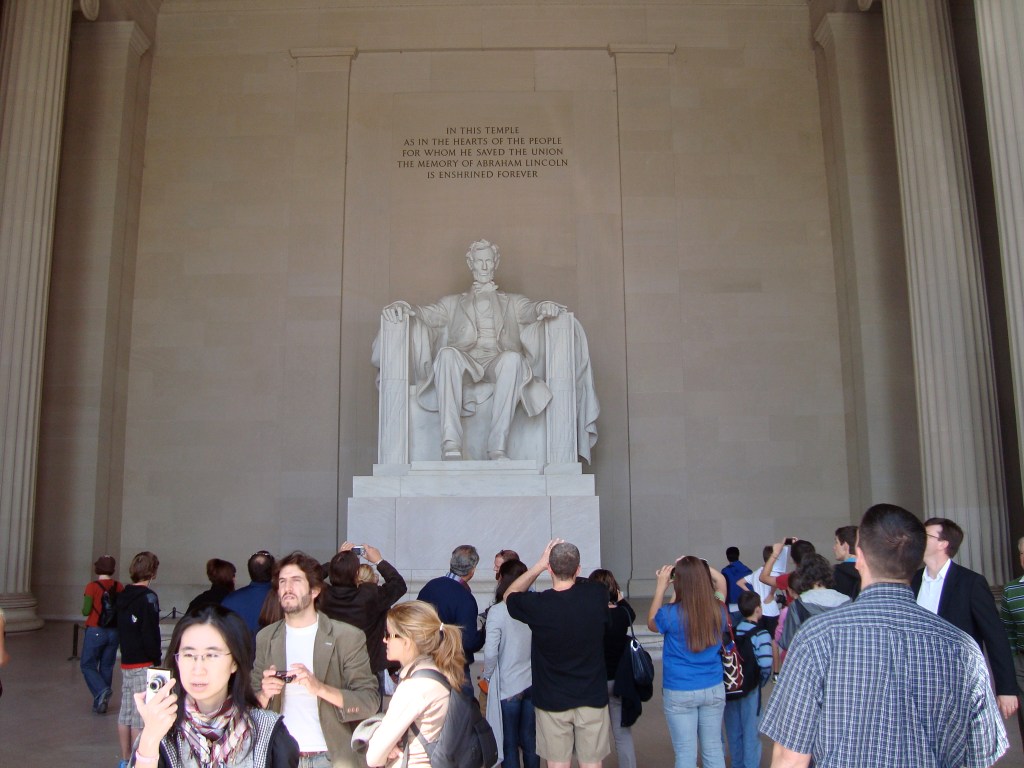
We will see but I feel calmer now with my epiphany. America is a mighty country, a good country, but it is obsessed with division, not unity. The super rich and powerful are in ascendence; MAGA Trump tribalism is all the rage. I am still an American but I am not a proud American who automatically thinks his country the best. Its very union is threatened but the memory of Lincoln remains as an inspiration we came come back to.
If George W. Bush, John McCain, Mitt Romney, or Liz Cheney were elected to serve beginning in 2025, I would not be happy but I would be reasonably sanguine. I had respect for the Republican Party before MAGA: it represented classic conservative values just as most Democrats represent progressive values.
I am a moderate who has voted for Republican and Independent candidates, though I am more progressive than conservative by far in today’s world. I took the Civil Rights struggle to heart in my youth and consider myself an environmentalist. I will die thinking that public schools that bring all of us together is one of America’s best inventions.
In factual, verifiable terms Donald Trump is a man of bad character who instigated an attack on the Capitol creating millions of dollars worth of damage and killing several people. He was twice impeached. He is a convicted felon. In the closing days of his recent campaign he joked that a bullet might find a way through protective glass toward him but would likely kill a member of the press, which he suggested would be a good idea. He talked about Arnold Palmer’s genitalia in a campaign appearance. That he said and did all of this is public record as is his insult of war hero John McCain and his recorded interview proclaiming that he could touch women at will.
The leader of a country is the symbol of the entire country. To the world at large Trump is America. We now have a strong man leader like Putin of Russia. Sure, theoretically he is more restrained than Putin but he is our American Putin. “Work hard, be of good moral character, and tell the truth, and you can grow up to become President” is out the window. Trump is a refutation of Washington, Lincoln, FDR, Kennedy, and Reagan. He dirties the office he holds.
NYC ran out of places to park refrigerated trailers to store deceased COVID victims. Trump presided over the epidemic often shouting down the country’s scientific advisors. He did despatch a Navy hospital ship to New York’s harbor. His voters forgot the seriousness of the epidemic and the world-wide economic downturn that it precipitated. Broken supply chains take time to reform.
The Biden administration spent big to revive the Trump economy they inherited at the end of January 2020: the Democrats pushed through the infrastructure projects that Trump promised but never delivered on. The Biden administration also brought back advanced chip factories to U.S. shores. The consensus of economists is that the spending initiatives spared us from a recession.
Steady economic growth has exacerbated one of our country’s fundamental problems. We are short on workers. The approximately 14 million illegal migrants in our country clean our hotel rooms, install shingles on our roofs, cut our meat, care for our sick, and pick our produce. American business brought them here and depends on them.
The Biden administration capitulated and Democrats voted for new border controls as per Republican leadership’s wishes. Trump vetoed the vote on the bi-partisan bill to help his candidacy. He needs to keep the border controversy alive to stoke controversy.
In my mind Trump won because most of his followers are low on information. Truth Social, X, and Fox are organs for spin, lies, and propaganda. Outside of those three media players, all other sources are considered “main stream” thus unworthy because they put objectivity over Trump worship.
I am a citizen. Of course, I hope the Trump administration is successful. It could be if he shelved his bully/ insult artist act for policy debates followed by Congressional votes. Maybe we should discard free trade and put tariffs on imports. I would love to see that idea debated in a way that could win me over. Perhaps we should use the nation’s police forces and military go door to door/ business to business to root out the aliens. Put the plan in the form of a bill and hold a vote. Perhaps we should discard health care access achieved by Obamacare. I would love to read the text of Trump’s plan.
Cut taxes further for the the richest; a trickle down could help the middle class this time. Discard the environmental initiatives to reduce carbon pollution. Maybe we are silly for considering environmental stewardship. Perhaps NATO is not worth the effort and Putin should be allowed to take neighboring countries.
I want to see all of this that I have heard Trump propose but I want to see it in the form of legislative debate that puts the ideas clearly before the voters who think they want such initiatives. He should encourage public Congressional debate as did LBJ in my youth who put this great question before the people: “Should we maintain segregation and unequal treatment or integrate to make all citizens equal?” I remember that contentious debate well that moderates and progressives won in the time when America was not great.
Putting something in writing seems to have helped me with my frustration. I am aiming to be a cooperative “elite” and see what billionaires Trump and Musk have in store for us. We will have an exciting four years of rule by Trump from his mansions and golf courses. He has the right to rule because he won. The majority should rule.
The forty-seventh President inherits a country that has at last ended the unnecessary war in Afghanistan, the world’s best economy, and an out-going administration that promises cooperation in the change of administrations, not insurrection. The new President should strive to leave his term with the best economy and absence of war as Joe Biden has.
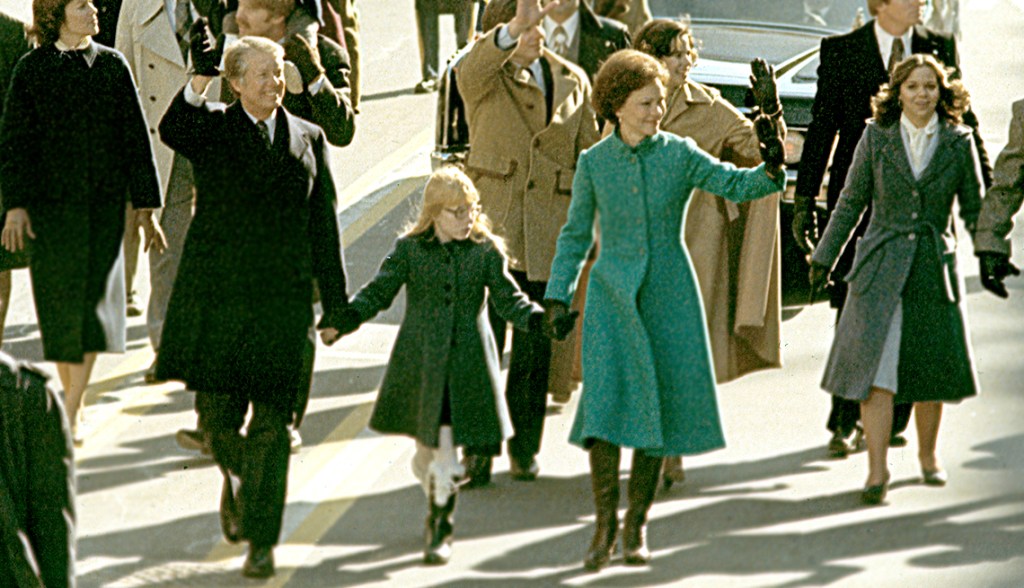
I am going to remember President Carter walking to his inauguration every time I hear people like me called elites by the elites just elected. Doing so helps my blood pressure.
memorable inauguration moments – Jimmy Carter, in 1977, walked the inauguration parade route from the Capitol to the White House
Noraly Schoenmaker is a thirty-five-year-old Dutch geologist who quit her regular work to live wherever her dual sport motorcycle is. I watched her ride from the tip of South American to Prudhoe Bay, Alaska, and became a fan. She disdains cities and pavement. She rides mainly on dirt. In Season 7 of Itchy Boots (YouTube) Noraly is in northern Africa riding in the Sahara.
Why do I like her vlogs so much? Part of my affection is her relentless upbeat personality, part of it is the places, and part of it is her encounters with regular folks. Last night I saw her sleeping by her out-of-order Honda 300 beside a railroad track in Mauritania in the desolate Sahara. She called Ahmed, a Mauritanian whom she just happened to encounter to help her with a motorcycle problem. Her casual acquaintance was driving seven hours to help her, of course, without a thought, because that is what good people do and the world is full of good people.
I have tent-camped in 47 states and want to think back to some people and places a la Itchy Boots style to remember little scenes that just pop into my head at times. I thought I would start with a Dutchman I met in Virginia.
Loft Mountain
lies along Skyland Drive Parkway in Shenandoah National Park in Virginia and is an extension of the Blue Ridge Parkway. About midway along Skyland Drive (not too far from Washington, DC), Loft Mountain Campground sits on the crest of a mountain with sheer drop-offs and lies across from the biggest natural bald I have ever seen.
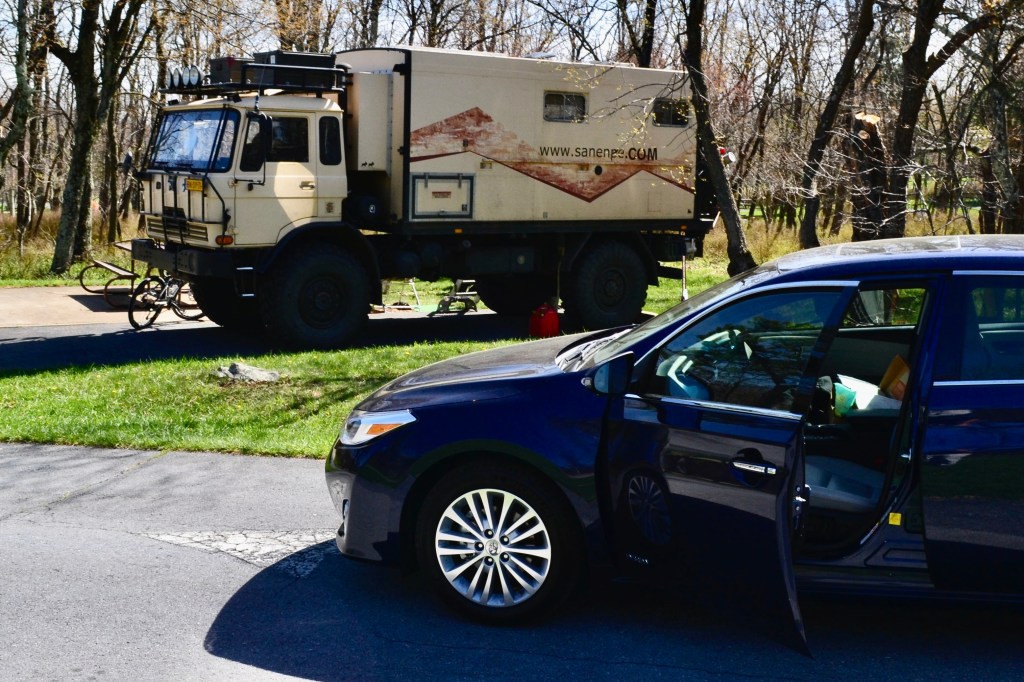
I remember the wind making my tent fly like a kite and paying quarters to take a shower but what sticks most is a Dutchman in a decommissioned NATO truck. He was about Noraly’s age and had started his adventure with shipping his camper to Canada and was working his way through the US on the way to Mexico.
Struggling a bit with his Dutch-accented English, I talked to him until someone needed to maneuver around me. He was relaxed and enjoying his voyage through America and was glad to discuss his unusual vehicle, a one-off of his own design. I wish I had gone back as per his invitation to look him up again to understand more about his voyage through North America.
Black Canyon of the Gunnison
is where I met a recently laid off programmer who one of just three campers in April of 2014 when I put my tent down. He caught my eye because he was driving a new silver Chevy Volt. I was in my nearly new Toyota hybrid. We talked cars, weather, and jobs.
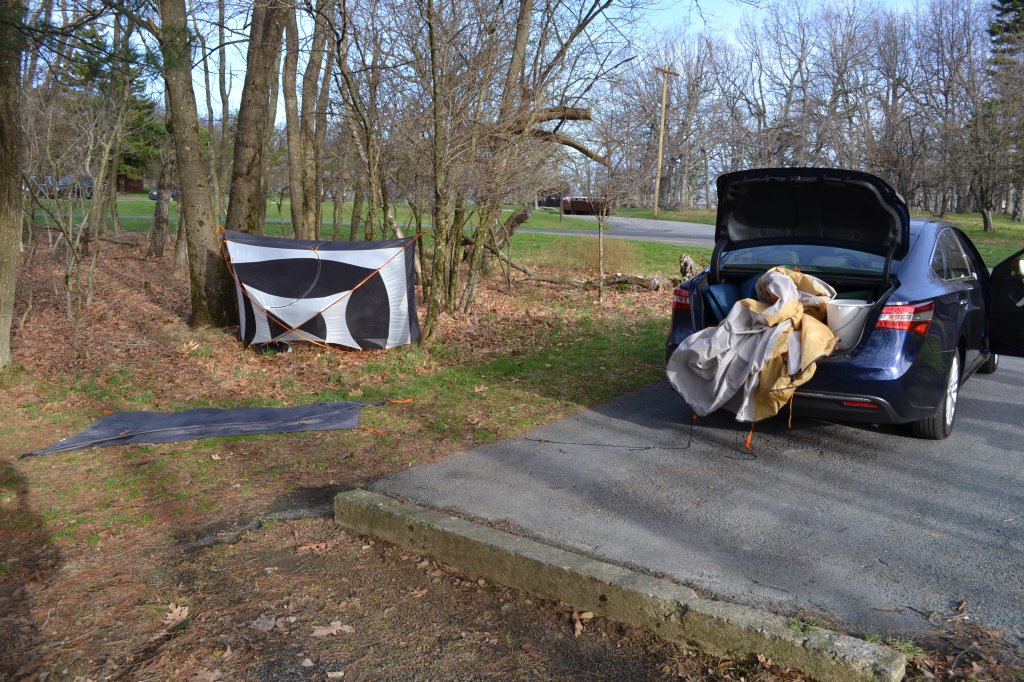
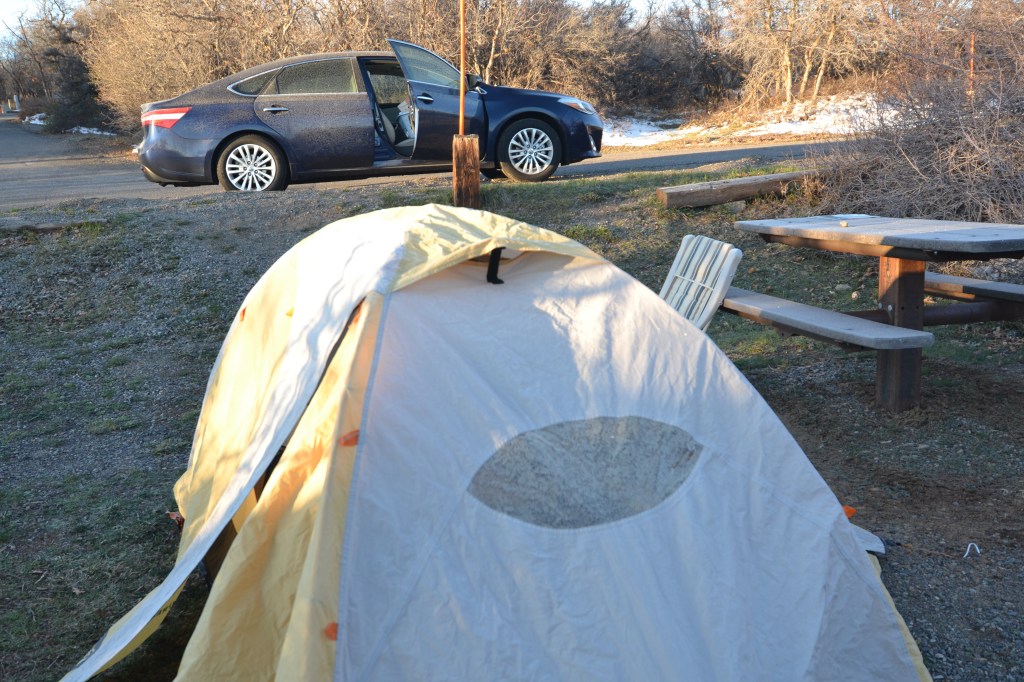
He was not all bummed out about his layoff because he had good contacts, was single, and had decided to drive around the country some himself before going back to work. The weather was topic #1: we had a light skiff of snow and a low around zero. I remember using my Coleman stove to heat ice from bottles of water in my trunk that had frozen solid. I had to use my pocket knife to remove the frozen contents in order to turn the ice in coffee.
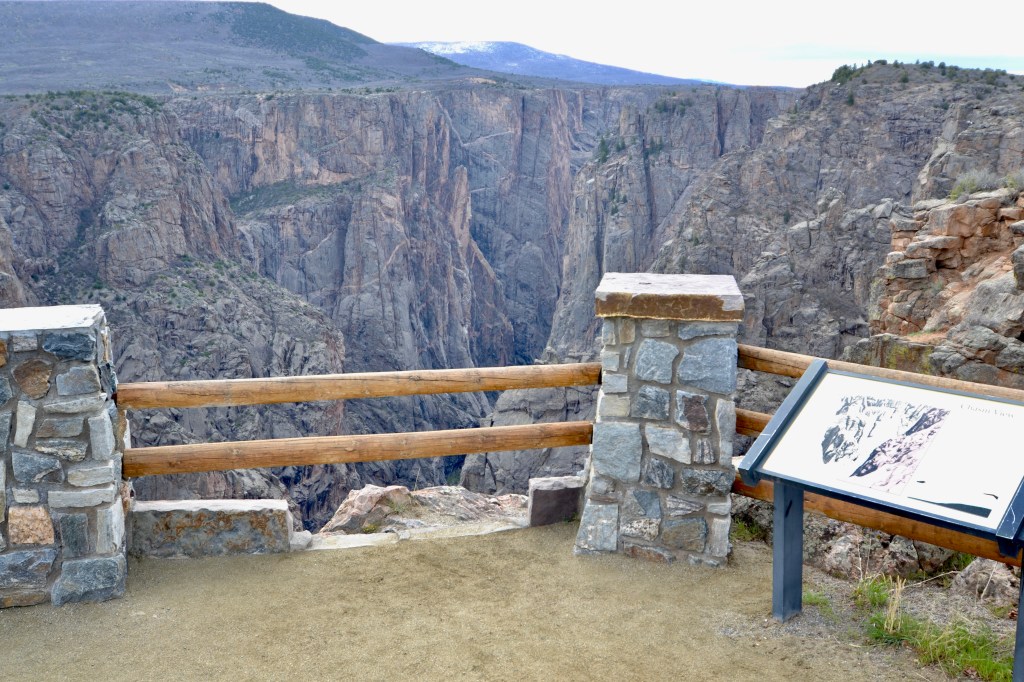
I suppose the cold is what etched the memory but the beauty of Black Canyon of the Gunnison is striking for its blackness. The rock is closer to pure black than gray and the canyon walls can be traced down to a black river. I learned that one wool blanket and two sleeping bags are not enough; I now take two wool blankets when I camp in high places.
Sam Solomon Springs at Balmorhea Springs State Park
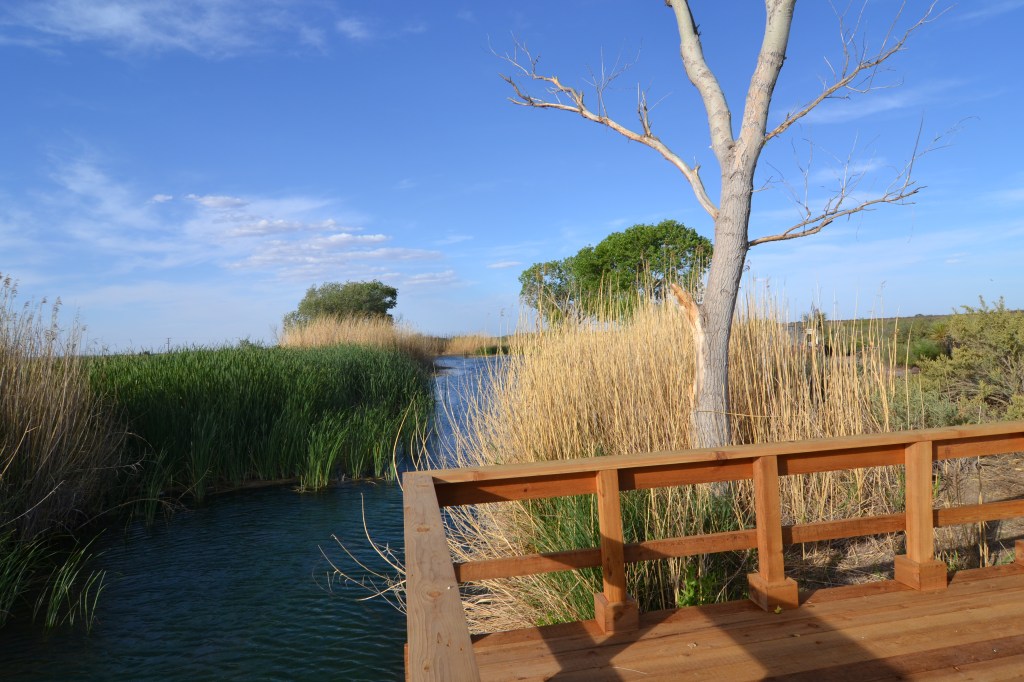
is in the desert of northwestern Texas on the way to El Paso and Ciudad Juarez not many miles off I-10. I lucked into a camping spot via a ranger who respected my tent camping. I could see campers all around as there was little cover and worried a bit about the cluster of fifth wheel campers at the edge of the campground. They were young, sociable and played music loud. A desert party seemed to be forming.
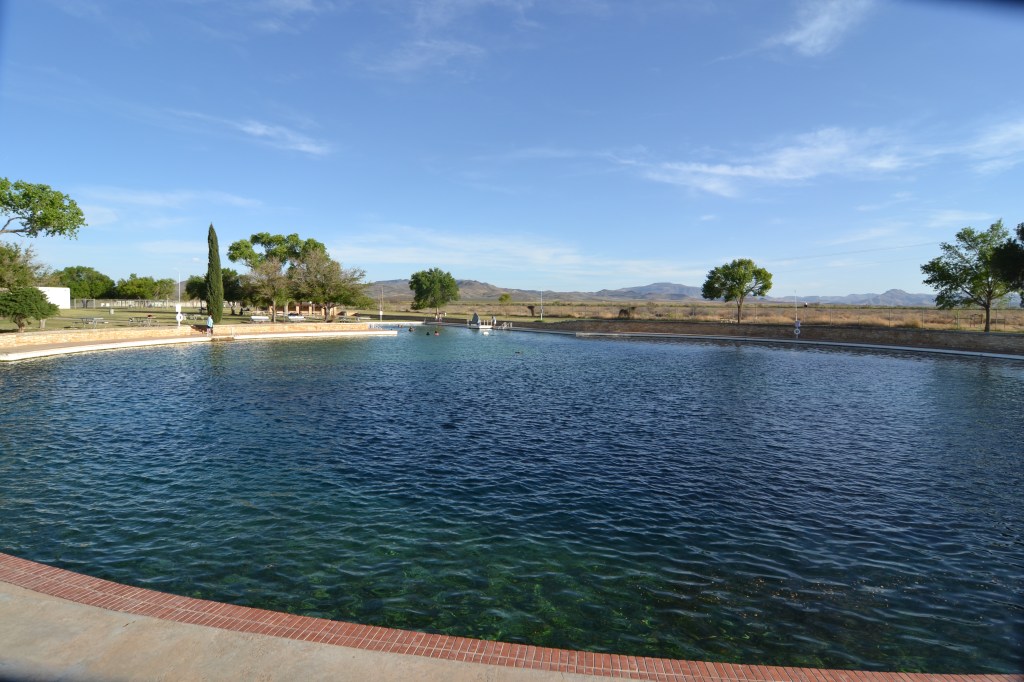
I took off to explore and found signs about the willows that grew freely and the rare fish that thrived in the spring waters and came upon the biggest swimming pool I have ever seen. Like the entire campground, it was a CCC project back in the FDR administration.
The sun was on its way day signaling the sudden shift from intense heat to coldness, but I reckoned I had enough time to avail myself of the product the CCC boys’ toil. I started off attempting laps because the water was cold but soon gave up. Most of the pool was quite deep with a natural bottom. I came back to my tent at sunset and slept well that night because the fifth wheel gang decided to ditch the music for the voices of what seemed like a hundred coyotes in the distance toward Mexico.
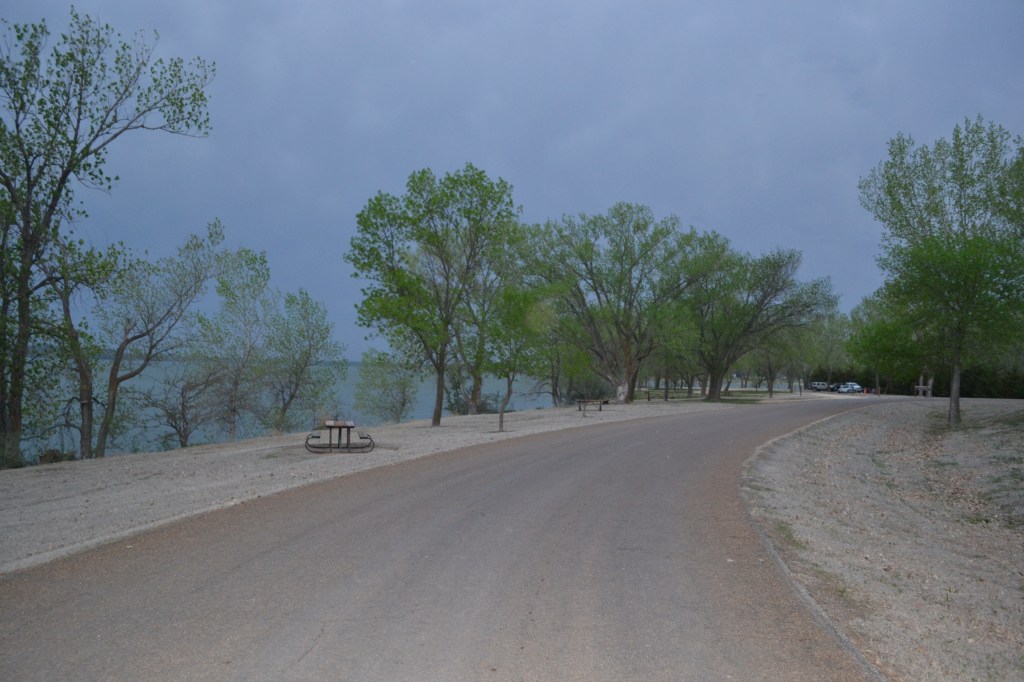
Lovewell State Park at the Kansas-Nebraska Border
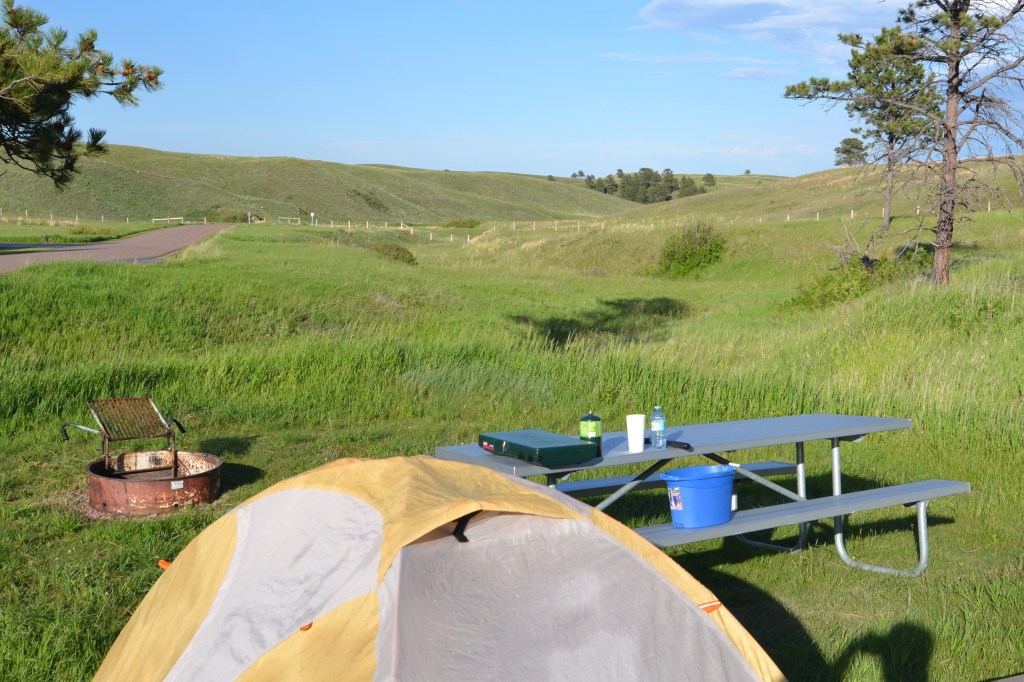
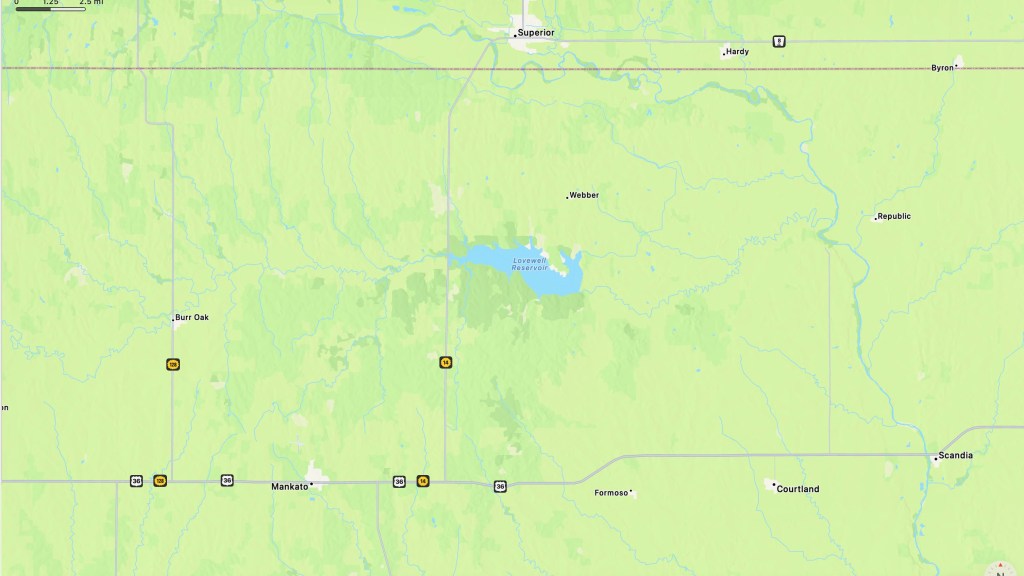
is off U.S. 36 in northern Kansas. My hatred of interstates has led me to adopt the route that connects Missouri to Colorado as an alternative to freeway lane-swapping. Because there are no big cities on the route, a driver can go for miles without seeing other vehicles. Small towns crop up every fifty miles or so, untouched by the plethora of national franchises that line the interstates. Most towns look like the fictional Mayberry of Andy Griffith show fame.
Screenshot
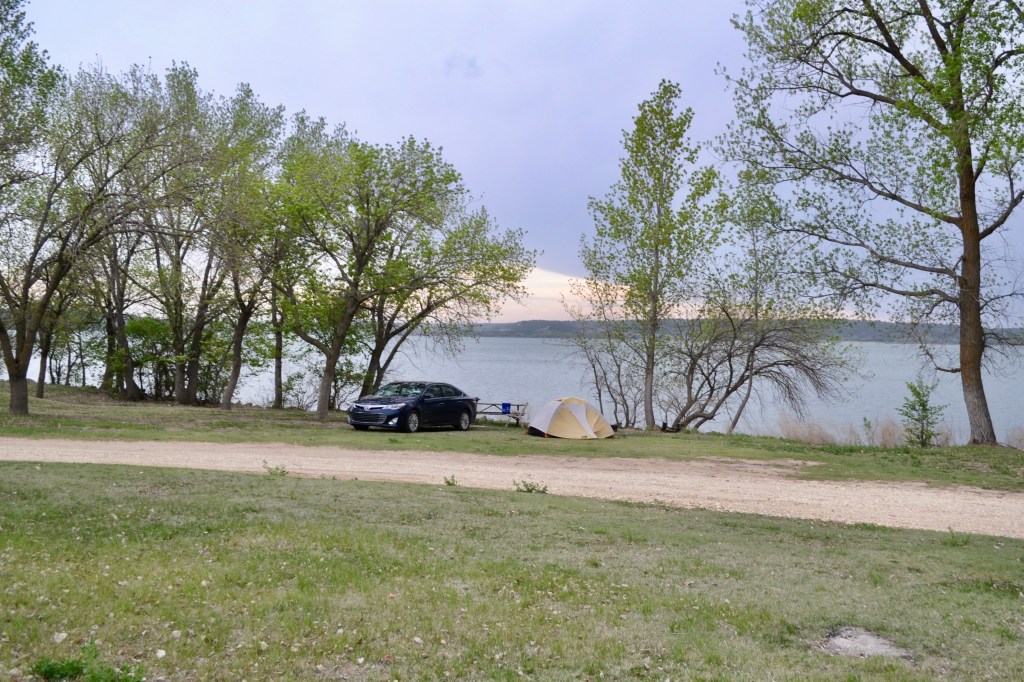
I chose Lovewell Lake State Park at 424 miles and 7 1/2 hours driving time from Black Hawk, Colorado, where I had been visiting my daughter Elle and her husband Dave. I was plenty early so I had several hours to read, write, and walk around. I could see a vast storm looking north toward Nebraska about three miles away across the lake.
As I walked around, my Colorado daughter was leaving to visit my wife in South Carolina, but her flight was re-routed well into Canada to escape the storm I was to experience. At the time I did not know the size of the storm which made regional headlines.
I added four stakes to the first four that held my REI tent in place as a precaution. Have I been caught in storms before? Let me count the times. Who cares?
I ducked into my tent around 8 PM to escape the first raindrops and expected, I suppose, a period of rain that would come and go as most East Coast rains do. As soon as I got inside, the wind picked up and vertical rain turned horizontal.
The first half hour was sudden fury that I had never encountered before, but I felt sure that the storm would reach its conclusion and I would survive, wet and unbroken. The second half hour saw my adrenaline-induced bravery turning to fear. The tent threatened to rise like a fat kite. Then it went flat across me and the wet contents of the interior.
I began to think about death during the second hour. The completely sideways rain had soaked nearly every inch of the interior. I became hypothermic. I shivered so much my teeth chattered. My arms ached from grasping the tent frame. Could I hold on?
I longed to release the frame given the lightening but in the puffed up periods I felt holding on was the best of two bad choices. I thought of each member of my family as a way to stay calm and thought how lucky I would feel to have chance to see each again.
Ten minutes short of the two-hour mark, I sensed the storm abating but still as intense as any storm I knew from my east coast existence. I made the choice to inch my way out without letting go of the tent. Standing upright was very difficult. I kneeled on the tent to remove some of the stakes and fly.
My equipment remained on the ground long enough for me to get to the car. My new fear was that the car door hinges would bend open too much so I kept them closed but managed to pop the trunk open.
I began to feel I could control my shivering as I worked up a little heat from my wet work. I got the now extraordinarily heavy tent and its contents in the trunk. The wind had diminished and the sideways–always sideways–rain was just drizzle now.
Shifting to the far side of the car, I found some dry clothes and a towel and got myself into the vehicle at last in a wind that still threatened to topple me. I cranked up the car and sat for a few minutes before heading out.
My Rand McNally Road Atlas and the Toyota navigation screen showed U.S. 36 tantalizing close. I decided to head east and then cut back south to it. My drive in was a good ten miles back west on a very poor remnant of a paved road.
What I noticed first was my sleek sedan was somehow going sideways south though I was moving forward. Seemed illogical. I drove on and came to an intersection that would allow me to proceed to good old paved U.S. 36 but drove on until I found yet another intersection of dirt roads that promised a shorter trek to pavement.
I had not reckoned on was what I could hear: mud caked up in layers in the fender wells that slowed the wheels down. I had determined to drive steadily without stopping to reach the bottom of the long hill that was no doubt part of the geographical dip that had allowed Lovewell Lake to form.
A hundred yards are so down the dirt road so tantalizing close to pavement, my sedan stopped going forward. I checked my watch and the clock and spoke aloud: “I can spend the rest of the night right here and walk back to the campground at daybreak.” It was already after 2 AM.
I did not sleep to speak of but took some comfort in the fact that I heard dogs barking in the distance. Everything would be ok in the morning. At around 4:30 AM I got out of the car. I struggled to keep my sandals on as I inspected my clogged wheel wells. Using a stick, I worked for a quarter of an hour or more to remove soil that seemed like ground rock on its way to becoming dirt.
I scouted the road backwards and forwards as best as possible for a few yards north and south. I decided to back up north toward Nebraska because I knew that the road I had turned off of was on higher ground. To my surprise the traction control and reverse worked on the gummy soil that was beginning to dry.
I drove back toward the campground and turned right toward what led to Webber, Kansas. Webber has a name but it is not a town, just three or four buildings, tops. I drove north some more and then turned east drove for the best part of an hour before I found a paved highway inside Nebraska that I could have gotten out and kissed.
Storms in rural Kansas and Nebraska have a width, breadth, and duration that those on the east coast lack. The scale of that storm is something I still struggle to understand.
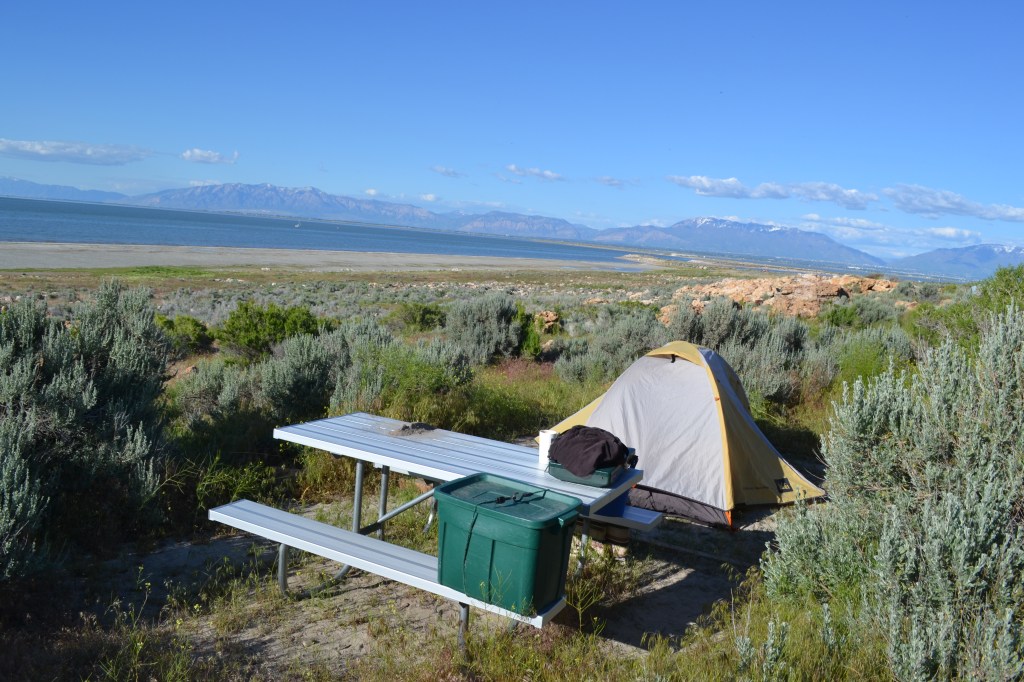
Antelope Island State Park
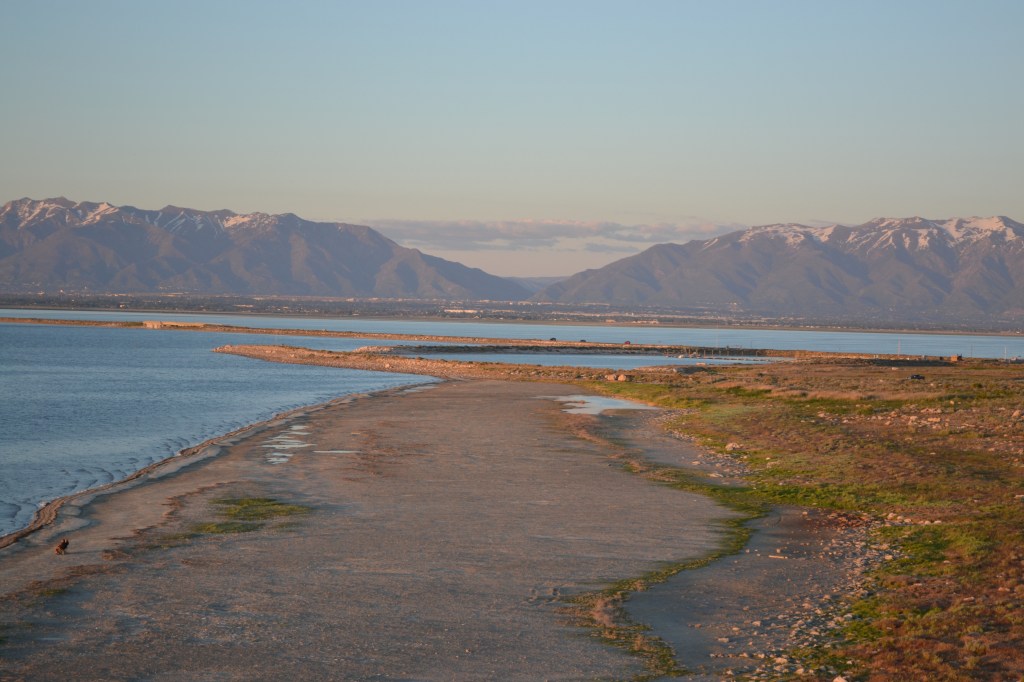
is very close to Salt Lake City, Utah, on a long island in the middle of lake which is likely to disappear soon due to a draught and over-irrigation.
Once I toted my gear in and set up camp, I made a series of short hikes: the first to swim in the lake. I was an absolute excellent floater for the first time in my swimming life.
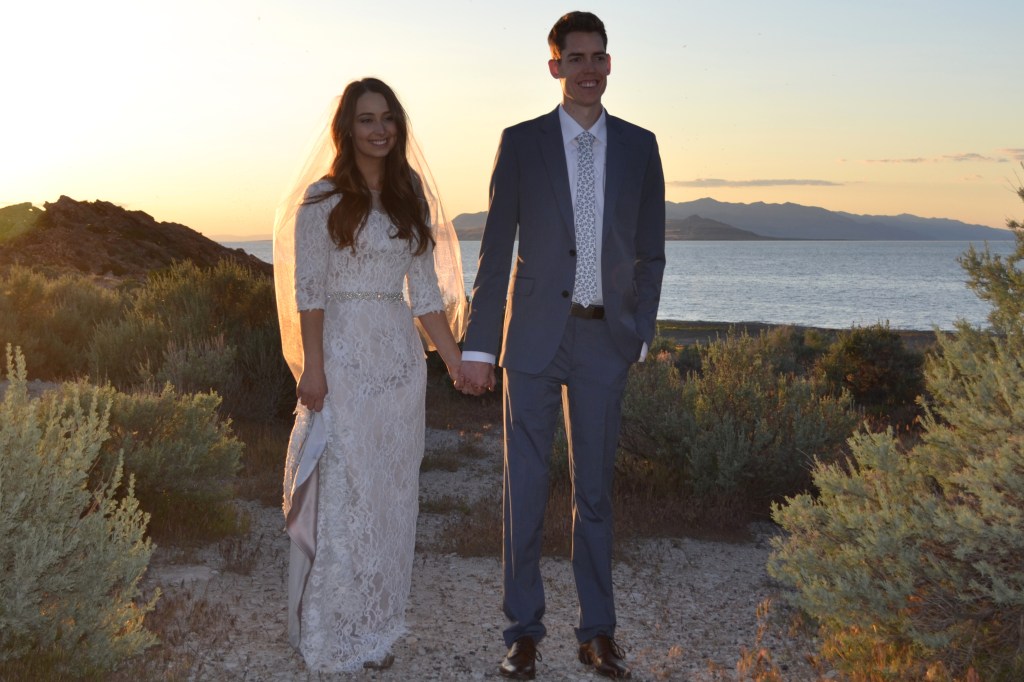
What amazed me most was being so close to a major city yet remote from it with sight lines to mountains twenty miles away. Toward sunset I followed well-dressed “hikers” moving up to a trail to a high point.
I spoke to some of the guests and did what they were doing: I photographed the beginning of the newly weds’ married life.
I remember the hiking and swimming and the vastness. Vastness is hard to come by on the east coast.
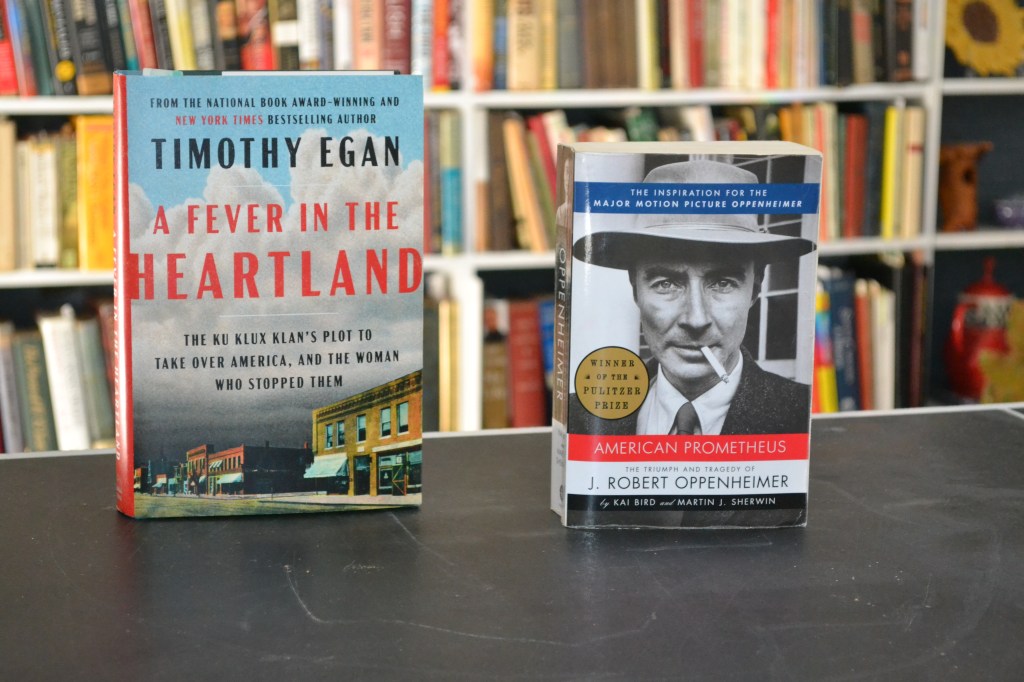
A Fever in the Heartland: The Ku Klux Klan’s Plot to Take Over America and the Woman Who Stopped It (2023) Tim Eagan
The Money Kings: The Epic Story of Jewish Immigrants Who Transformed Wall Street and ModernAmerica (2023) Daniel Schulman
Hamilton Carhartt in Rock Hill, South Carolina: Founder of Carhartt Clothing, Creator of Bob Overalls (2022) Pat Grant
Pioneer Girl: An Annotated Autobiography (2014) Laura Wilder, edited by Pamela Smith Hill
The Hundred Years War on Palestine: A History of Settler Colonialism and Resistance, 1917-2017 (2023) Rashid Khalidi
Paved Paradise: How Parking Explains the World (2023) Henry Grabar
Through the Groves (2023) Anne Hull
In a Different Key: The Story of Autism (2016) John Donovan and Caren Zucker
Wanderlust: An Eccentric Explorer, an Epic Journey, a Lost Era (2023) Reid Mitenbuler
The Color of Water (1996) James McBride
Fortune’s Bazaar: The Making of Hong Kong (2023) Vaudine England
Nine Robes: Inside the Supreme Court’s Drive to the Right and Its Historic Consequences (2023) Joan Biskupic
Charleston: Race, Water, and the Coming Storm (2023) Susan Crawford
American Prometheus: The Triumph and Tragedy of J. Robert Oppenheimer (2006) Kai Bird and Martin J. Sherwin
The Days of the French Revolution (1980) Christopher Hibbert
Master Slave Husband Wife: An Epic Journey from Slavery to Freedom (2023) Ilyon Woo
are from my 2024 Reading Record and 2023 Reading Record. I read two or three books per month and write about each book. Sometimes I get carried away and write the rough draft of what could make a decent essay that runs several pages; mostly I put together six to ten paragraphs that allow me to consolidate my thoughts on what I have read.
To me each book represents a long private conversation that I have spent weeks engaging in. No one hears me but me. I sometimes break up the “not hearing” problem by reading excerpts to my wife but she is usually reading her own book and rarely follows in my reading footsteps. I write to interact in a way that helps me refine what I thought and to remember.
I am a reading snob: what I read must be a seriously reviewed book that has won some acclaim. I used to read more fiction. Since I retired in 2006, I have concentrated on history and science. I read to engage with the world, not escape from it.
The Indiana KKK dominated America in the 1920s, surpassing the Atlanta-based southern wing of the organization, and drawing in nearly half of its white Anglo-Protestant residents. Women and children had their own special divisions and high school yearbooks of the era feature photos of students in robes. Colorado and Oregon had large KKK presences, too.
The mass of Italian, Irish, and Eastern European immigrants in and around WW I created worry over “the other” that Klan organizers exploited. State and local governments in Indiana were part of a political machine that the KKK ruled. A Fever in the Heartland did what I look for a book: it scrambled my brain and challenged my incomplete knowledge. It troubled me. I am taking my respect for midwestern wholesomeness and virtue off the top shelf.
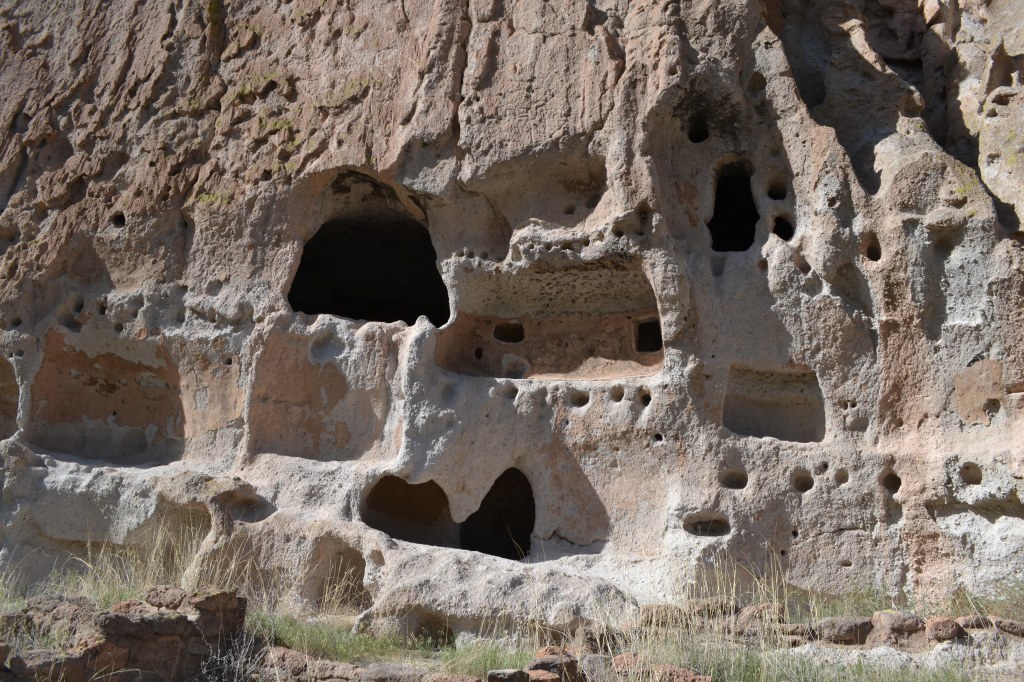
American Prometheus took me to Los Alamos National Laboratory near Santa Fe, New Mexico. Robert Oppenheimer and his crew of scientists reinvented the modern world there by taking the atomic genie out of its vase. Oppenheimer loved the then remote area and did his thinking atop a horse there across a dry mountainous landscape that includes ruins of Ancestral Puebloans’ civilization that date to around 1100.
He would have seen these dwelling places. I have camped a couple of miles above them two times in Bandelier National Monument. My camping preceded my reading of Kai Bird and Martin J. Sherwin’s absolutely masterful American Prometheus.
Hiking and camping on part of the setting of the book–Bandelier lies within the atomic laboratory tract–is what I call history camping. I have set out through the years to visit book sites, starting with books I had read about the Civil War. The combination of mental (reading) and physical (camping) is often more than 1 + 1 = 2. The spirit of the place seems to overtake me. Something ineffable happens, creating an experience that is more than two inputs.
When I taught English at Northwestern High School, I used to put a sketch of two concentric circles on the chalk board: the first circle was the student before reading a work of classic literature that they were required to interrogate and write about. The second outer circle was the student post reading. Worthy reading enlarges.
Like the growth rings revealed in a fallen tree, I have a heap of circles that have made me a bigger human. I seek the bigness that shows me my smallness relative to vast universe that I am so curious about.












 Danny Forrest