I have not been sleeping on the ground much these last two years due to COVID, but I anticipate tent camping my way out to New Mexico and Colorado soon. I like working my way across America via two-lane highways to see my daughter who lives in Colorado and to visit national parks and historic sites. I never tire of looking at farms and small towns. My home away from home is two-person REI tent that has been on the ground in 47 states.
I have spent cold nights in it but none colder than in April of 2014. By that stage of my camping across the country, I was wise enough to to always have two sleeping bags and a wool blanket but not wise enough to know that two bags and TWO wool blankets are a must.
I came up to Black Canyon of Gunnison National Park south of Denver in western Colorado via Montrose where I had visited a hot springs that my daughter Danielle knows about. Montrose and the hot spring were between five and six thousand feet and cold but not freezing the afternoon I drove up into Black Canyon of Gunnison National Park. I was pleasantly warm from soaking in swimming pool size spring of warm water.
Black Canyon of Gunnison National Park
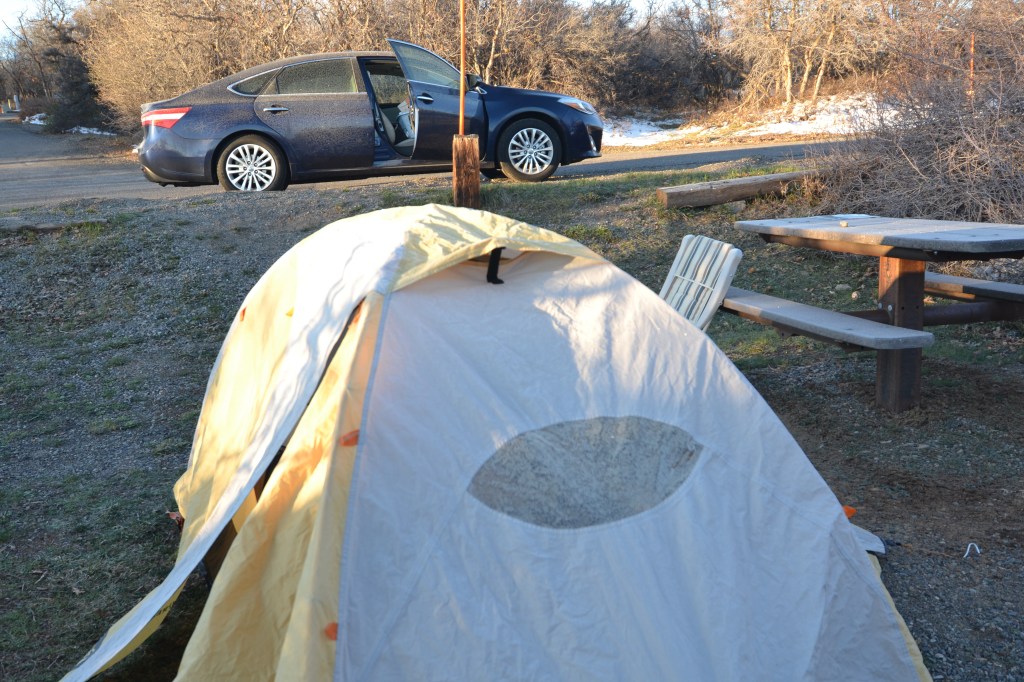
I found myself to be one of three campers atop Black Canyon Mountain. Because I was about out of sunlight, I set up my tent and walked around the three campground loops a bit and turned in as dark and a snow shower settled in. To begin with, I removed one of my outer layers and zipped myself tight into my best mummy bag with my summer bag atop it. I slept fitfully at best adding layers during the night. Worry over snow and cold kept me awake.
What took me back most the next morning when I snapped the photo above was my water bottles: they were frozen almost solid. I used my camp stove to thaw water for coffee and enjoyed my solitude perched atop a sheer canyon mountain that allowed no more than an hour of sun to shine at its bottom.
I like the chance conversations that I fall into with people who like the places I spend my nights. I was on Loop A by myself but came upon a young man on Loop B who was camping in a Chevy Volt. His car led us into a good conversation. Being young and single, the young engineer from Austin took his company’s demise as an opportunity to do what he really wanted to do: drive around America for a month or two before settling into a new job.
My Avalon registered 17 degrees when I began poking around the park beyond the campground at nearly 9,000 feet in the sky.
Valley of the Fire State Park
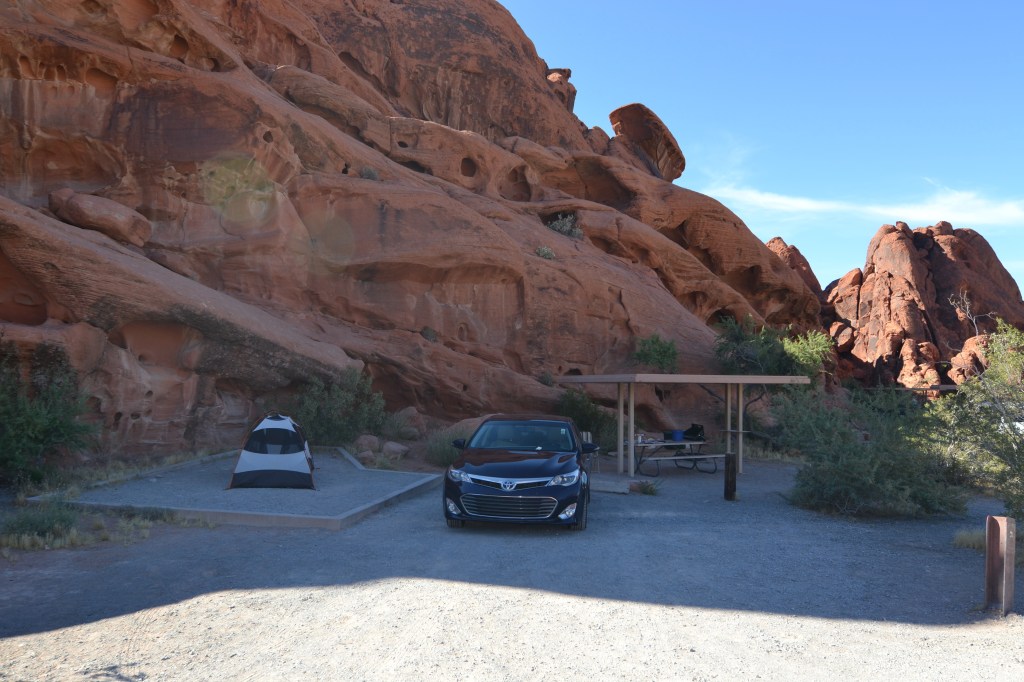
Valley of the Fire State Park is in southeast Nevada near the Arizona line north of Las Vegas. I spent the hottest night of my camping career there on Tuesday, May 20, 2017.
I arrived at 3 P.M. according to my journal, early, and took the time to hike around wearing long sleeves and a broad brimmed hat. Of course, it was too hot to hike but I circled clumps of petrified trees protected by wire fencing. Petrified wood intrigues me. The light was bright white, red approaching the cliffs, and near night black against them.
Arriving early afforded me a chance to pick a shaded sight. I saw 110 degrees at the welcome center and knew that it was dangerously hot, though the dry Nevada heat is not as apparent as South Carolina humid heat. I remember feeling so alive that afternoon in the bright white light but stopped myself from walking after three miles or so. The payoff was a rare bathroom facility with a shower. Cold showers can be just right.
As per usual I retreated to my tent (sans fly) at soon as the sun dropped. I had a view of starlit sky and I saw it plenty because sleeping was difficult. I remember hauling cold water bottles from my cooler near midnight to douse myself with. My journal doesn’t show a temperature, but I guess it cooled to the 80s. I probably should have moved my tent away from the cliff face to escape some of the stored radiant heat and, perhaps, caught breeze in the open.
Sometimes when I have trouble sleeping at my favorite permanent camping site on Ragin Lane here in Rock Hill, I try to remember camping in a particular state at a particular time. These two nights are easy to summon.
January 20, 2022: I am back at this blog about a year after writing on it last. My idea is to write a record of who I am to come back to for myself that is accessible to others who may wish to know more about me when I die or who stumble upon danielforrest.org on Word Press.
COVIDand Trumpism
My life is still limited by the spread of the virus. I am double vaccinated and boosted but many are not, hence the continued limitations that circumscribe my movement. The latest iteration of the virus is somewhat less dangerous than the previous versions. If no new version supplants it, I will enter restaurants again and camp out of state in 2022. Being vaccinated means that I could catch the disease but it would likely not lead to hospitalization.
At my age I try to never be angry but I am. Former President Trump, Fox News, and various other right-wing disrupters continue to spread false information that restrains the influence of factual, scientific data. Because anti-vaccine proponents and Trump worshippers are sealed off in a silo that does not allow rationale penetration, disagreeing with them is impossible. Were I still teaching or a medical worker, I would be a hot ball of anger for sure. Killing others for the freedom to choose not to vaccinate imprisons all of us. Commerce and education suffer needlessly.
The January 6, 2021, Trump-led insurrection based on the plain lie that he really won the election last January damaged the White House and killed capitol policemen fighting off insurrectionists wearing red Trump caps and toting Confederate flags. My faith is America is greatly diminished. An entire society and commerce in general is held hostage by vaccine refusers embraced by former President Trump and his followers.
What I do is avoid others, wear a very good mask, and try not to dwell on what I can not control. In the end I know that the source of the blame is those who voted for Republicans and who think Twitter/Face Book feeds provide accurate information. Beyond that I hope that America will right it itself going beyond insurrection and vaccine denial. I will continue to believe that my individual freedom is fairly and logically constrained by what is good for all of us. Seeking independent factual information is a way of life for me. The Golden Rule is seared into my cortex.
Chinese Immigrants, The O.J. Simpson Trial, Nutmeg, Mammalian Evolution, Poland in WW II
Those are five words from titles linked to ideas that I have held in my head for hours and hours so far this year. They are lifted from two records that I keep: 2022 Viewing Record and 2022 Reading Record. I wrote short essays about the 36 books that I read and 81 movies or television series that I viewed in 2021. My 2022 list is growing.
I am a serious reader and viewer who enjoys science and history. Sometimes I shift through channels to watch old black and white movies that my parents could have seen or snatches of other programs like The Andy Griffin Show. Mainly I stick to serious, worthwhile, critically acclaimed reading and viewing. I am not now and never was an escapist is reading and viewing. My somewhat snobbish approach is likely stems from my degrees in English and habits of a lifetime.
I know more than I ever have. I am well informed and still very curious. Sometime I lament that attainment because I have no audience but I believe being curious is fundamental to being alive. I love ideas, even if they ravage my brain at times.
As per usual Nita and I enjoy some television every night. I watch The Newshour on PBS and Nita joins me form Jeopardy. Then we split and come together to watch something more serious. Last night I watched part of a Nova program about dinosaurs in Alaska. Because I had read Beasts Before Us: The Untold Story of Mammal Origins and Evolution by a young paleontologist named Elsa Panciroli, I was very interested in the hour long Nova program; Nita less so. We returned to streaming The Duchess of Duke Street, a 1976 BBC series about an upwardly mobile cook in Great Britain at the turn of the twentieth century. It is our current joint viewing project.
My brain works by taking in but imperfectly retaining good books and viewing. I then, even against my will, think and think about what I have learned. In can be an affliction but it is part of my constitution. My head turns over the notion that the spice trade, specifically nutmeg, led to the modern capitalistic system etc. I can not stop thinking about ideas.
My Two Cancers
In the last week I have permitted myself to do pushups and pull-ups again. I had a basal cell carcinoma removed from my back in December and another from my arm in January. Surgical excision successfully removed the tumors root and all resulting in a 95% prognosis for being completely cancer free.
For about two months I had to limit the use of my left arm to avoid tearing stitches. I could still walk my usual two or more miles a day but I had to limit myself otherwise. That was not good for my body–or mind. I need to move. So much of who I am is expressed by movement.
Walking to Grocery Stores
Today January 22, 2022, is cold and sunny with a temperature close to 40; yesterday prior to the light snow fall was dark and grey and colder.
Needing nothing in particular other than a change of walking route, yesterday I walked to Food Lion and bought to some bacon and sausage. The 1 1/2 miles took me past the new condominium development. Latino workers were steadily framing the end unit closest to our house in 30 degree weather.
Today I followed the same drill walking on the west side of India Hook Road in the opposite direction to take advantage of the sun that had melted most of the light, fluffy snow. I bought peanut butter, dog food, and beer at Harris Teeter, a two-mile walk.
Walking to the store is unusual around here but I have always loved walking to the store since my days as a boy in Saluda when I could been downtown in short 1/2 mile walk. Am I crazy? Why is what I do so singular?
On Saturday February 20, 2021, President Biden met with former Kansas Senator and Republican Presidential candidate Bob Dole. Dole is suffering from brain cancer and his old colleague Biden visited to pay respects.
The Wall Street Journal reports in “Making Washington Work” (Gerald F. Seib Feb. 22, 2021) that Dole recounted a story about a last-minute pending judicial nomination that he wished to get through the Senate the 1990s. The Senate was about to adjourn and Dole wanted his candidate on the bench, but there was no time for a committee hearing before adjournment.
Was there a way to get her confirmed before the Senate adjourned? Notice what Dole said about Biden. “I believe his response was, ‘Well, if you say so, we won’t need a confirmation hearing,'” Dole recalled. Dole’s desired appointment was a respected qualified candidate and Biden, the Chairman of the Judiciary Committee, trusted Dole’s judgment.
I like that story about trust very much and I like that President Biden took time to meet with Senator Dole. It ties in with the recently deceased Alex Trebeck’s special theme in his last season of Jeopardy. The master of agreed-upon-facts emphasized the importance of building “a kinder and gentler society” as he faced his own death near the 2020 election. He often ended his show with the statement about building a kind and gentle society.
Bruce Springsteen and Barack Obama have set down a series of conversations about their lives and the nature of our current society in a podcast series entitled Outsiders: An Unlikely Friendship. I find myself laughing out loud and being moved to tears as I listen to them talk about friendship and society. They are putting into practice the civility that the recent Biden–Dole meeting demonstrated and that Trebeck emphasized in his show business career.
We can have a civil society. Conversation is possible. This weekend will see former President Trump making his first public appearance at the C-PAC meeting. What will his remarks be like? Will they be civil and factual? I suspect they will return me to the hateful division that I am just now getting over one month into the Biden presidency.
Do I think President Biden will be a very successful president. No. Our country is too divided for him win the support of the opposition, but he will try. He will be a civil president who puts unity above division and that pleases me.
Rainy, cold, gray. I am back at my blog of sorts, a document I keep as explained in “What I Plan to Do with danielforrest.org” at the top of my homepage.
I add to my primary reason about wanting to provide access to who I was after I am dead another reason: I want to remember myself and I feel that self fading with age. I lose grasp of who I wasand what I did.
A Cold Day in the Pole Orchard
In the winter of 1972 I had moved from Fort Jackson to Fort Gordon for my advanced individual training (AIT): pole line construction. AIT was like returning to USC in a way: class after class in a big building. The culmination of learning how to climb a telephone pole was hands on in the pole orchard.
My guess is that it was about five poles by five poles wide each standing about ten feet apart. Being Fort Gordon it was sandy and there might have been some wood chips on the ground that was not soft.
Its firmness was in my mind as my final climb came. I had done my progressive short climbs partway up and had various instructions shouted at me. Rule one is to watch the angle of your body relative to the pole. The climber should always lean out and never allow his body to form a parallel with the telephone pole.
That knowledge works against the immediate tendency to go up straight or lean in as the gaffs attached to inside of your combat boots bite wood. The belt helps. It is slid up after each two steps but to slide it up requires a quick release of the tension formed by leaning out.
My pole was a mess. It looked like a small child had attempted to hatchet it down top to bottom. Splinters bloomed everywhere. My instructor warned me to be careful and the prior training photos of badly scarred arms from a burnout were fresh in my mind.
Half of us were finished and I was at my last step and among the last to prove out. All I had left to do was to go all the way up to the top, get comfortable, lean out, remove my service cap, and set it on the top of the pole.
Once it was atop the telephone pole, I was to await an all clear to retrieve it and work my way back down.
I do remember it being on the top of the pole. Vaguely I remember the quiver present in my tired arms and legs. (Climbing a pole using gaffs is very hard work.)
I do not remember my slide down. My fatigue jacket was torn and my arms were burned and bloody. I must have remembered to work back against my belt some as I slide because I was able to stand at the bottom still hitched to the post.
I do know I was shaken and tired but no matter. A quick review of my situation by the training officer led to the following indirect order, “What are you waiting on Forrest? Go get it.”
I went back up successfully as tired as I was and donned my cap and climbed back down without gaffing out. For over 48 years that memory has hung on the edge of my memory. I wish I could recall more about what went on in the manner of video recording so that I could elaborate but most details are faded from memory.
Marsha Cockrell’s Blue Bike and the Old Elementary School
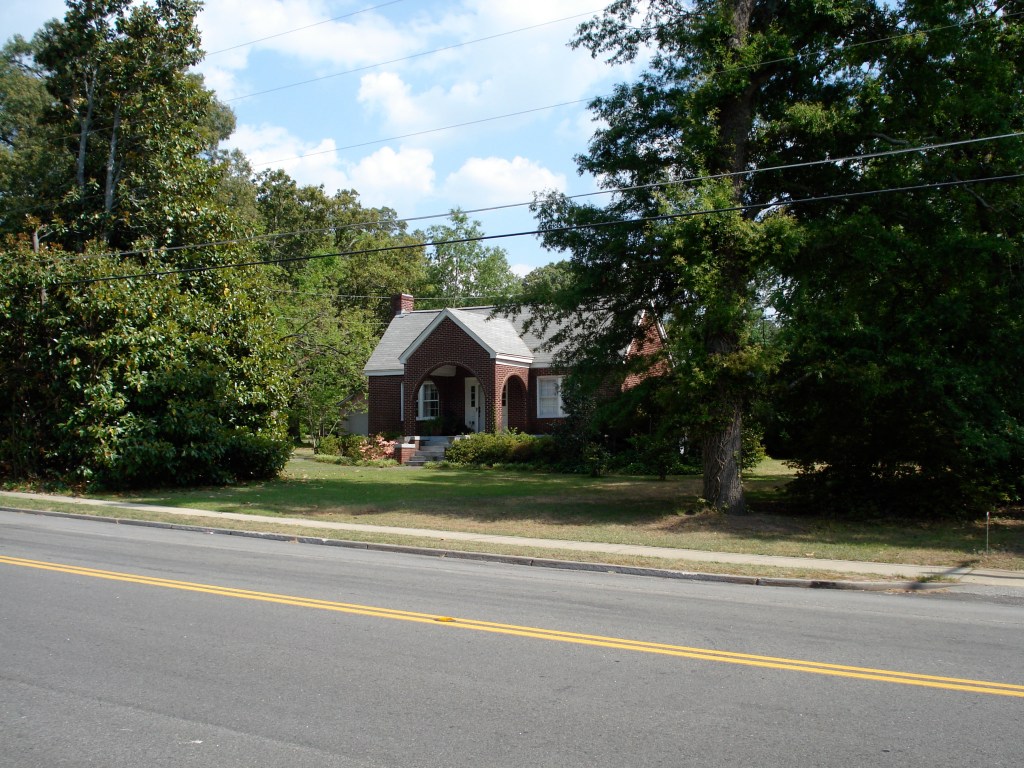
I lived mainly at 513 West Church Street, Saluda, SC for my first 18 years. I remember the path behind my house near Preacher Padgett’s hunting dog pen along the side of our garden. That is where I cut through to the Cockrell’s yard on the block behind my house. Once on W. Eutaw Street I walked east on my way to my first grade schoolroom.
513 W. Church Street, Saluda, SC
I looked forward to the rough macadam road giving way to wider, smooth asphalt just at Bonnie Boland’s house. From there I would sometimes be joined by other walkers. Walking to school was a cool big deal to me in 1956.
Saluda Elementary School was a three-story brick building facing South Jefferson Street and on it last days. During that same year we would be moved to a new low slung modern building adjacent to Saluda High School.
My walk led me to the school beside the unattached cafeteria building behind the school at the intersection of Eutaw and North Calhoun. I liked that spot because it dipped deep on North Calhoun leading up to W. Church where Ben Hazel’s boarding house stood. Sometime I would walk back that way.
Where the bicycle was parked escapes me as does who I was with that day after school. We got out early and for some reason I took the blue bicycle. Who was with me? I have lost names but I think there were three of us involved. We likely just walked by the parked bike and took a notion as we headed home.
I think I was dared to hide Marsha’s bike. I remember walking it, not riding it. It may have been too big for me.
I took the cut toward Ben Hazel’s and scooted off the road to the right. Who helped me? Not sure but I put the Western Flyer in the big culvert that ran under the road and pushed it partway under.
I had been in the culvert before and even walked all the way across under North Calhoun on a dare. Was it a dare that prompted me to stash the bicycle?
Were I old enough for crushes, I would have one on Marsha, who was years older, a tall black-haired pretty girl. My belief is that I did what I did per someone’s dare, certainly not out of animus for Marsha.
When I got home, I did what I always did: put whatever tablet and pencils I had down and went out to play. The days were long enough that I did not get questioned in regard to my crime until close to sundown. Witnesses, phone calls, inquiries? No doubt a criminal investigation ensued while I went on with my after school play.
At about the time I should be squared away from supper and headed toward shared bath water with my brothers, I was on the ropes. My parents needed to talk to me. Asked, I broke immediately under the questioning.
A spanking would have been a given but I lose my memory beyond confession. I think the event comes to my old man’s head because I felt so bad about what I did. To this day I have a propensity for guilt–even about minor events in the last century.
Bloody Sunday February 25, 1968
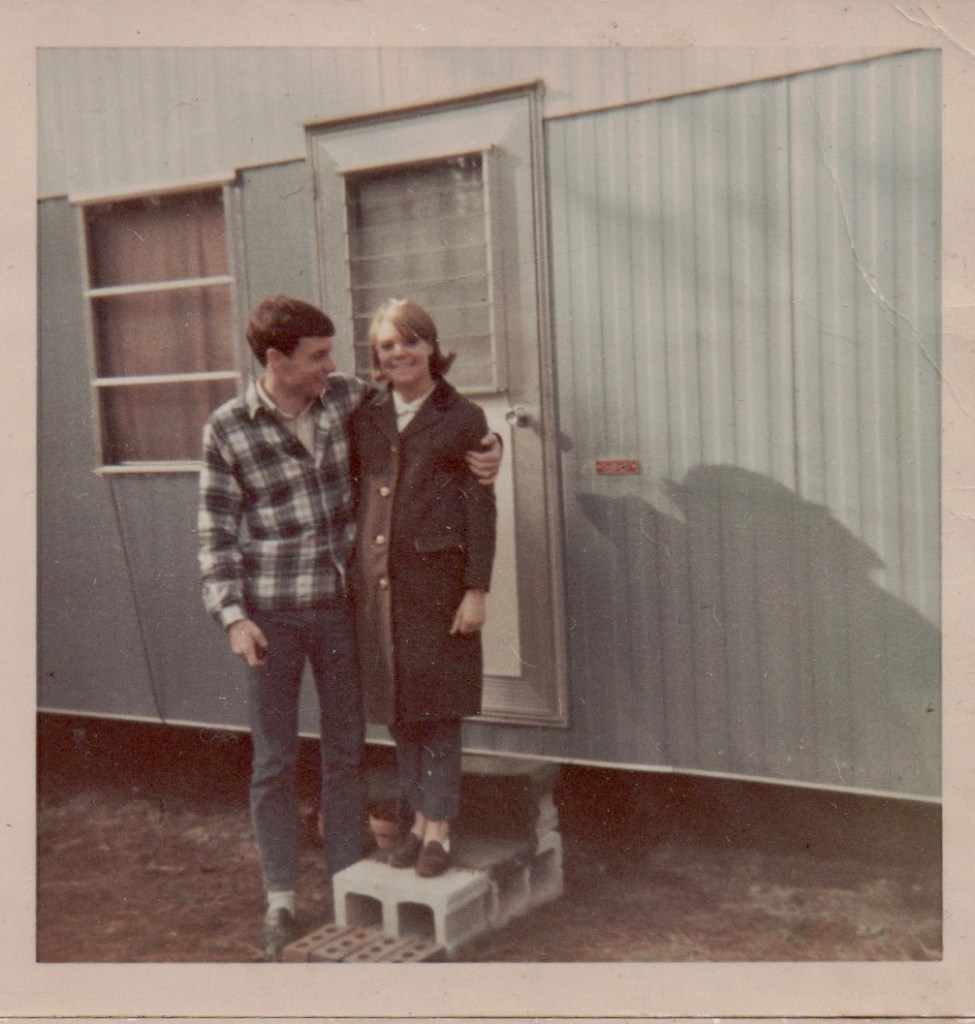
Nita says we ate with my mother and younger brother in Saluda on that Sunday. She remembers her stomach hurting but put her pain off to eating something. She said she remembered Cally acting odd. Apparently we headed back toward our Newberry home after stopping by her parents’ house.
12′ X 47′, our Park Avenue mobile home in Newberry
She says that on the way back to Newberry Bobby Shook drove up behind us, flashing his car lights. We pulled over and I got out to talk along side the highway. No memory–edge or elsewhere. She says he followed us back to Buddy Neal’s Mobile Home Park beside the Newberry airport where we lived.
Her memory is going back to the bedroom to lie down while Bobby, a friend from earlier days, and I caught up. “I was back on the bed suffering and you and Bobby were laughing and talking the evening away,” she told me recently. I worry about my mind because none of that comes back.
What does come back is pulling up in front of Dr. Sawyer’s office across from the agricultural classroom building next to Mathews Field. According to Nita we called and he agreed to meet us at his office. Her stomach pain had blossomed into “I think the baby is coming.”
I saw four or five cars there with people standing around. I left Nita temporarily to go inside and that’s where I came upon blood on the floor, the door and all over people’s clothes.
My pregnant wife was not Dr. Sawyer’s only patient. Knives or razors? I was thinking razors. So many bodies and so much blood. Cars parked haphazardly; people whispering. Dr. Sawyer must have already stitched up several bleeding victims. He emerged from a backroom and told me to bring Nita in.
I think that visit must have lasted less than five minutes altogether. What I clearly heard, what I clearly remember was a sentence something like this from the unflappable, laconic, short Dr. Sawyer, “Get to Self Memorial fast.”
I had just driven 25 miles back to Saluda and faced a 30-mile drive to Greenwood. Nita was going to give birth to my son Chris. We may or may not have dropped by her parents again before heading out of Saluda fast on Highway 378.
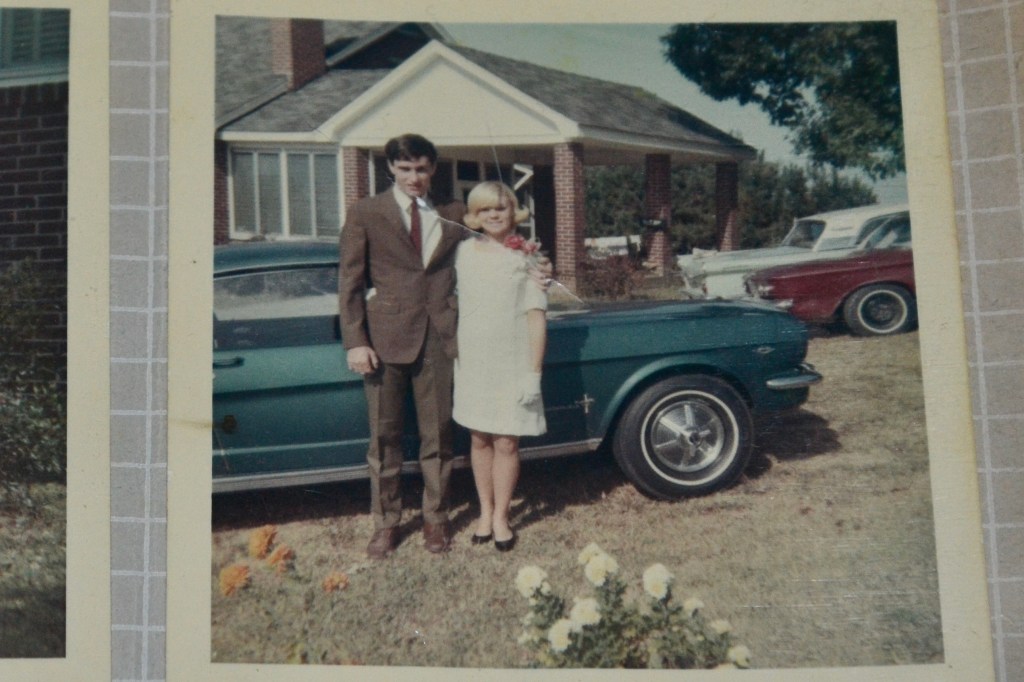
Nita and me on August 6, 1967, our wedding day
The Mustang we drove is just behind us in our one and only wedding photo. It looked like a good car to drive fast but underneath it was just a Ford Falcon, a big economy car, and I never liked going fast. With Nita’s condition in mind as well as Dr. Sawyer’s command, I drove close to 75 for most of the trip. Highway 378 is from Saluda to Greenwood is curvy. I had in my head one particular curve where my brother Butch had totaled a Ford Galaxy a few years earlier.
I pushed 80 mph on straight stretches but my 1965 Mustang was a former wreck that vibrated at 80 and above. A shaky steering wheel gives a driver pause.
I remembered to go straight and not turning as usual when we got close to Greenwood. My memory of stopping in front of Self Memorial is clear as is the car shutting down as we drifted into the visitor parking lot. Somehow Nita walked along with me and the bag she had packed to the front door to check in.
Chris was born a few hours later in the early morning of February 26, 1968. Nita was fine. I could not have been happier.
“I live in the best country in the best of times.” That sentence has left my mouth plenty over the last ten years or so that I have been driving around America to pitch a tent. Sometimes I history camp by routing my travels so that I can see what I have read about. Civil War histories have sent me to many historic sites, including Appomattox Courthouse.
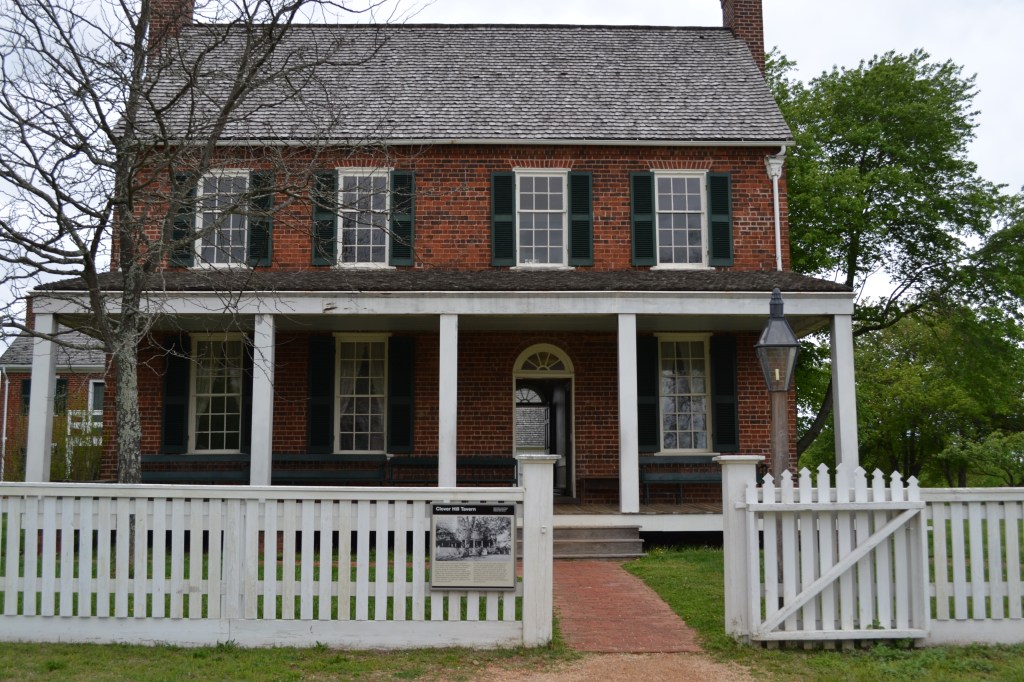
McLean House Appomattox Courthouse Village, VA
Robert E. Lee and Ulysses Grant spent ninety minutes in McLean House signing the surrender order of April 9, 1865, that was to end the Civil War. I spent an uneasy night camping in Buckingham State Forest just a few miles away, thinking about the Civil War in 2013. Hanging around such places brings out ghosts. Visits to Gettysburg, Shiloh, Antietam, and Vicksburg are even more disturbing.
Of course, it did not really end in 1865. It raged on through Jim Crow. I grew up in the segregated south that made the Civil War into the noble War Between the States. It came to another nearend around 1965 when President Lyndon Johnson pushed through civil rights legislation that federally mandated freedom for all, or so I thought.
It was still not over. The loss of Vice President Hubert Humphrey, Johnson’s successor, in 1968 to Richard Nixon featured the openly pro-segregationist George Wallace and set up the underground “us v them” politics that leaders in the Republican party have exploited for decades to undermine the credibility of those who wanted to the civil war to end.
The primary underlying plank of “us v them” is white supremacy. A significant portion of people with my pale skin type need to elevate a vision of themselves in some long ago society by attacking others, especially African-Americans. They attached themselves to a lying narcissist who railroaded the Central Park Five into the penitentiary for a crime they did not commit. They cheered on that supporter of the Obama birther doctrine. Trump’s racism is a hallmark that draws fans to his brand.
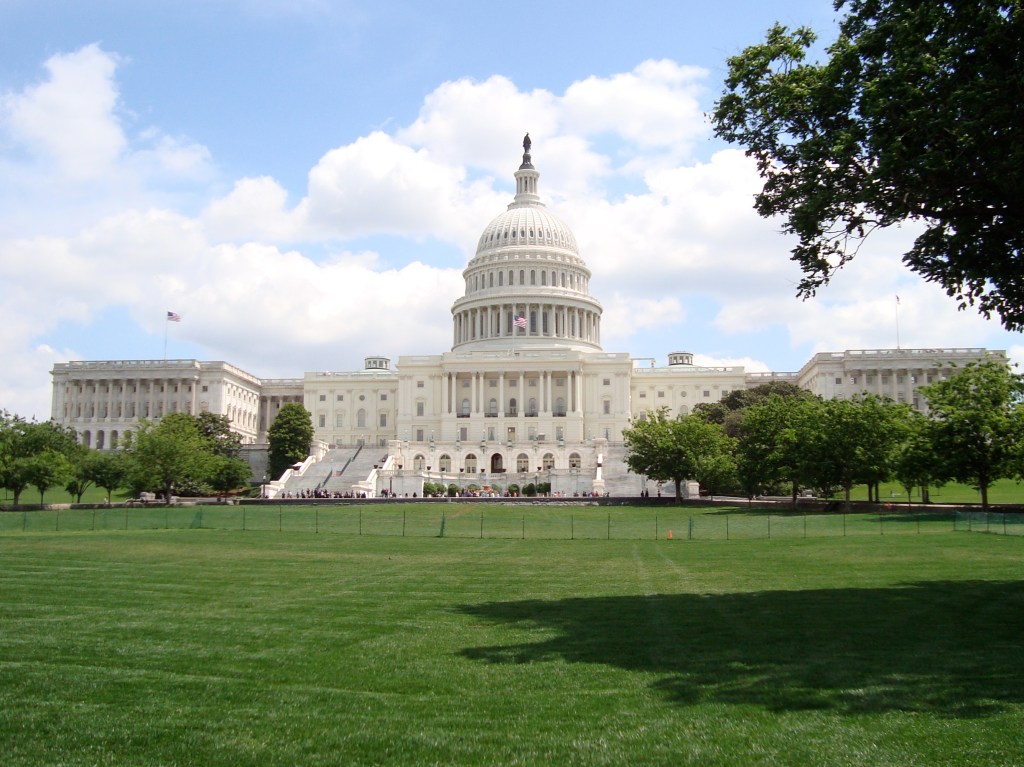
He took the continuing war to a new climax again on January 6, 2020, by inciting a mob to storm the nation’s holiest place, the Capitol building, where Congress was in session to declare Joe Biden as the next president. The insurrection was broadcast live for all to see.
Capitol 2010
The Capitol invaders waved the rebel battle flag adopted by Southern resisters as a symbol of their noble cause. The insurrectionists went too far this time. The majority of Americans do not approve of a President sending a mob into the sanctuary of democracy to kill, injure, deface, pillage, and destroy.
The arc of history has bent further forward but the continuing civil war has only subsided. The national Republican partly leadership is still controlled by President Trump, and 187 Republican legislators voted to perpetuate the lie that somehow the 2020 election was rigged despite no proof at all. The appalling act has some of those whose careers hinge on Trump’s popularity pulling back, but there is no wholesale disavowal of the dark force that undergirds their party.
For the war to finally end Republicans must reclaim their traditional conservative party. Its existence is necessary for balance and full representation of all views in government, but it can not be the party of Trump and hatred of “the other.” It could become the party that used to draw my interest and respect.
My love for our country is strained and will remain so as I contemplate the vitriol unleashed by Trump’s presidency. The war continues and we do not live in the best country in the world in the best of times.
At the beginning of Act III of George Bernard Shaw’s Pygmalion Henry Higgins shows up unannounced to his mother’s at-home day tea.
Mrs. Higgins (dismayed). Henry (scolding him)! Go home at once.
Higgins. Oh bother! (He throws the hat down on the table.)
Mrs. Higgins. But you mustn’t. I’m serious, Henry. You will offend all my friends. They stop coming whenever they meet you.
Higgins. Nonsense! I know I have no small talk, but people don’t mind. (He sits on the settee.)
Mrs. Higgins. Oh! Don’t they? Small talk indeed! What about your large talk? Really, dear, you mustn’t stay.
Higgins. I must. I have a job for you. A phonetic job.
The job is to test out Eliza Doolittle in mixed company. She looks the part of a lady in such a setting and for a while she succeeds at the gathering–long enough to catch the eye of Freddy Enysford Hill and to keep Professor Higgins interested in turning a flower girl into a lady.
Liza’s small talk soon turns into large talk about details of her personal life in a Cockney register that does not fit the at-home day gathering. Small chit chat about topics designed to go nowhere were the rule for such gatherings.
My head comes back to ways of talking at Christmas because I missed the chance to engage in any kind of talk to speak of due to the pandemic. I can speak small talk. My way of doing it is by listening much more than I talk and just giving back occasional signals to others that I am listening and interested. I can work a room.
Yet I am not at ease doing so. I like large talk. What I mean by large talk is conversation about a significant idea that develops. I crave conversation that builds thinking on one subject with two or more people exchanging thoughts that form something that is larger than anything inside one person’s head.
Maybe my desire for large talk comes from teaching English. I loved critical reading questions that started with one student saying what he thought using logic and facts that led to someone quickly jumping in with a slightly different take on what had begun the conversation. On good days I just stepped back and played the role of conversation promoter.
I can find such conversations on National Public Radio. I love to listen to Terry Gross on Fresh Air because she is always prepared but never pushy. She asks questions of guests in a way that draws them out and she knows when to take her foot off of her mouth accelerator to allow the guests to bring forth something significant that had not been planned. Good conversation requires the ability to listen and to allow slight pauses to ripen.
I love to listen to someone who is smarter and more prepared on the subject than I am. I relish thinking that challenges and extends what I know and am thrilled when what I have heard makes me rethink what I thought I thought. Of course, I am talking about civil, polite conversation. Conversations that become heated do not necessarily offend me, but I hate cable news shouting matches and talkers who are locked in to set way of seeing the world that precludes outside ideas.
To my mind good conversations can attack an idea but not the person. They can be about any subject or experience that is more than just a report from a speaker that does not invite a response from a listener. My favorite subjects are from big ideas in science and civic life that affect all of us. I like seeing what is in a speaker’s head and heart about climate change, government, pandemics, or the future of retail or almost anything that connects us all as citizens.
I like talking to friends who think like me, but I do not seek confirmation bias. I like best talking to someone who knows more than I do and has thought deeper than I have. I like the mental tag-a-long that is created in my head trying to follow a train of thought down its tracks.
Small talk that sticks to the superficial and skates around here and there without landing anywhere ultimately bores me. Like Higgins I am best at conversational large talk, but at 72 I am not looking to sell my perspective as gospel and I am open to most any subject.
Yeah, like most people in this pandemic-stricken world, I miss talking to people period. For now I will just keeping reading books, listening to NPR, and occasionally talking to myself around the dog.
Serving a pallbearer for my former best friend led me to start this blog or collection of writing. Nathan was remembered at funeral presided over by preachers. My end will not be like that but I do want a way for people who have known me to connect up the way I did at that funeral.
My idea was to write about what I think and my life from time to time–mainly in the dark winter months when I am more likely to be indoors. I have included various specimens of written self so far. My idea was that it will be a public face for me after I die, but sometimes people stumble onto my online existence in current time.
Recently a dear friend from about age thirteen left a comment, having stumbling across my name on this WordPress site at danielforrest.org. Jimmy remembers me from that age and then his memories stop because he moved away and we never saw each other again.
Jimmy and I both had crew cuts back in that age of astronauts. He lived in a blonde brick home across from my Uncle Earle’s house. It had a carport on the righthand side.
We palled around, played basketball, and talked the way thirteen-year-olds do. I remember his easy smile and gentile disposition as much as I remember his personal form. What I remember most was an embarrassing situation.
I think I spent the night at his house and wanted him to spend the night at mine. He came over and we started out on what was a big deal at that age but the overnight was aborted. My father and mother got into a big fight over my dad’s drinking. There was noise and more. The details are gone but I know that Jimmy could not stay with me and I was embarrassed.
He was a good friend at a crucial time in my life and I still see his smiling face in my head. His leaving a comment for me about something I wrote touches me. The older I get the less I seem to exist in the way I did when I was younger and working. I do not have a regular wide audience.
He confirms to me when I need it that I am still here and count for something to people in general. Thanks, Jimmy. He also connects me to Donna.
She, too, left a comment. Unlike Jimmy I remember her cousin. We both remember Donna. Seems we were both in love with her.
I have always been shy and am more an introvert than not, though I can get quite wound up on a few cups of coffee. At thirteen I attempted to connect to Donna who was a kind of teen goddess to Jimmy and me. Brenda facilitated the connection.
Donna had beautiful golden skin and, like Jimmy, a bright white smile. I loved looking into her eyes but was afraid to hold her gaze. She had thick light brown curly hair and a beautiful figure. She was gorgeous.
My mind goes to seeing her and Brenda at a picnic table at the swimming pool across from the diving board at the end of the log dressing room. I think she and Brenda were sitting under an umbrella. Donna had on a two piece bathing suit–my mind says it was green or lime and checkered.
She is so stunning and I am so pleased to just be in her presence that I can not think of what to say and do. Man oh man would I love to travel back to that time to see our young selves. Two cute girls and my stumbling gangly self.
I think I expressed myself in some letters–not sure–and I do remember holding on to the idea that she would be my girlfriend. I remember once I got a car driving go Joanna, SC, to see her but not summoning the confidence to do so.
At 71 I see the importance of living in someone’s mind. Donna and Jimmy live in my mind and that they remember my young self delights me. Remembering them takes me out of my COVID funk and reminds me that I still have an audience. I exist in memory.
We have been out of touch and I hardly ever see him. He called yesterday for the first time in more than a year and asked me to bring in a bag hooked to his mailbox.
Without delay I stopped eating to get the task over with. I stepped out into the light rain, walked out the front door and down Ragin Lane two houses, and unhooked the bag from the doorless mailbox. The only “mail” was a bird’s nest.
I walked down his unpaved driveway and found myself trapped between his beat up Kia and a significant mud puddle. I jumped it because my stride would not bridge the little lake and used the overgrown sidewalk that led from the driver’s side door to the house.
More than ten feet out of range of the front steps, I bent low and then lower to negotiate the weeds and bushes that obscured the way to the steps. My first step up felt loose. The front concrete stoop was pulling away from the house, a house that can not be seen beyond faint outline due to overgrown shrubbery and volunteer trees that push against the structure.
I knocked hard on the front door and got Robert right away. He is a small man and now much smaller and thinner than before, short of 100 pounds. He looked down and I was in a hurry as a courtesy knowing he has to be ashamed of his living conditions. His glasses rode down on his noise and his beard was sparse and prickly with black stubble.
He thanked me and I said, “Let me know if you need help.”
Today he called five times, getting me up each time to walk toward the phone. He talked in his rapid way but had to stop after each sentence or two to gain his breath. Would I go up to Walgreens and get him a 20 oz. Coke and two packs of Camel Silver crush pack menthol in the black box with the green circle around the Camel? He said he would pay me on a certain date. Save the receipt.
The follow-up calls were classic Robert. He wanted me to make sure I got the right kind of cigarettes. His idea was for me to take my phone to Walgreens and hand it to the cashier so that he could tell her.
In one of the follow-ups he had the idea of leaving an old pack on the front steps so that I could take it but he could not locate a pack. He wanted to know about the time of my arrival. I was vague but said I was going out to walk and would have the package in about one hour.
I made my daily walk in the direction of Walgreens and bought his supplies with aid of a clerk who knew a thing or two about smokes so I felt good about the purchase. My walk route was not scenic but it gave a purpose and direction to my only outing on this rainy day in the COVID-19 era.
I tried another way to Robert’s front door but was forced back to puddle jumping. As per his instruction in one of the follow-up calls, I left the package inside the storm door and knocked hard. I could hear him talking on his phone inside what must be his lamp-lit living room.
What I feel somewhat bad about is the note I put inside the bag. In it I told him to forget paying me back the $14, to stop smoking, and not to call me. I told him if he needed serious help to call 911.
The money is nothing to me. The favor was no trouble but getting entangled with Robert is always sticky. I know from past experiences that once he calls a habit is formed. Maybe he just needs to talk, though he has very little breath and is on oxygen.
In one of today’s conversations I asked him about food. He said that Medicare had just sent him a box. “I’ve got food.” Not so sure. Medicare sent?
He talked about a sore on his leg and keeping “stuff” on it. I suspect that he lungs are diseased to the point that the daily walk out of his house down the steps to his car are too much.
What should I do?
My mind goes back to the time I agreed to meet him at his wife’s death bed along with a lawyer. I think back to his children–two were my students–and the entangled history of his residence. Mostly I remember the phone calls.
I will let him sort out his own affairs even though I could and, perhaps, should help.
Moods are expressions of how people feel and countries, being collections of people, have moods, too. COVID-19 hangs ominously over us now but from the threat of an epidemic good can emerge.
We are all in the same dilemma, rich and poor. Rich people can not comfortably remain apart and aloof. The constant emphasis on division that has characterized the national mood since the election of President Trump is likely to wane.
Facts and data matter. Fox News and the Trump administration are notorious for claiming their own set of facts and creating a kind of separate reality. What people insist on in this time of crisis is factual data that is observable by all of us. The President is now less able to just throw out statements on Twitter and haphazardly on Fox News and walk away with the confidence that what he proclaims is accepted as factual.
Science is of the utmost importance. It has taken a beaten since the beginning of Trump administration. Important government posts go un-filled or staffed by those who lack credentials but support whatever the Trump party line is. There will be less patience with conservative pundits who proclaim science, especially in regard to climate change, irrelevant.
COVID-19 proves that government is the best hope for our national good. It is not a dirty word. Business and commerce may still be emphasized by President Trump and his incredibly loyal believers, but the necessity for government rises at a time of crisis. The government is all of us working through a system of laws and traditions and is the only instrument at our disposal for responding to the national emergency.
Unity or common purpose will best the purposeful division that has been in vogue. The angry old mood was bound to come to an end. How long can so many people stay angry? The gloomy spell that has seized us will lift because most citizens will see that the need to work together.
The political consequence will be that the 2020 election will be a setback for the Republicans. Moods emerge and wane and we are all subject to them. From this crisis a calmer mood will emerge that will allow us to work together again.
Today I ate a saltine. The taste lingered on my tongue. I thought of taking communion as a boy in Saluda Baptist Church.
I marched up and down the front steps singing Onward Christian Soldiers, threw spit balls into a spinning fan during Sunday School, and rode in a Cadillac hearse to my father’s funeral at 13.
118 Hazel Street, Saluda, SC, August 8, 2013
Grasshoppers
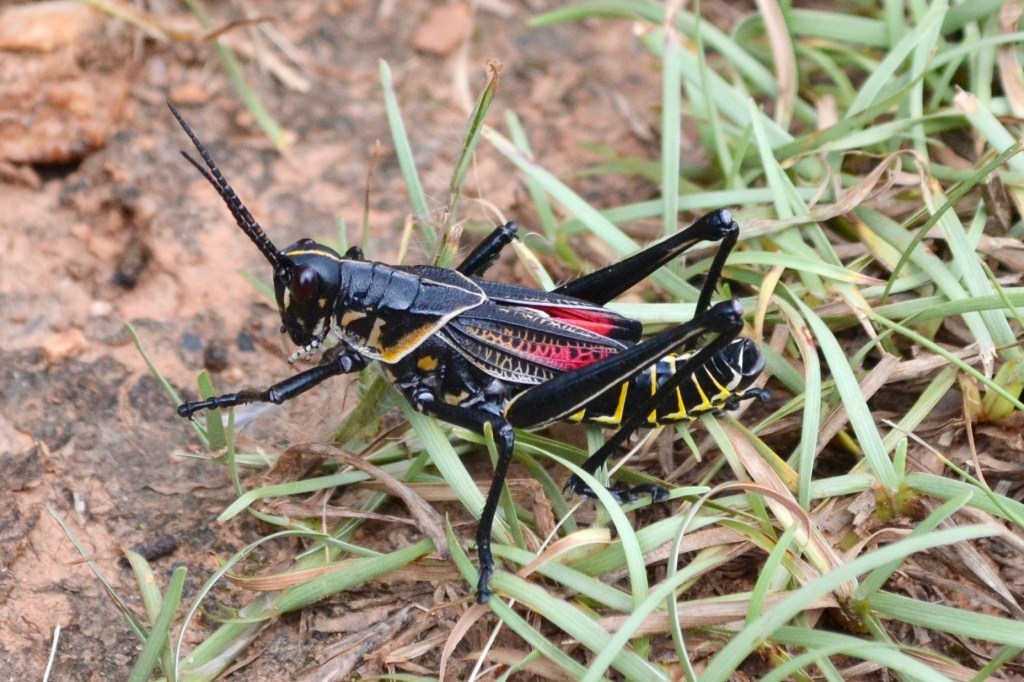
By 1958 I was smart enough to identify the make, year, and model of a car from as far away as I could see and kid enough to love grasshoppers. The grasshoppers of my youth were colorful and still overrun Saluda, South Carolina, in the hot summer months.
I zoomed in on the one pictured above a few years back in my mother-in-law’s yard. She didn’t realize that most grasshoppers are green or brown, less flamboyant.
Of course I walked around barefoot, even went to school barefooted, so I was expert at stepping on them. They crunched loud enough to be heard and ran around in groups or families in the swarming time of summer. I delighted in the range of sizes; the smallest were mostly black and less colorful.
I remember looking down to be simultaneously pleased and appalled to see grasshopper guts oozing between my toes and outlining my feet. Catching them was my first form of hunting.
Before the hunt, I would find a jar with a lid that I had already punctured or get a fresh jam jar and poke holes in the metal lid with an ice pick. Once I miscalculated one of my jabs and sent the metal of an ice pick through the soft tissue of my palm so that its tip emerged from my flesh.
Clay Cockrell, my brother Cally, and I would head out on hunting trips to see who could jam the most critters into a jar. Capturing the prey required kneeling down and anticipating the coming jump.
Once in hand the grasshopper tickled and scratched–fascinating to a boy who had not yet formally learned about exoskeletons. In my imagination I was subduing a little monster. Up close they were as fearsome as the monsters I saw in the double feature movies at the Indian Chief movie theater downtown.
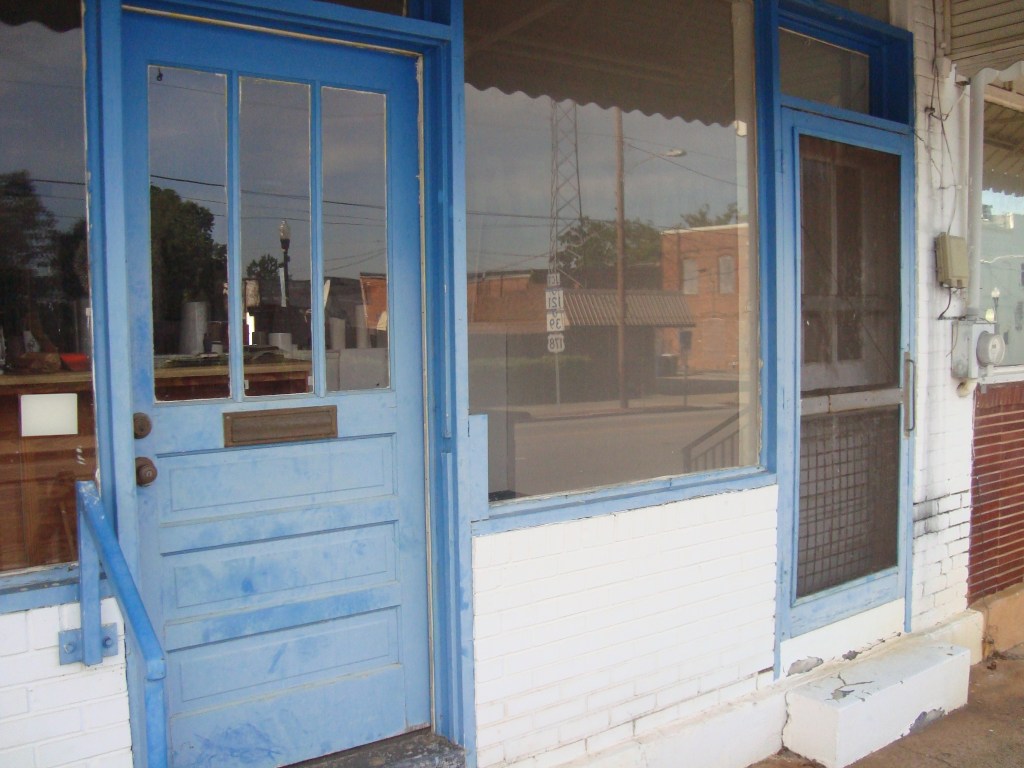
Frank Hite’s Grill Church Street Saluda April 9, 2012
Frank Hite’s Grill
A through traveler headed west through Saluda on Church Street would end up in McCormick, South Carolina, almost in Georgia and pass by my old house on West Church Street, four blocks from the site of Frank Hite’s old hamburger cafe downtown Saluda.
How many times a week would I walk past it? Seven or more for sure. I was always afoot. My mother Leona would lock the screen door and bid her children to stay away until meal times. Ever seen Opie Taylor walk around fictional Mayberry? I was a real version of him through the boyhood of the 1950s and 60s, except for the times Leona left my father Harold to take us north to live in or near Altoona, Pennsylvania.
Hite’s was just a business I walked past on my way to the Five and Ten (an elaborate forerunner of today’s Dollar General) or to the F & S Drugstore to peruse the latest comic books. I made daily tours of downtown businesses including C.B. Forrest and Sons Drygoods store where my dad worked.
I took the two doors of Hite’s for granted as a small child. In the early 1960s I started working for Alfred and Miriam Adams at the Saluda Red and White Supermarket just past Truman Trotter’s barbershop four doors down from Hite’s. One of my duties their was to deliver hundred-pound burlap sacks of russet potatoes via hand truck to Mr. Hite’s cafe. I came to know the place first from the back entrance.
Alfred Adams was savvy businessman who had developed a strong following of both black and white customers. He had a white Chevy van with a Red and White store logo on the sides that I drove to deliver groceries–primarily to African-American customers along Boughknight-Ferry Road in their separate part of downtown.
Sometimes I would take lunch in his place on Saturday. I entered via the left-hand door, stepped to counter to order a hamburger grilled in sight with a side order of fries from the potatoes I delivered. Frank patted hamburger to form my meal with a metal spatula chewing an ever present cigar in his mouth. He cooked, nodded when the order was done, and seemed averse to talking. I never saw him without his white paper cap and dirty apron and I am not sure I would have recognized outside of his cafe.
I liked sitting in one of the small tight booths to claim a space for my own next to the junk box music selectors. For a quarter I could hear Ray Charles sang as I ate. I liked is lyrics and delighted in hearing anything by Sam Cooke.
I usually ate alone as my fellow employees never left the Red and White Supermarket during operating hours together. We had about fifteen minutes to grab food and had to be on duty to provide customer service that was unparalleled to patrons who overran our small “supermarket” Thursday through Saturday.
What came to worry me was the door to the right. African-Americans came through that door to order and had little or no space to sit down to eat. The grill behind both doors was one unit but the wall was a kind Berlin Wall separation. I so wanted to go in via the right door for some inexplicable reason.
Black and white customers did not mingle by law and custom. I began to think about the world I lived in by then at age thirteen forward. At night at home I begin to follow the Civil Rights protests led my first and foremost hero, Martin Luther King. My conscience led to formation of a sense of social justice.
The double doors are a symbol of the terrible duality of existence that I took for granted growing up in my white world of separation.
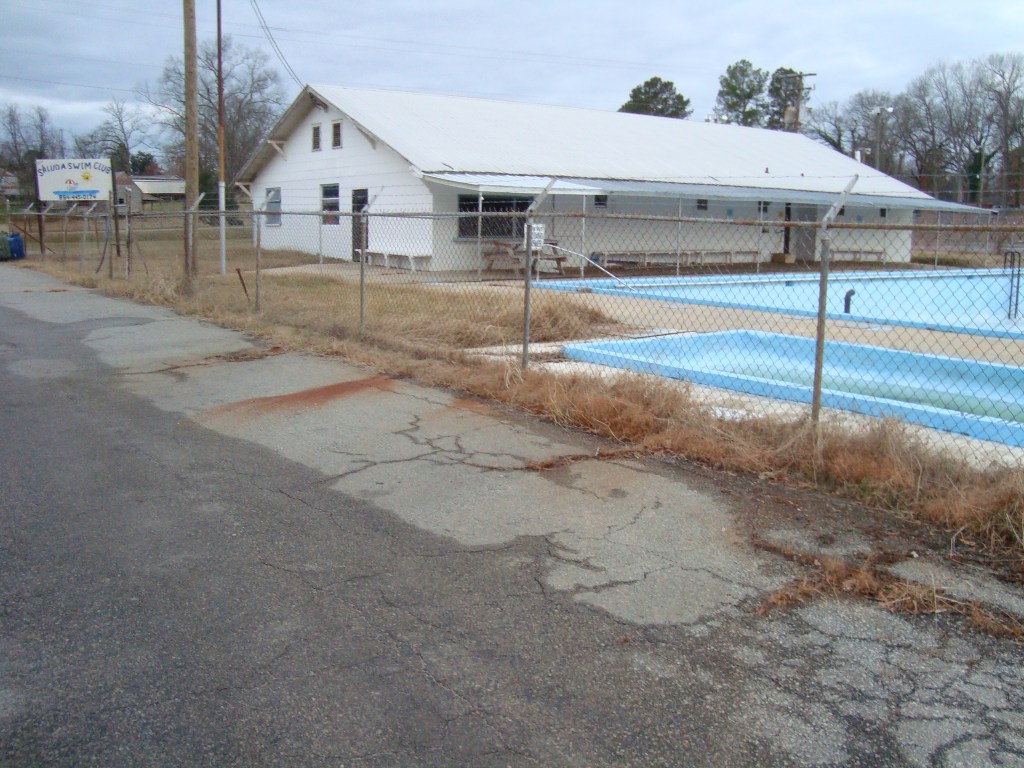
Saluda Swim Club 2008
Saluda Swimming Pool
This pool was about a two-mile walk from my house on West Church Street. As I child I would walk to it in the summer nearly every afternoon, coming home with wrinkled skin from near constant immersion in water. Back then the building pictured was longer and the missing extension was built of logs, dank and white-washed. There I changed clothes, showered, and took my wire basket of clothes back to the window at the entrance for safekeeping.
I learned to swim in it around seven or eight, taking lessons from a visiting swim instructor. My pals hung out there and we played childish games like listening to the bottom of the a metal ladder to decipher a message from above. We lined up to do various dives including flips, our most daring feat.
The longer building held a commons areas with a juke box and table tennis table. As I aged, I came to meet up with girls and socialize. Going to the pool was what I did as an elementary school child in summer. My days were arranged so that I could walk to arrive at opening time, 1 o’clock, I believe, and leave at closing, 5 P.M.
It was my world but it, like the right-hand side of Frank Hite’s Grill, was a white world. Back then I never gave a thought to the all-whiteness of it. In my old age I have accumulated all the history books available on my old Saluda and I discovered that the pool was dug as a Civilian Conservation Corps project during to Depression. How it became a club for whites only is not clear.
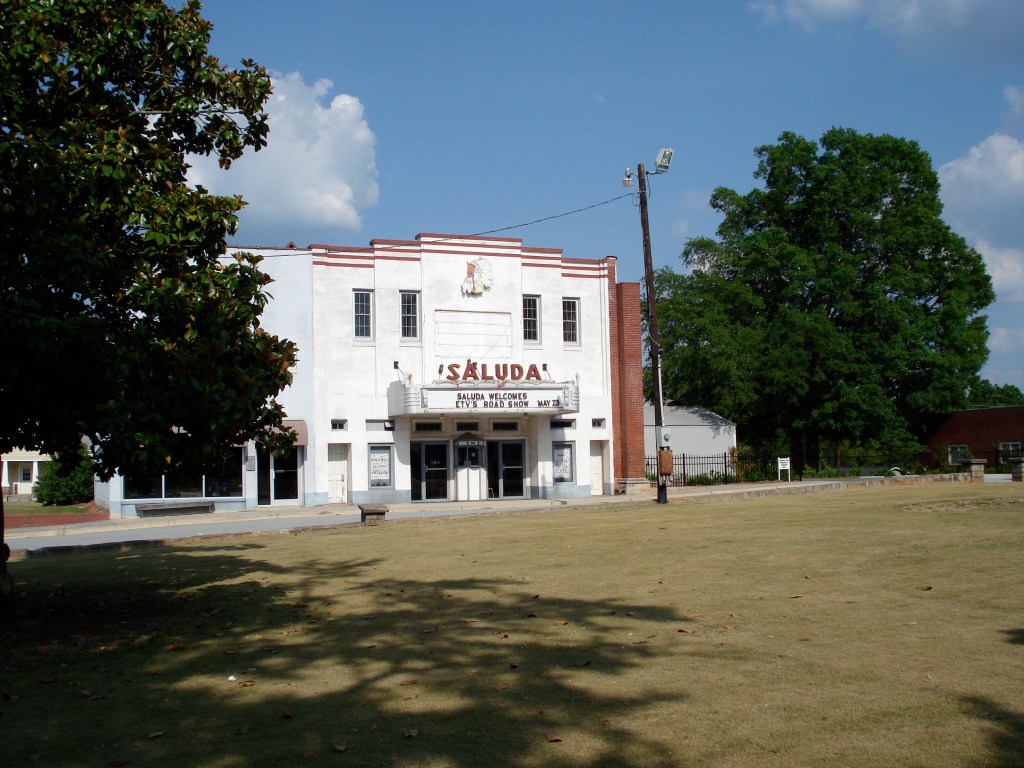
Indian Chief Theater
May 2007
Until the summer of my thirteenth year I spent nearly every Saturday afternoon in the Indian Chief. I made sure I had about 50 cents and walked five blocks to reach it. Always a double feature.
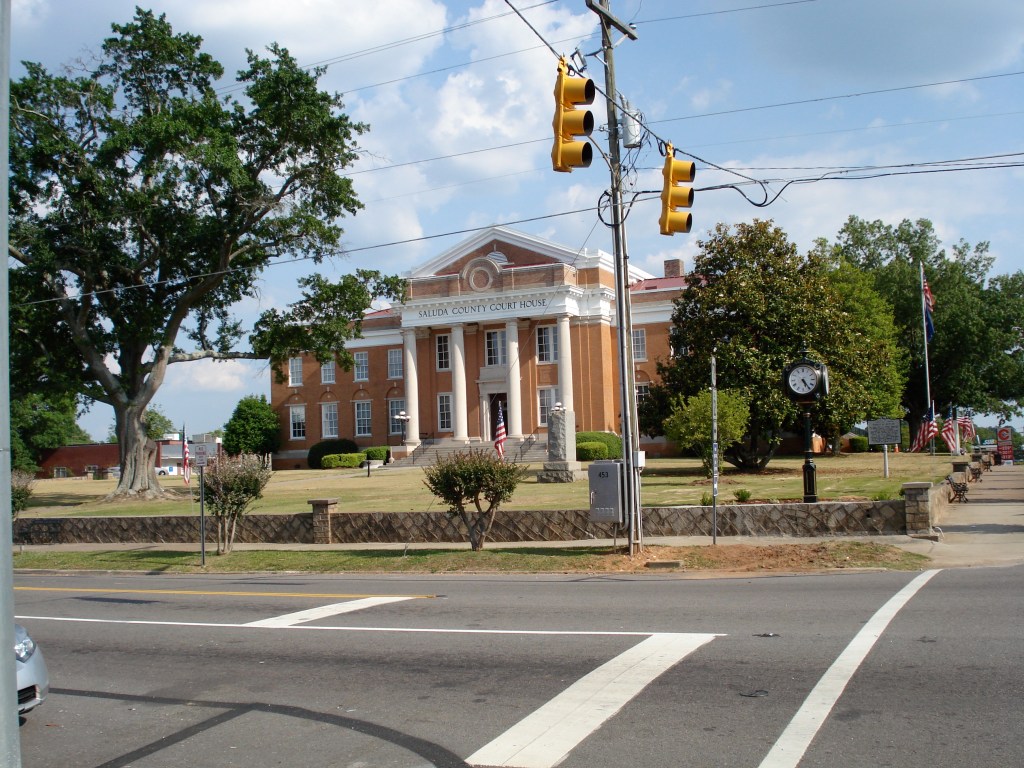
I usually arrived early to climb on the two magnolias that used to be on the courthouse lawn just in front. We climbers must have looked like so many monkeys moving through the limbs.
Pay a quarter out front, once in turn left and stop just before the curtain to buy a Zero bar for a nickel or a bag of pop corn. Move way down front, maybe one or two center aisles back, take a seat, and wait for the previews of coming attractions to start. God, how I loved the previews and the big sound and big screen.
Saluda County Courthouse
May 2997
Go back to 1963 or 1964. Make it Saturday afternoon. I am walking across from the courthouse pushing a two-wheel cart full of groceries to a customer’s car as a bag boy for the Red and White Supermarket. As I moved down the street to follow the customer I would weave in and out of heavy foot traffic.
The wall in front of the courthouse would be near full up with people sitting in the sun. Some would be in overalls but many would appear to be dressed for church. They were an older crowd, mainly men. Strangely they were a mixed crowd of black and white. People just talking, telling stories, watching the street action and passing cars.
Downtown Saluda of the era was like a section of Manhattan or Brooklyn. All hustle and bustle. People came to town to do business and to socialize. Walking around involved dodging pedestrians entering stores or window shopping.
What pleased me but seemed odd was that they were a mixed crowd, black and white.
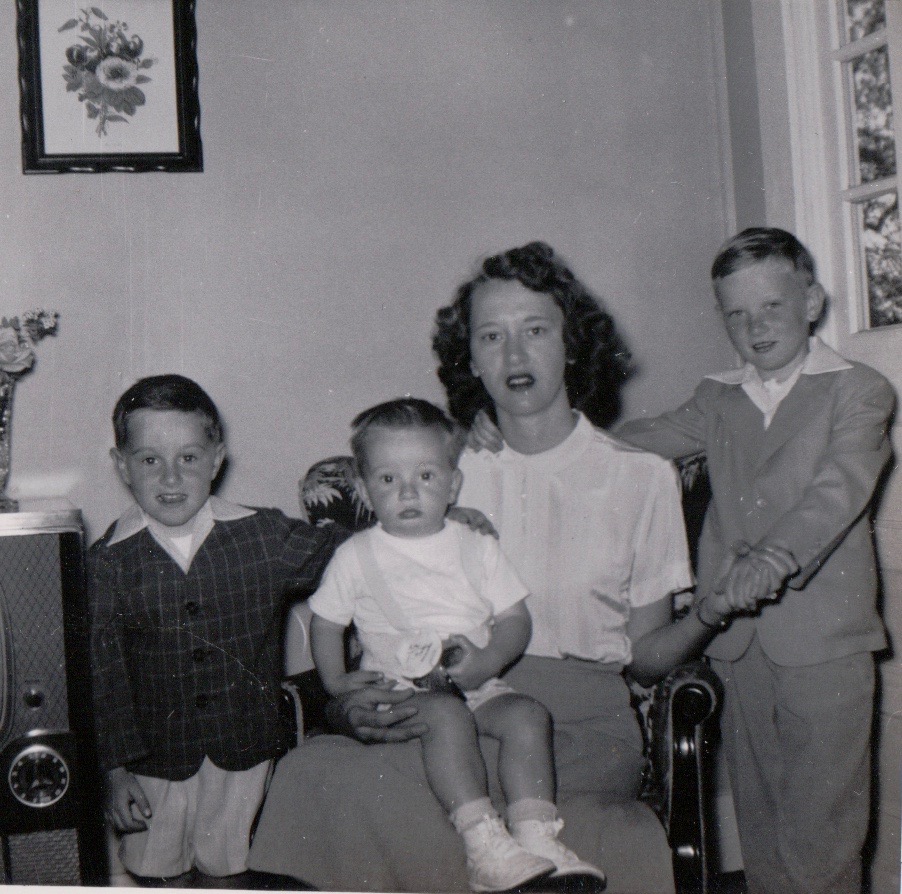
Leona, Butch, Cally, and Me
513 West Church Street
That is me on the left around 1953. Butch is just inside the front door on my mother’s right side. I suppose my father Harold took the photo.
We are in what was known as a living room in the 1950s. I was not allowed to hang out in the area too much, though I spent a lot of time in the chair my mother is sitting in.
Why? I was often guilty of “back talking.” For the crime of not directly obeying, I could be sentenced to it for half an hour. Of course, I was switched and I tasted the flavor of a bar of Ivory soap a a few times for saying something I should not have.
The taste of soap is unpleasant and a switch across the back of the legs stings, but I could endure both better than sitting. I tried hard to conduct myself in a way that would keep me out of the chair by the front door.